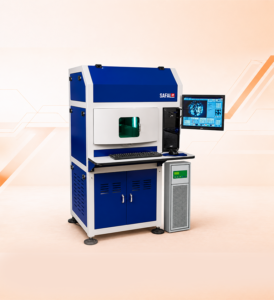
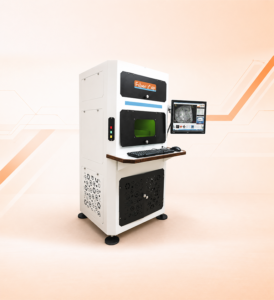
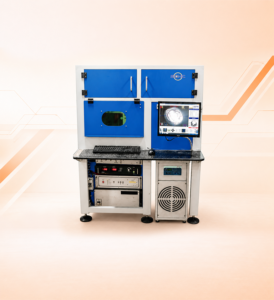
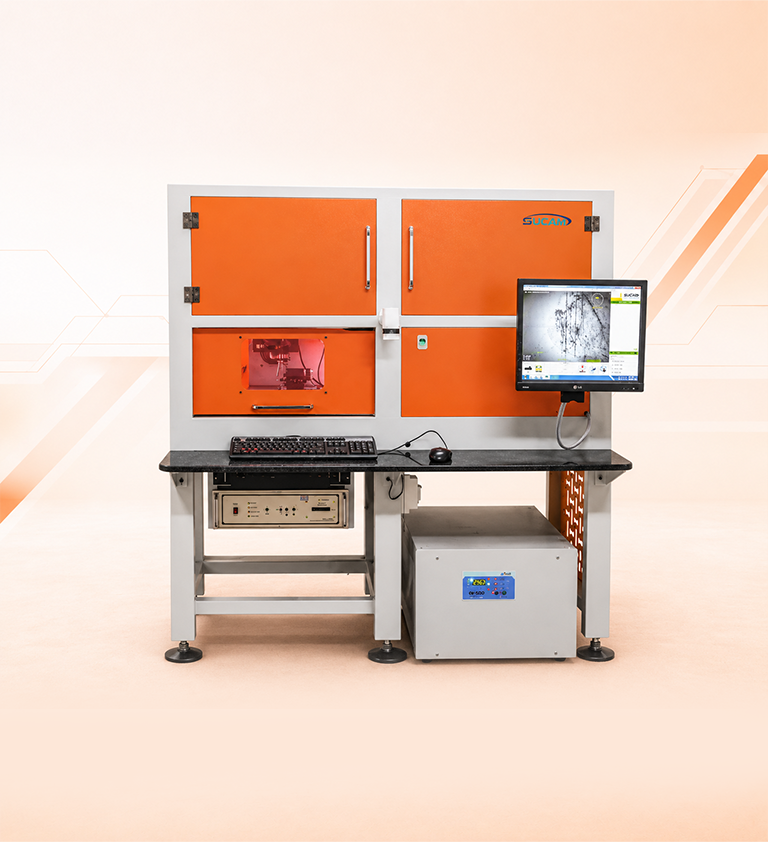
Laser Diamond Cutting Machine

Sawing · Multi Sawing · 4P & 8P · Made in India · ISO & CE Certified

Laser Diamond Cutting Machine – IR, Green and Fiber Laser for Sawing and 4P Shaping

A laser diamond cutting machine saws and shapes rough diamond – natural or lab-grown – by focusing a pulsed laser beam into the stone along a planned line while a CNC stage moves the stone beneath it. Diamond is largely transparent to the beam, so the cut does not begin the way it does in metal: at the focus the diamond is converted to graphite, the graphite absorbs the beam and is removed, and the cut advances pulse by pulse. It is the machine that replaced the diamond-powder saw blade on the manufacturing floor, and its real output is not stones per hour but carats kept and stones not broken. Sigma Mechotronics Pvt. Ltd. builds five machines in this category at its own Ahmedabad plant, across three laser types – IR, green and fiber – for multi sawing, 4P and 8P work, each with a 1-year warranty. This page covers how the process works, which laser suits which goods, what kerf and tension do to your yield, and what to check before you order.

Machines in the range
5

Laser types
IR, Green, Fiber

Processes
Sawing, 4P, 8P

Warranty
1 year

Diamond manufacturing is one of the few industries where the material is worth far more than the machine that cuts it, and that changes how a cutting machine should be judged. A machine that saves time but loses a few cents more weight on every stone is not the cheaper machine, and a rough broken along a tension line is a loss no cycle time recovers. So this category is measured differently from almost any other laser: by the weight retained after the cut, by the breakage rate on difficult goods, and by how cleanly each operation lines up with the next.

The work itself has also changed. Laser sawing freed diamond planning from the grain: a blade can saw a diamond only along a limited set of crystal directions, while a laser cuts along whatever plane the planner chooses. 4P machines then brought table sawing, crowning, bruting and cone blocking into a single fixing of the stone. And lab-grown diamond has added coring and slicing – operations natural rough never needed – to the front of the process. A buyer today is choosing not just a laser, but where in that sequence the machine will sit.

Sigma Mechotronics Pvt. Ltd. builds its laser diamond cutting machines at its own plant in Ahmedabad, so the laser type, the process and the fixture are settled with the people who build and commission the machine. This page is written for diamond manufacturers, unit owners and production managers specifying a machine for real goods: how the process works, where IR, green and fiber lasers each earn their place, what separates sawing, multi sawing and 4P, why kerf and tension decide yield, and what the room around the machine needs.

At a Glance

Key Takeaways

Six things that decide whether a laser diamond cutting machine pays for itself.

Yield Is the Output

The machine is judged by carats kept and stones not broken, not by cutting time alone. Weigh stones before and after any test cut, and compare on that.

The Cut Runs Through Graphite

Diamond is largely transparent to the beam. At the focus it turns to graphite, which absorbs the beam and is removed – which is why a sawn face comes off the machine black.

Wavelength Sets the Kerf

With the same optics, a 532 nm green beam focuses to about half the spot of a 1064 nm IR beam. That is the physics behind green’s narrower cut.

Tension Breaks Stones

Strain locked inside a rough can release as feathers and cracks when a cut passes through it. Check stones under a polariscope and plan cuts around tension zones.

4P Means One Fixing

Table sawing, crowning, bruting and cone blocking are done without re-fixing the stone, so all four operations stay referenced to the same position.

Five Machines, Three Lasers

IR and green multi sawing, a fiber 4P, 4P with multi sawing, and a 4P / 8P machine – built at our Ahmedabad plant with a 1-year warranty.

Definition

What Is a Laser Diamond Cutting Machine?

A laser diamond cutting machine is a CNC-controlled laser system that divides and shapes rough diamond by moving the stone under a tightly focused, pulsed laser beam along a path set by the planner. It performs the cutting operations that once needed a diamond-powder saw blade, a bruting machine and skilled hand setting – sawing a rough into pieces and, on 4P machines, shaping the table, crown, girdle and pavilion as well. The same machines are called laser sawing machines when they saw and 4P machines when they shape, and they are used on natural rough and lab-grown diamond alike.

A laser cuts diamond differently from the way it cuts metal. Pure diamond is largely transparent from the deep ultraviolet through the visible and near infrared, so neither a 1064 nm IR beam nor a 532 nm green beam is simply absorbed at the surface. What starts the cut is the intensity at the focus: the diamond there is converted to graphite, and graphite, unlike diamond, absorbs the beam strongly. The graphite is heated and removed, the next pulses meet fresh graphite at the bottom of the cut, and the focus is stepped down through the stone as the cut deepens. That is why the depth axis matters as much as the table, and why every laser-sawn face comes off the machine covered in a thin black graphite film that has to be cleaned off – normally by boiling in acid – before the stone’s interior and colour can be judged.

Before lasers, sawing was limited by the crystal itself. A diamond can be sawn mechanically only along a small number of grain directions – the cube direction, known to cutters as the four-point grain, and the dodecahedral direction, the two-point grain – and it cleaves along its octahedral planes, so the planner had to fit the stone to those directions. Laser sawing, developed for the trade in the 1980s, removed that constraint: the beam cuts along whichever plane gives the best yield, including through stones whose structure would defeat a blade. That freedom is what lets the plan follow the yield rather than the grain, and it is why blade sawing has largely given way to the laser on the manufacturing floor.

The Four Subsystems That Decide the Result

01

The Laser Source

Its wavelength and beam quality set the smallest spot the beam can be focused to, and so the narrowest kerf. Average power and pulse rate then set how fast the cut advances.

02

Focus and the Z Axis

The focus has to travel down through the stone as the cut deepens. How finely and consistently it steps decides whether the kerf stays narrow at depth or opens up.

03

The CNC Stage and Fixture

X-Y travel and the stone holder decide whether the cut lands on the planner’s line. On 4P and double-side work, the fixture also decides whether each operation lines up with the last.

04

Camera and Software

On a modern machine the stone is aligned to its planned line through a camera, and the software holds the shape files and cutting parameters that make results repeatable from stone to stone.

Laser Type

IR, Green or Fiber: Which Laser Suits Your Goods?

All three laser types cut diamond by the same graphite mechanism, and all three are in production use in Indian diamond units. They are not a ranking from worst to best. They trade kerf, speed, running cost and machine price against each other, and the right one depends on what your goods are worth and how difficult they are to cut.

Laser Type Wavelength and Source Where It Earns Its Place What to Weigh
IR 1064 nm, diode-pumped solid-state (DPSS) Nd:YAG, Q-switched. Indian makers commonly publish IR sawing sources at around 20 W and above at 10 kHz. Volume sawing of natural rough and everyday goods, where cost per stone matters as much as the last micron of kerf. The long-established workhorse of laser sawing. A larger focused spot than green with the same optics, so a wider kerf. The diode pump modules age with operating hours and are replaced at end of life – a running cost to budget for, not a fault.
Green 532 nm, frequency-doubled DPSS Nd:YAG. Green sawing sources are commonly published in the 15 W to 20 W range. High-value rough, stones carrying tension, and lab-grown coring and slicing – wherever a narrower kerf and a gentler cut are worth more than machine price. Lower average power than IR in this class, and generally a higher machine price. The frequency-doubling crystal adds a temperature-sensitive stage to the source, so cooling and room temperature matter more.
Fiber Around 1064 nm, from an ytterbium-doped optical fiber. Fiber sources at the power levels used on diamond are commonly air cooled. 4P and shaping work, where a sealed source with no free-space pump module to align suits a unit that wants low upkeep. The wavelength sits with IR, so the focused spot is IR-sized rather than green-sized. Prove it on your own goods – tension-prone stones included – before assuming it matches a DPSS machine you already run.

How to decide between them – put a value on a micron of kerf for your goods. On low-value, low-tension rough, IR does the job at the lowest cost per stone. As the value of the rough rises, or the share of tension stones in your parcels grows, the narrower kerf and gentler cut of green start paying for their price. Fiber belongs in the conversation mainly for 4P and shaping, where upkeep weighs heavily. Whichever way you lean, decide on a test cut of your own goods, weighed before and after, rather than on a brochure.

Process

Sawing, Multi Sawing and 4P: What Each Machine Actually Does

The laser type decides how a cut behaves. The process decides which cuts the machine makes – and therefore where it sits between the planning scan and the polishing wheel. Choosing the process is really a decision about which operations your unit keeps on other machines and which it wants done in one setup.

Process What the Machine Does Choose It When
Sawing Divides the rough along the planned plane – table sawing to open the top of the stone, pie sawing into several pieces, or splitting one rough into two or more stones. Your unit already bruts, blocks and polishes on other machines, and sawing is the stage where capacity is short.
Double-Side Sawing Turns the stone and saws from both faces, so each pass reaches only part of the way through and the two cuts meet inside the stone. Weight loss on thicker rough is the cost you most want to cut. A tapered kerf loses less material when each pass reaches only about half the depth.
Multi Sawing Holds several stones in one loading and saws them in sequence without the operator resetting the machine between stones. Operator time per stone is your bottleneck. Multi sawing changes how many stones one operator handles; it does not make an individual cut better.
4P Table sawing, crowning, bruting and cone blocking – the table, crown, girdle and pavilion operations – carried out with a single fixing of the rough, leaving a shaped preform for faceting and polishing. Re-fixing stones between separate machines is costing you yield or rework, or you want fewer hand-offs between departments.

The value of 4P is easy to understate. Every time a stone is taken off one machine and fixed onto the next, its position is re-established by hand, and each re-fixing adds a small error between operations that were meant to line up – a table not quite square to the girdle, a pavilion cone slightly off the stone’s axis. The polisher later removes that error as weight. Doing all four operations in one fixing keeps them referenced to the same position, and that, more than the handling time it saves, is the real case for 4P over separate sawing, bruting and blocking steps.

Combined machines follow the same logic in the other direction. A machine that pairs 4P with multi sawing puts shaping and batch sawing on one frame, which suits a unit whose work genuinely splits between the two. It earns its place only when both kinds of work actually run on it; a unit that saws all day and shapes occasionally is usually better served by a machine built around the operation that fills its shifts.

Tell us your work split at enquiry stage – the share of your goods that is sawn only, the share that goes through 4P, and how many stones per shift each takes. That single breakdown usually settles whether a sawing machine, a 4P machine or a combined machine is the right starting point, before the laser type is even discussed.

Yield

Kerf, Weight Loss and Tension: Where Yield Is Won or Lost

On a laser diamond cutting machine, the result that matters leaves the machine as weight you still own. These are the mechanisms that take weight away, and what controls each one.

A focused beam does not cut a parallel slot. It converges to its focus and spreads again beyond it, so a laser kerf in diamond is tapered – widest where the beam enters and narrowing towards the bottom of the cut. The deeper a cut has to reach, the wider its entry becomes, which means the material lost to the kerf grows with the thickness of the stone rather than staying fixed. That is why double-side sawing exists: when the stone is turned and cut from both faces, each pass reaches only about half the depth, the taper on each side is shallower, and less diamond is turned to graphite.

Wavelength sets the other half of the kerf. The smallest spot a beam can be focused to scales with its wavelength, so with the same optics and beam quality a 532 nm green beam focuses to roughly half the diameter of a 1064 nm IR beam. A smaller spot means a narrower cut and finer control along the edge of a shape. It does not make green universally better – it makes a micron of kerf cheaper to save – and it is why makers of green machines position them for high-value goods and for stones where a gentler cut matters.

Tension is the risk no machine specification removes. Many rough diamonds carry internal strain, and when a cut passes through a high-tension zone that strain can release as feathers and cracks, or the stone can break apart altogether. Strain shows under a polariscope as interference colours, and careful planners check for it before a cut line is drawn, then route cuts away from the worst zones. A gentler laser and conservative parameters reduce the risk on difficult stones; skipping the check and blaming the machine afterwards does not.

What Costs You Yield Why It Happens What Controls It
Kerf width Diamond along the cut line is turned to graphite and removed, over a width set by the focused spot. Wavelength, beam quality and focus control – and choosing green where the value of the goods justifies it.
Taper on thick stones The kerf is widest at entry, and the entry widens as the cut goes deeper. Double-side sawing, and planning cut depth so no pass reaches further than it must.
Breakage and feathers Internal tension is released when the cut passes through a strained zone. A polariscope check at planning, cuts routed around tension, and gentler cutting on difficult stones.
Misaligned operations Each re-fixing of the stone between machines shifts its reference position slightly. Fewer re-fixings – the case for 4P – and a fixture that holds the stone without movement.
Decisions made on a black stone The graphite film on a sawn face hides the interior and colour of the stone. Acid boiling before the next planning decision, so you judge the diamond and not the film.

Judge any test cut on weight, not time – weigh the stones on a carat balance before the cut and again after boiling, count any breakage, and compare machines on retained weight first and cutting time second. A machine that is faster but loses a few cents more per stone is costing you money on every stone it cuts.

Lab-Grown Diamond

Cutting Lab-Grown Diamond: Coring, Slicing, Then the Usual Flow

Lab-grown diamond is diamond – the same carbon crystal as natural rough – so the laser cuts it by exactly the same mechanism. What changes is the front of the process. A CVD crystal does not come out of the reactor as a clean rough stone, and preparing it adds operations that natural rough never needs.

In chemical vapour deposition, diamond is grown layer by layer on a flat seed plate, and the crystal typically comes out with rough, graphitised or polycrystalline material around its sides. Coring cuts that material away to leave a clean single-crystal block. Slicing then cuts the block into plates – separating the grown diamond from its seed, and producing thin plates, some of which are used as seeds for the next growth run. HPHT crystals, grown under high pressure and high temperature, are also sliced and sawn by laser. After coring and slicing, lab-grown goods follow the same path as natural rough: planning, sawing, 4P or shaping, blocking and polishing.

Kerf matters even more in slicing than in sawing. The number of plates a block yields is its thickness divided by the plate thickness plus one kerf, so every micron saved on the cut is multiplied by every slice taken from the block. That arithmetic is why narrow-kerf lasers, and green sources in particular, are so commonly specified for lab-grown slicing.

Raise coring and slicing at enquiry stage – the fixture, the cut path and the parameters for coring and slicing a CVD block are different from those for sawing a rough stone. If either operation is part of your work, the machine should be confirmed for it on your own crystals before you order, not after.

The Range

Sigma’s Five Laser Diamond Cutting Machines Compared

The Sigma Mechotronics Pvt. Ltd. range covers batch sawing, 4P shaping, and machines that combine the two. What separates the five machines is the work each one is designed to run – and, on the sawing and fiber machines, the laser it is built around.

Machine What It Runs Built For
IR Multi Sawing Multi sawing on an IR laser Sawing at volume, where stones per operator and cost per stone decide the economics
Green Multi Sawing Multi sawing on a green laser Sawing goods where kerf and breakage cost more than machine price – higher-value and tension-prone stones
Fiber Z+ 4P 4P on a fiber laser Units that want their 4P shaping on a fiber laser source
4P With Multi Sawing 4P and multi sawing on one machine Units whose work genuinely splits between shaping and batch sawing
4P / 8P 4P and 8P Units that want both 4P and 8P work available on one machine

Read this table by process first – decide whether your unit needs batch sawing capacity, 4P shaping, or both, and that narrows five machines to one or two. On the sawing side, the choice between IR and green is then made on the value and difficulty of your goods and settled on a test cut.

Five Steps

How to Specify a Laser Diamond Cutting Machine

Work through these in order. Each narrows the specification, and starting from the laser type instead of the goods is how units end up with the wrong machine.

  1. 1

    Profile Your Goods Honestly

    Natural or lab-grown, the size range you actually cut, the value band, and the share of your parcels that carries tension. Take it from your records rather than your best week – every later decision depends on this one.

  2. 2

    Decide Which Operations the Machine Takes Over

    Sawing only, with bruting and blocking kept on existing machines? 4P, to bring those operations into one fixing? Coring and slicing for lab-grown blocks? Map your current flow and mark the stage where capacity or yield is actually being lost.

  3. 3

    Choose the Laser by What Kerf Costs You

    Low-value, low-tension goods at volume point to IR. Higher-value rough, tension-prone stones and lab-grown slicing point to green. For 4P and shaping, weigh a fiber source against the DPSS options on upkeep and on the result of a test cut.

  4. 4

    Size It by Stones per Operator

    Count stones per shift and operators per shift. If operator attention is the constraint rather than laser time, multi sawing is the lever. If the constraint is stones waiting to be re-fixed between departments, the lever is 4P.

  5. 5

    Prove It on a Parcel of Your Own Goods

    Include your difficult stones, not only clean ones. Weigh before the cut and after boiling, count breakage, inspect the sawn faces, and compare on retained weight first. This is the step that turns a specification into a decision you can defend.

Avoid These Buying Mistakes

6 Mistakes Buyers Make Choosing a Laser Diamond Cutting Machine

1

Comparing machines on cutting speed. Speed is visible in a demonstration; weight loss is not, until the stones are weighed. On diamond, a few cents of extra loss per stone outweighs the hours a faster machine saves.

2

Testing only on easy stones. A clean, low-tension rough cuts well on almost any machine. What separates machines is how they handle your difficult goods, so those belong in the test parcel.

3

Buying green for every job, or IR for every job. Green’s narrower kerf is worth its price on high-value and tension-prone goods and wasted on low-value volume sawing. IR on expensive goods saves capital and hands it back as lost weight.

4

Blaming the laser for breakage that planning caused. A cut routed through a high-tension zone can crack a stone on any machine. The polariscope check belongs in planning, before the cut line is drawn.

5

Putting the machine in the wrong room. Graphite and polishing dust on the optics, heat, and an unsteady supply all show up as drifting results. Plan a clean, temperature-controlled space and a stable electrical supply before the machine arrives.

6

Forgetting what keeps a DPSS source alive. The pump diodes in an IR or green source age with operating hours, and their cooling protects them. Know what the source needs – chiller water kept clean and at temperature, a stable room – and budget for module replacement over the machine’s life.

Where It Is Used

Where Laser Diamond Cutting Machines Are Used

In a diamond manufacturing unit, the laser machine takes the stone from its planned rough to a preform ready for faceting and polishing.

  • Rough Diamond Sawing
  • Table & Pie Sawing
  • Double-Side Sawing
  • Multi-Stone Batch Sawing
  • 4P Preform Shaping
  • Round & Fancy Shape Preforms
  • Lab-Grown CVD Coring & Slicing
  • HPHT Diamond Slicing & Sawing
  • Diamond Manufacturing Units
  • Job-Work Laser Sawing

On the manufacturing floor, the laser machine is one stage in a chain. Before it, rough is examined for inclusions and tension and planned for the best yield. After it, the sawn or shaped preform is cleaned of graphite, then blocked and polished to its final facets, and a finished stone may be laser-inscribed on the girdle for identification – work done on dedicated inscription systems rather than on a sawing or 4P machine. Fancy shapes such as princess, pear, marquise, oval and heart are cut as preforms from shape files, which is why on shaping machines the shape library and the software matter as much as the laser.

Room, Upkeep and Safety

What the Machine Needs Around It

A laser diamond cutting machine is a precision optical instrument running on a production floor. Most drifting results trace back to the room and the routine rather than the machine.

Routine Task When
Inspect the protective window and focusing optics, and clean off graphite dust Start of every shift – dust from the cut settles on the optics and weakens the beam at the stone
Clean the stage, fixtures and stone holders Every shift – debris under a holder shifts the stone’s position and the cut with it
Check chiller water level, temperature and filter on water-cooled sources Daily, with the water changed on the schedule in the machine manual
Check focus and alignment on a test stone After any optics cleaning, service visit or machine move
Log laser output at the same settings At a fixed interval – a falling reading is the early warning that pump diodes are ageing
Check enclosure interlocks, viewing window and laser eyewear Every shift, before the laser is armed

Safety and the room, in practice: the laser sources used to cut diamond are powerful enough to fall in Class 4 under IEC 60825-1, so the beam must stay inside the machine’s enclosure with its interlocks working, and the interlocks are never to be bypassed for setup. Eyewear has to be rated for the wavelength in use – protection rated at 1064 nm does not necessarily protect at 532 nm, and a frequency-doubled green source can carry residual 1064 nm light, so eyewear for a green machine should cover both. The graphite-removal step uses hot acid, which belongs in a separate, ventilated area with its own procedures, never beside the laser. For the room itself, plan a clean space away from polishing dust, kept within the ambient temperature range the source and chiller are rated for, and an electrical supply matched to the machine: many machines in this class run on single-phase 230 V and some need three-phase, so confirm the requirement and add stabilisation where the supply is unsteady.

Manufacturer, Not Trader

Why Buy a Laser Diamond Cutting Machine From Sigma Mechotronics Pvt. Ltd.

A diamond laser machine is judged on your goods, not on a demonstration stone. Buying from the manufacturer means the machine is specified, built and commissioned by the same team, and set up on the goods you actually cut.

Built at Our Own Ahmedabad Plant

Each machine is designed and built at our own plant in Ahmedabad, with its components selected and integrated by our engineers and stage inspection carried out during the build rather than only at the end. The laser type, process and fixtures are settled with the people who build the machine, not requested through a trader.

ISO & CE Certified, MSME Registered

A registered Indian private limited company – ISO and CE certified, MSME registered and GST registered. Every machine is supplied against a proper GST tax invoice under your GSTIN, for input tax credit and capital equipment accounting.

1-Year Warranty, Serviced Directly

A 1-year warranty against manufacturing defects, handled directly by Sigma Mechotronics Pvt. Ltd. rather than through an agent, with spares held in India instead of ordered on an international shipping cycle.

Installation, Parameters and Operator Training

We install and commission the machine at your unit, set cutting parameters on your own goods, and train your operators before handover – including the alignment, cleaning and daily checks that keep results consistent after our engineer has left.

Straight Answers

Frequently Asked Questions

The questions diamond manufacturers ask most before choosing a laser diamond cutting machine.

It is a CNC-controlled laser system that saws and shapes rough diamond by moving the stone under a focused, pulsed laser beam along a planned path. It does the work of the diamond-powder saw blade and, on 4P machines, of bruting and cone blocking as well, on natural and lab-grown diamond alike. Sigma Mechotronics Pvt. Ltd. builds five machines in this category, across IR, green and fiber lasers, for multi sawing, 4P and 8P work.

By turning it into graphite first. Pure diamond absorbs very little at 1064 nm or 532 nm, but at the intense focus of a pulsed beam it converts to graphite, which absorbs the beam strongly and is removed. The cut advances as the focus steps down through the stone, and it leaves a thin black graphite film on the sawn face.

Wavelength, and what follows from it. IR machines use a 1064 nm diode-pumped Nd:YAG source; green machines frequency-double that light to 532 nm. With the same optics the green beam focuses to roughly half the spot size, giving a narrower kerf and a gentler cut, which is why green is favoured for high-value rough, tension-prone stones and lab-grown slicing. IR machines run at higher average power in this class and generally cost less, which suits volume sawing of lower-value goods.

4P is a process in which table sawing, crowning, bruting and cone blocking – the table, crown, girdle and pavilion operations – are carried out with a single fixing of the rough. Because the stone is not re-fixed between operations, all four stay referenced to the same position, which reduces the alignment errors that would otherwise be polished away as lost weight.

Multi sawing loads several stones into one setup and saws them in sequence without the operator resetting the machine for each stone. It raises the number of stones one operator can handle in a shift. The quality of each individual cut is still set by the laser, the focus and the planning.

Because the cut works by converting diamond to graphite, and some of that graphite stays on the sawn faces as a thin black film. It hides the stone’s interior and colour, so it is removed – normally by boiling the stone in acid – before the goods are inspected or planned for the next stage. It is a surface layer that cleans off, not a crack or an inclusion.

It can, when the cut passes through a zone of internal tension. Strain locked in the rough can release as feathers and cracks, and in the worst case the stone breaks. The protection happens at planning: check the rough under a polariscope, route cuts away from high-tension zones, and use a gentler laser and conservative parameters on difficult stones.

For most work, yes, because it is not bound to the grain. A blade can saw diamond only along a small number of crystal directions – the four-point and two-point grains – while a laser can cut along any plane the planner chooses, including through stones a blade could not saw. That lets the cut follow the best yield rather than the constraints of the crystal.

Plan cuts so that no pass goes deeper than it must, saw thicker stones from both sides so each tapered kerf reaches only about half the depth, and use a narrower-kerf green laser where the value of the goods justifies it. Then measure the result: weigh stones before cutting and again after boiling, rather than judging loss by eye.

Lab-grown diamond is the same material as natural diamond, so sawing and 4P shaping work by the same mechanism. What lab-grown adds is preparation: CVD crystals are cored to remove the rough rim left by growth and then sliced into plates, and HPHT crystals are also sliced and sawn. Those operations need their own fixtures, cut paths and parameters, so confirm a machine for coring or slicing on your own crystals before ordering.

A clean space away from polishing dust, a room kept within the temperature range the source and chiller are rated for, and an electrical supply matched to the machine – many run on single-phase 230 V and some on three-phase, with stabilisation where the supply is unsteady. Add a separate, ventilated area for acid boiling, and laser eyewear rated for the machine’s wavelength for everyone who works at it.

Price depends mainly on the laser type, the process the machine runs, whether it multi-saws, and the fixtures and options fitted, so we quote against a confirmed specification rather than a list price. Compare quotations on what they include – the rated laser power, the fixtures for your processes, installation and operator training, the warranty term and where service comes from – because a lower price that leaves any of those out is not the cheaper machine.

A 1-year warranty against manufacturing defects, handled directly by Sigma Mechotronics Pvt. Ltd. rather than through an agent. We install and commission the machine at your unit, set cutting parameters on your own goods, train your operators before handover, and hold spares in India.

Get a Laser Diamond Cutting Machine Specified for Your Goods

Tell us five things: whether you cut natural or lab-grown diamond, the size range of your goods, the operations you run today and the one you want the machine to take over, your stones per shift, and how much of your rough carries tension. We will recommend the laser type and the process against that, and quote against a specification built around your goods rather than a catalogue.

Laser Diamond Cutting Machines · IR, Green & Fiber Laser · Multi Sawing, 4P & 8P · Made in India · ISO &
CE Certified · MSME Registered · 1-Year Warranty
Works: Plot No. 58-59-60, Gopal Charan Industrial Hub, Bakrol, Ahmedabad,
Gujarat
Office: No. 22, Bileshwar Industrial Estate, Opposite
GVMM, Odhav Industrial Estate, Odhav, Ahmedabad, Gujarat 382415 · +91-9909026467 ·
info@sigmalaser.in