Laser Welding Machine
Showing the single result
Laser Welding Machine · Made in India Since 1997 · ISO 9001:2015 Certified
Laser Welding Machine – Hand-Held 4-in-1, 1500W to 3000W
Sigma Mechotronics manufactures a hand-held laser welding machine – genuinely 4-in-1, combining weld, cut, weld-seam clean and rust clean in one gun – available at 1500W, 2000W and 3000W. A laser welding machine fuses metal joints by focusing a high-power beam through a handheld gun, producing a narrower heat-affected zone, less distortion and a faster cycle than MIG, TIG or stick welding on thin-to-medium gauge sheet metal and stainless steel. Sigma’s machine adds a single-axis wobble with an adjustable line spot from 0 to 5mm, widening the melt pool for a more forgiving seam on imperfect fit-up, and an optional dual wire-feeder for enhanced penetration and gap-filling on wider joints. Built and supported in India since 1997, it carries a 2-year warranty and ISO 9001:2015 certification. This guide explains how laser welding works, where Sigma’s machine fits against traditional welding processes, which power tier and accessories suit your application, and what to check before you order.
- Power options
- 1500W-3000W
- Functions
- 4-in-1
- Manufacturing since
- 1997
- Certification
- ISO 9001:2015
Sigma Mechotronics was established in 1997 in Ahmedabad, Gujarat, and manufactures – rather than trades or imports – its full fiber laser range, including this hand-held laser welding machine. Our facility is ISO 9001:2015 certified and MSME registered.
Fabrication shops choosing between a laser welding machine and conventional MIG or TIG equipment are usually weighing the same trade-off: laser gives a narrower, lower-distortion weld at speed on thin-to-medium gauge material, while conventional arc processes remain the practical choice on very thick sections. Sigma’s hand-held 4-in-1 is built for the first case – sheet metal, stainless steel fabrication, railing, furniture and structural repair – with welding, cutting, weld-seam cleaning and rust cleaning in one gun.
This page is a complete reference for anyone evaluating a laser welding machine for industrial use in India: what it is and how it works, how Sigma’s hand-held 4-in-1 compares with traditional welding, which power tier and accessories suit your material and joint, the materials and thickness it handles, the questions buyers ask most before ordering, and what to check before you specify one for production use.
Key Takeaways
The essentials, before the full guide below.
One Machine, Four Functions
Sigma’s hand-held laser welding machine welds, cuts, cleans weld seams and removes rust from one gun, at 1500W, 2000W or 3000W.
Narrower Weld, Less Distortion
Against MIG, TIG or stick welding, laser welding typically gives a narrower heat-affected zone and less distortion on thin-to-medium gauge metal, at faster cycle times.
Wobble & Wire-Feeder
A single-axis wobble (0-5mm adjustable) widens the melt pool for a forgiving seam; an optional dual wire-feeder adds penetration and gap-filling on wider joints.
Built for Sheet Metal, Not Thick Plate
1500-3000W suits thin-to-medium gauge sheet and stainless steel fabrication. Very thick structural plate is still better served by conventional arc processes.
ISO Certified, 2-Year Warranty
Manufactured in India since 1997, ISO 9001:2015 certified and MSME registered, backed by India-based spares, service engineers and a 2-year warranty.
Power Tier Is Decided by Joint, Not Budget
1500W, 2000W and 3000W suit different gauge and gap conditions – the right tier is decided by your typical joint, not by the lowest quoted price.
What Is a Laser Welding Machine?
A laser welding machine fuses two metal parts by focusing a high-power beam at the joint, melting both edges so they combine into one continuous weld as the material cools – without the filler-rod technique, wide heat spread or open arc of conventional welding. Sigma manufactures a hand-held laser welding machine that adds three more functions to the same gun: cutting, weld-seam cleaning and rust cleaning.
Laser welding runs in one of two modes, decided mainly by power density at the focal point. In conduction mode, the beam melts the surface and shallow subsurface without vaporising material, producing a wide, shallow, cosmetically smooth weld pool – suited to thin sheet and visible joints. In keyhole mode, higher power density vaporises a narrow channel through the material, and the surrounding molten metal collapses around it as the beam moves, producing a deeper, narrower weld with a smaller heat-affected zone than an equivalent arc weld. Handheld laser welding machines in the 1500-3000W range Sigma manufactures typically work at the conduction-to-shallow-keyhole end of that spectrum – correct for sheet metal, stainless steel fabrication and structural repair, rather than thick-plate deep-penetration structural welding, which calls for higher-power fixed systems or conventional arc processes.
The practical result for a fabrication shop: a fiber laser welding machine puts less total heat into the part than MIG, TIG or stick welding achieving the same joint, which is what drives its two biggest advantages – visibly less warping on thin sheet, and a narrower, often cosmetically cleaner seam that needs less post-weld finishing.
How a Hand-Held Laser Welding Machine Works
Five steps from trigger pull to finished, permanent joint.
- 1
Mode & Parameters Selected on the HMI
The operator selects weld, cut, weld-seam clean or rust clean on the HMI, and loads a pre-set parameter profile matched to material and thickness – no manual calculation before every job.
- 2
Gun Positioned at the Joint
The lightweight handheld gun is positioned at the joint line, at the travel angle and standoff distance appropriate to the material and joint type – butt, lap or fillet.
- 3
Beam Fires, Wobble Widens the Pool
The focused beam melts the joint edges. The single-axis wobble sweeps the spot across an adjustable 0-5mm line width, widening the melt pool so minor gaps and fit-up variation are absorbed rather than left as a defect.
- 4
Optional Wire Feed Adds Filler
Where the dual wire-feeder option is fitted, filler wire feeds into the melt pool in step with the beam, adding material for gap-filling and joint strength on wider or thicker joints than autogenous (no-filler) welding alone would close cleanly.
- 5
Joint Fuses on Cooling – Switch Modes as Needed
The pool solidifies into one continuous joint as it cools, with the water cooling system supporting the next weld without a recovery pause. The same gun then switches to weld-seam clean or rust clean mode for post-weld finishing, without picking up a second tool.
Hand-Held vs. Fixed & Robotic Laser Welding Machines
Industrial laser welding equipment falls into two broad configurations. Fixed or robotic laser welding stations integrate the laser head into an automated cell with a jig or robot arm, built for high-volume, repeatable welding on one part geometry – the right choice where the same joint is welded thousands of times a month on an assembly line. Hand-held laser welding machines put the same beam-delivery technology into a lightweight gun the operator carries to the joint, trading some of that repeatability for the flexibility to weld any part geometry that fits on your shop floor, without programming a robot cell for every new job.
Sigma manufactures the hand-held configuration – the practical fit for fabrication shops, job shops and repair work running varied part geometries, rather than single-part-number mass production. If your operation is a dedicated high-volume assembly line on one component, a fixed or robotic cell is worth evaluating separately; for most Indian fabrication and job-shop work, a hand held laser welding machine is the more practical starting point, which is why it’s the configuration Sigma has focused on.
Sigma’s Hand-Held Laser Welding Machine (4-in-1)
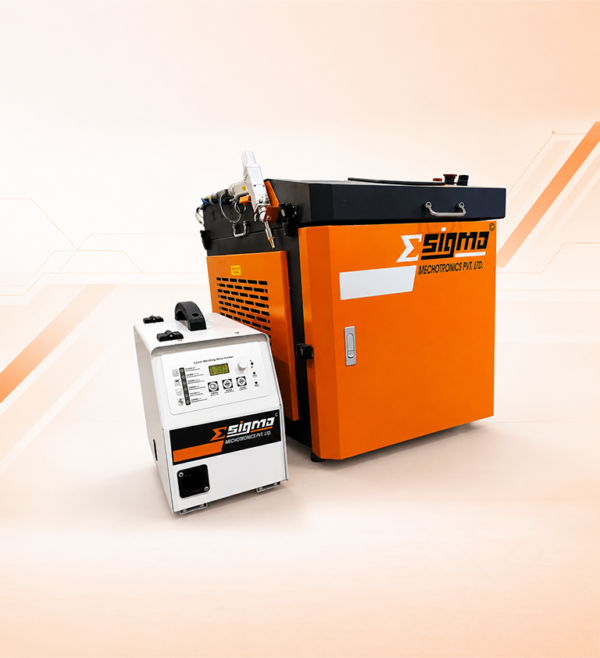
One gun, one control system, four functions – weld, cut, weld-seam clean and rust clean – selected through an HMI with pre-set parameters, at 1500W, 2000W or 3000W. This is the only configuration in Sigma’s welding range, and it’s built to replace three separate handheld tools with one.
| Power options | 1500W / 2000W / 3000W |
| Operating modes | Weld · Cut · Weld Seam Clean · Rust Clean |
| Control | Intuitive HMI with pre-set parameters |
| Wobble | Single axis, adjustable line spot 0-5 mm |
| Cooling | Water-cooled, for continuous working |
| Gun | Handheld, lightweight |
| Wire feeder | Optional dual wire-feeder for gap-filling & penetration |
| Consumables | Minimal |
The Four Modes, Explained
Weld
Fuses metal joints via focused beam, wobble and optional wire feed – the gun’s primary function, rated for both spot and continuous seam welding.
Cut
Switches the same gun to a cutting function for thin sheet and light trimming – a convenience for small in-line cuts, not a substitute for a dedicated cutting machine on thicker stock.
Weld Seam Clean
Removes oxidation and discolouration from a finished weld seam, improving cosmetic finish without picking up a separate cleaning tool.
Rust Clean
Ablates rust and light surface contamination from the work area – the same principle as Sigma’s standalone cleaning machine, built in as a secondary mode.
Power Tiers – 1500W vs. 2000W vs. 3000W
| Power | Suits | Typical Use |
|---|---|---|
| 1500W | Thin-gauge sheet metal, lighter fabrication | Entry point for stainless steel furniture, railing, cabinet and enclosure welding |
| 2000W | Medium-gauge sheet metal, mixed job-shop work | The middle ground for most general fabrication welding |
| 3000W | Thicker sections, wider gaps – especially with the dual wire-feeder fitted | Structural repair, heavier fabrication, higher-throughput production welding |
How to use this table – treat it as a starting reference. Exact maximum thickness and gap tolerance depend on material, joint design and whether the dual wire-feeder is fitted – for a job on the edge between two tiers, a same-material trial settles it faster than a spec sheet.
Applications & Industries
Sheet metal fabrication, stainless steel furniture, railing and kitchen equipment welding, architectural metalwork, electrical panel and enclosure welding, and structural repair work where a fast, low-distortion joint matters more than heavy-plate penetration. It suits job shops and fabrication units running varied part geometries day to day, rather than one part number on a fixed line.
Advantages & Limitations
Advantages
Narrower heat-affected zone and less distortion than arc processes on thin-to-medium gauge; minimal consumables; a lightweight handheld gun rather than a fixed station; water cooling supports continuous production; wobble widens tolerance for imperfect fit-up; the dual wire-feeder option extends capability on wider gaps; four functions in one gun reduce tool count on the shop floor.
Limitations
Weld consistency still depends on operator travel speed and angle – it is a manual, handheld process, not a robotic one. The 1500-3000W range suits thin-to-medium gauge rather than thick structural plate. The cut mode is a convenience function, not a substitute for a dedicated cutting machine on thicker material. Shielding gas needs should be confirmed for stainless steel and aluminium, as with any welding process.
Production Capacity
Exact throughput depends on joint length, material, thickness and operator technique rather than a single fixed number. A continuous-duty, water-cooled system is built to sustain production runs rather than short intermittent bursts, but actual parts-per-shift is best measured on your own joint geometry during a trial or demonstration rather than assumed from a generic figure.
Safety
As a high-power industrial laser, a machine in this class is typically classified as a Class 4 laser product – the highest hazard classification – which means wavelength-rated eye protection, controlled access to the work area, and adherence to standard laser safety interlocks are not optional, regardless of manufacturer. Confirm the specific safety certifications and interlock configuration of Sigma’s machine at the time of inquiry.
Maintenance & Consumables
Routine maintenance is protective-lens replacement on schedule, wire-feed mechanism upkeep where the wire-feeder option is fitted, periodic nozzle and gas-diffuser checks, and confirming the water cooling circuit is running correctly before multi-shift use. Consumables are minimal by design – a protective lens, and wire plus shielding gas only where the wire-feeder option is in use.
Optional Accessories
The dual wire-feeder is the confirmed upgrade path on this machine – it adds filler wire for enhanced penetration, gap-filling and joint strength on wider gaps or thicker sections than autogenous welding closes cleanly on its own. It’s worth specifying upfront rather than retrofitting if your fit-up is regularly inconsistent, which is common in field repair and retrofit work.
Buying tip – if your gap fit-up is inconsistent, specify the dual wire-feeder with the original order. Retrofitting a wire feeder later costs more than including it from the start, and it’s the single accessory decision buyers most often regret skipping.
Hand-Held Laser Welding Machine – Full Specifications & Pricing
Laser Welding vs. MIG, TIG & Stick Welding
The question behind most laser welding machine searches: is it actually better than what I’m already using? Here’s how the processes compare on the criteria that matter for a buying decision.
| Criteria | Laser Welding | MIG Welding | TIG Welding | Stick / Arc Welding |
|---|---|---|---|---|
| Heat input | Low, highly localised | Moderate to high | Moderate | High |
| Heat-affected zone | Narrow | Wider | Moderate | Widest |
| Distortion on thin sheet | Minimal | Moderate | Low to moderate | Highest |
| Welding speed | Fast | Fast | Slow | Moderate |
| Operator skill required | Moderate – HMI presets simplify setup | Moderate | High | High |
| Consumables | Minimal – wire only if fitted | Wire + shielding gas | Filler rod + tungsten + gas | Electrodes |
| Best suited to | Thin-to-medium gauge sheet, precision and visible joints | General fabrication, thicker sections | Precision, thin material, aesthetic welds | Heavy sections, outdoor and field work |
Bottom line – for stainless steel furniture, railing, sheet metal fabrication and structural repair where distortion, cosmetic finish and cycle time matter, a laser welding machine is generally the better tool. For very thick structural plate, conventional arc processes typically remain the more practical and economical choice – this is a case-by-case call based on your material and section thickness, not a blanket rule either way.
Materials & Thickness a Laser Welding Machine Handles
What it welds well, and what it isn’t the right tool for.
Mild & Carbon Steel
Welds cleanly across the 1500-3000W range on thin-to-medium gauge sheet – general fabrication, brackets, enclosures and structural repair. Higher power and the wire-feeder option extend reach into thicker sections and wider gaps.
Stainless Steel
The most common material on this machine in Indian fabrication – furniture, railing, kitchen equipment and architectural work, where a narrow, cosmetically clean seam with minimal discolouration is the whole point of choosing laser over MIG or TIG. Confirm shielding gas needs for your grade.
Aluminium & Alloys
Weldable, though aluminium’s high reflectivity and thermal conductivity make parameter selection more sensitive than on steel – confirm your alloy and thickness with our applications team before committing to a job.
Galvanised & Coated Steel
Weldable, with standard welding practice applying: zinc coating at the joint should generally be prepped or accounted for in parameters, the same consideration that applies to galvanised steel on any welding process, laser included.
What It’s Not Built For
Very thick structural plate and heavy-section deep-penetration welding sit outside the practical range of a 1500-3000W handheld gun – that work is better served by higher-power fixed laser systems or conventional arc processes.
Industries That Run Sigma’s Laser Welding Machine
Used across Indian fabrication clusters – Ahmedabad, Rajkot and Surat in Gujarat, Pune and Aurangabad in Maharashtra, and fabrication hubs across Punjab, Tamil Nadu and Delhi-NCR.
- Stainless Steel Furniture & Railing
- Sheet Metal Fabrication
- Kitchen Equipment Manufacturing
- Architectural Metalwork
- Electrical Panel & Enclosure Welding
- Automotive & Auto-Ancillary
- General Engineering & Job Shops
- Structural Repair & Maintenance
How to Select the Right Laser Welding Machine
Most buying mistakes come from picking a power tier off the price list before working through material, joint and utility readiness. These six decisions, in order, get you to the right machine.
- 1
Confirm Material and Typical Joint First
Mild steel, stainless steel, aluminium or galvanised – and your typical joint thickness and fit-up gap – decide almost everything downstream. Bring this to the first conversation rather than starting with a power number.
- 2
Choose the Power Tier for Your Typical Job, Not Your Occasional One
1500W, 2000W or 3000W should match the gauge and gap you weld most often. If your heaviest job is rare, it’s often more economical to handle it with the wire-feeder or a slower pass than to buy the top tier for a once-a-month job.
- 3
Decide on the Dual Wire-Feeder Upfront
If fit-up on your jobs is regularly inconsistent – common in field repair and retrofit work – specify it with the original order. It is more cost-effective included from the start than retrofitted later.
- 4
Confirm Shielding Gas Needs for Your Material
Stainless steel and aluminium in particular may need shielding gas for a clean, oxide-free weld – confirm this with our applications team for your specific material and grade before finalising your order.
- 5
Check Electrical, Water and Floor Readiness
Confirm your electrical supply matches the machine’s requirement, that a water supply is available for the cooling circuit, and that the source unit and gun cable reach comfortably cover your typical work area – before the machine arrives, not after.
- 6
Verify Service Capability, Not Just Price
A lower-priced machine from a source without India-based spares and service is not a saving once it sits idle waiting on parts. Check warranty terms, spare-parts location and service response before comparing quotes on price alone.
Installation Requirements
Industrial fiber laser welding equipment in this power class typically runs on a three-phase electrical supply – confirm the exact voltage and load requirement for your chosen power tier with our team before your electrical contractor finalises the connection. The water cooling circuit needs a reliable water supply and drainage point near the source unit; if shielding gas is used for your material, plan cylinder or line placement within safe reach of the gun. Beyond the source unit’s own footprint, allow clear floor space for the operator to move around the workpiece with the handheld gun, and confirm the gun’s cable length comfortably reaches your typical work area without repositioning the source unit mid-job.
Maintenance, Troubleshooting & Safety Guide
Problem vs. Solution
| Problem | Likely Cause | Solution |
|---|---|---|
| Porosity in the weld | Surface contamination, insufficient shielding, or wrong parameters | Clean joint surfaces before welding, confirm shielding gas flow, adjust HMI preset for the material |
| Weak fusion or lack of penetration | Power too low for the thickness, or travel speed too fast | Step up the power tier or reduce travel speed; confirm joint fit-up first |
| Inconsistent seam appearance | Inconsistent gun travel speed, angle or standoff distance | Practice a consistent travel speed and angle; use the wobble function to widen tolerance |
| Excess spatter | Contaminated surface, or incorrect wobble amplitude/frequency | Clean the base material; adjust wobble settings via the HMI presets |
| Reduced cleaning speed in seam-clean or rust-clean mode | Heavy contamination, or wrong power tier for the task | Run multiple passes, or step up to a higher power tier; confirm surface condition beforehand |
| Reduced duty cycle or overheating | Cooling system not keeping pace with continuous operation | Verify the water cooling circuit is functioning correctly; avoid exceeding the machine’s rated duty cycle |
Safety in Practice
A laser welding machine in this power class is typically a Class 4 laser product, the highest hazard classification – wavelength-rated eye protection for anyone in the work area, controlled access, and correctly functioning interlocks are standard requirements, not optional accessories. Welding fume extraction is standard industrial hygiene practice for any welding process and applies here as it would for MIG, TIG or stick welding. Interlocks exist to stop the beam firing in an unsafe condition; they are never to be bypassed for convenience.
Why Fabricators Choose Sigma’s Laser Welding Machine
A welding machine is a production tool your shop depends on daily – who built it and who answers the phone when it needs attention matters as much as the spec sheet.
Built by a Manufacturer, Not Assembled by a Trader
Sigma engineers and builds this machine in Ahmedabad – we are not importing an unbranded unit and putting our name on the housing. That means we know the machine’s behaviour well enough to advise honestly on what it can and can’t do for your job.
One Manufacturer for Your Whole Laser Range
If your operation also needs a laser cutting machine, a marking machine, or a dedicated laser cleaning machine, you’re dealing with one manufacturer who already knows your operation – not a fresh vendor relationship for every machine type.
ISO 9001:2015 Certified, Made in India
Sigma is an ISO 9001:2015 certified, MSME-registered Indian manufacturer. Spare parts are held in India, service engineers are based in India, and the organisation you call for support is the one that built your machine.
Honest Guidance on Power Tier and Accessories
We’d rather tell you the 1500W is enough for your job than sell you the 3000W you don’t need – and we’d rather flag that your material needs the wire-feeder now than let you discover it after the first inconsistent batch.
Manufacturer Credentials & After-Sales Support
What you should know about who you’re buying from, and what happens after the invoice.
Registered, GST-Compliant & ISO Certified
Sigma Mechotronics Pvt. Ltd. is a registered Indian private limited company, GST-registered, ISO 9001:2015 certified and MSME registered, with a proper GST tax invoice under your GSTIN on every purchase.
2-Year Machine Warranty
The laser welding machine carries a 2-year warranty covering manufacturing defects in the gun, control electronics, cooling system and wire-feeder mechanism where fitted. Claims are handled directly by Sigma.
Installation, Training & Commissioning
Our technical team installs and commissions the machine at your premises, sets parameters for your material and typical joints, and trains your operators before handover.
Spares & Service Across India
Critical spares – lenses, wire-feed components, control boards – are held in India. Primary service coverage includes Gujarat, Maharashtra, Tamil Nadu, Karnataka, Punjab and Rajasthan, with remote support and coordinated visits elsewhere.
Technical content on this page is reviewed by the Sigma Mechotronics Applications Engineering team. All machine specifications should be confirmed at time of inquiry, as configurations may be updated.
8 Common Mistakes When Buying a Laser Welding Machine
Choosing 1500W when your regular joint needs 3000W to avoid slow, marginal welds. Match power to your typical gauge and gap, not to the lowest price on the list.
Skipping the dual wire-feeder when fit-up is inconsistent. Field repair and retrofit work rarely has perfect fit-up – retrofitting a wire-feeder later costs more than including it upfront.
Assuming laser welding replaces arc welding for thick structural plate. A 1500-3000W handheld gun is built for sheet metal and medium-gauge work, not heavy-section deep-penetration welding.
Not confirming shielding gas needs for stainless steel or aluminium. Skipping this check is a common cause of avoidable porosity or discolouration on the first production run.
Treating the built-in cut mode as a substitute for a dedicated cutting machine. It’s a genuine convenience for thin sheet and light trimming, not a replacement for Sigma’s dedicated cutting range on thicker stock.
Not budgeting for wavelength-rated PPE and safety compliance. This is a Class 4 laser product – eye protection and access control are requirements, not optional line items.
Buying without a same-material trial. Weld appearance, penetration and cycle time all vary with grade, thickness and finish – a demonstration on your actual material is the only reliable way to confirm fit before you commit capital.
Buying the lowest-price machine from an unverifiable source. A machine without India-based service, spares or a genuine warranty is not a saving the first time it needs unplanned maintenance.
Frequently Asked Questions
Direct answers to the questions Indian fabricators most commonly ask before evaluating or ordering a laser welding machine.
A laser welding machine fuses two metal parts by focusing a high-power beam at the joint, melting both edges so they combine into one continuous weld as the material cools. Sigma’s hand-held version delivers that beam through a lightweight gun rather than a fixed head, with a single-axis wobble widening the melt pool and an optional wire-feeder adding filler material – giving the operator the flexibility of manual welding with a narrower, lower-distortion result than conventional arc processes.
The core difference is heat input and how it’s delivered. Laser welding concentrates energy into a narrow, focused spot, producing a smaller heat-affected zone, less distortion on thin sheet, and generally a faster cycle than MIG or TIG on comparable joints. MIG and TIG remain very capable processes with lower equipment cost and no laser-specific safety requirements – the trade-off is usually more heat spread and, for TIG especially, a slower process requiring more operator skill for the same quality.
It’s a laser welding machine where the beam is delivered through a lightweight gun the operator carries and positions manually, rather than through a fixed head in an automated cell. It trades some of the repeatability of a robotic system for the flexibility to weld varied part geometries on a job-shop floor without programming a robot for every new job – which is why it suits fabrication and repair work more than single-part mass production.
It means one gun and one control system perform four separate functions, selected on the HMI: welding, cutting (for thin sheet and light trimming), weld-seam cleaning (removing oxidation from a finished weld for a cleaner cosmetic finish), and rust cleaning (removing surface rust and light contamination). It’s genuinely four functions in one tool, not four separate machines bundled together.
Match the power tier to your typical joint, not your occasional one. 1500W suits thin-gauge sheet metal and lighter fabrication – stainless steel furniture, railing, cabinets. 2000W is the practical middle ground for mixed job-shop work. 3000W suits thicker sections and wider gaps, especially with the dual wire-feeder fitted, and higher-throughput production welding. If your heaviest job is rare, the wire-feeder or a slower pass on a mid-tier machine is often more economical than buying the top tier for an occasional job.
Mild and carbon steel, stainless steel, aluminium and alloys, and galvanised or coated steel all weld on this machine, with parameters adjusted per material. Stainless steel is the most common material in Indian fabrication work on this class of machine, since the narrow, low-discolouration seam is exactly what buyers are choosing laser welding for. Aluminium’s reflectivity and thermal conductivity make it more parameter-sensitive – confirm your alloy and thickness with our applications team before committing to a job.
There’s no single number that applies across every material and joint type – thickness capability depends on power tier, material, joint design (butt, lap or fillet) and whether the dual wire-feeder is fitted. As a general guide, 1500-3000W handheld machines are built for thin-to-medium gauge sheet metal rather than thick structural plate. For a job on the edge of your comfort zone, a same-material trial gives a more reliable answer than any published figure.
For thin-to-medium gauge sheet metal and stainless steel work within its intended range, a properly parametrised laser weld is a fully structural joint, often with less distortion and a cleaner finish than the equivalent MIG or TIG weld. For very thick structural sections outside that range, conventional arc processes are typically still the more practical choice – strength comparisons only make sense within the thickness range a given process is actually designed for.
Often, yes – particularly on stainless steel and aluminium, where shielding gas helps prevent oxidation and porosity at the weld, the same principle that applies to MIG and TIG welding on these materials. Requirements vary by material and joint; confirm the specific shielding gas recommendation for your material with our team before ordering.
Laser welding machines in this power class are typically classified as Class 4 laser products, the highest hazard classification. Wavelength-rated eye protection for anyone in the work area, controlled access, and properly functioning interlocks are standard requirements. Standard welding fume extraction also applies, as it would to any welding process. Confirm the specific safety certification and interlock configuration of Sigma’s machine at the time of inquiry.
The machine welds without filler wire (autogenous welding) as standard, which is sufficient for many thin-gauge, well-fitted joints. The dual wire-feeder is an optional accessory that adds filler material for enhanced penetration, gap-filling and joint strength on wider gaps or thicker sections – worth specifying upfront if your typical fit-up is inconsistent, since retrofitting it later costs more than including it with the original order.
The wobble function sweeps the beam spot across an adjustable line width from 0 to 5mm instead of holding a single pinpoint, widening the melt pool. In practice, this makes the weld more forgiving of minor gaps and fit-up variation, which is one of the main reasons a laser weld from this machine looks more consistent than a static-beam laser weld on parts that aren’t perfectly fitted.
Partially, and it’s important to be clear about where the line sits. The built-in cut mode handles thin sheet and light trimming conveniently, but it will not match the throughput or thickness capability of Sigma’s dedicated laser cutting machines, which run from 1.5kW to 20kW. Similarly, the rust-clean mode handles light, incidental cleaning, but a facility with dedicated, high-volume cleaning needs is better served by Sigma’s standalone laser cleaning machine. Think of the welding machine’s extra modes as genuinely useful secondary functions, not replacements for dedicated equipment at scale.
Routine maintenance is light compared with conventional welding equipment: protective-lens replacement on schedule, wire-feed mechanism upkeep if that option is fitted, periodic nozzle and gas-diffuser checks, and confirming the water cooling circuit runs correctly before multi-shift use. There’s no tungsten to sharpen and no gas nozzle assembly to rebuild the way TIG equipment needs.
Pricing depends on power tier (1500W, 2000W or 3000W) and whether the dual wire-feeder option is fitted. We don’t publish fixed pricing because the right specification differs by material and joint, and an under-powered machine is a poor investment regardless of its price. Send an inquiry with your material, typical joint thickness and gap, and volume for a detailed quotation.
The machine carries a 2-year warranty covering manufacturing defects in the gun, control electronics, cooling system and wire-feeder mechanism where fitted, handled directly by Sigma rather than through an agent. Installation, commissioning, parameter setting and operator training are included, with spares held in India and service coverage across Gujarat, Maharashtra and key centres nationally.
The HMI’s pre-set parameters reduce the setup expertise needed compared with manually tuning a TIG torch, but consistent weld quality still depends on the operator’s travel speed, angle and standoff distance – it remains a manual, hands-on skill, just with a shorter learning curve than TIG welding typically requires. Operator training is included with installation to get your team up to speed on your specific materials.
With correct installation, proper operating conditions and routine maintenance – lens and nozzle checks, cooling system upkeep – industrial fiber laser equipment in this class is built for many years of production use. Actual service life depends heavily on duty cycle and maintenance discipline; a machine from a manufacturer with local spares and service will meaningfully outlast one bought solely on price from a non-serviceable source.
Yes, and for any material or joint where cosmetic finish, penetration or cycle time is critical to your decision, we recommend it. A trial on your actual material and joint geometry is the most reliable way to confirm the right power tier and whether you need the wire-feeder, before you commit capital.
The handheld gun and cable-connected source unit give it more field flexibility than a fixed welding station, but practical considerations apply – power supply availability, water supply for the cooling circuit, and environmental protection for the source unit all need planning for outdoor or on-site use. Confirm your specific site conditions with our team before planning a field deployment.
Quick Summary
Sigma’s hand-held laser welding machine is a genuine 4-in-1 tool – weld, cut, weld-seam clean and rust clean – built for thin-to-medium gauge sheet metal and stainless steel fabrication at 1500W, 2000W or 3000W. It gives a narrower, lower-distortion weld than MIG, TIG or stick welding on the material range it’s built for, with a wobble function that forgives imperfect fit-up and an optional dual wire-feeder that extends its reach on wider gaps. It is not a replacement for heavy-plate structural welding or for Sigma’s dedicated cutting and cleaning machines at scale – matching the tool to the job, not the price tag, is what makes it the right investment.
More From Sigma Mechotronics
Ready to Specify the Right Laser Welding Machine?
Tell us your material, typical joint thickness and gap, and production volume – our team will come back with the right power tier, accessory recommendation and pricing for your actual requirements. No generic quotes. No mismatched specifications.