Trust In Quality With Us
Laser Cleaning Machine
Showing the single result
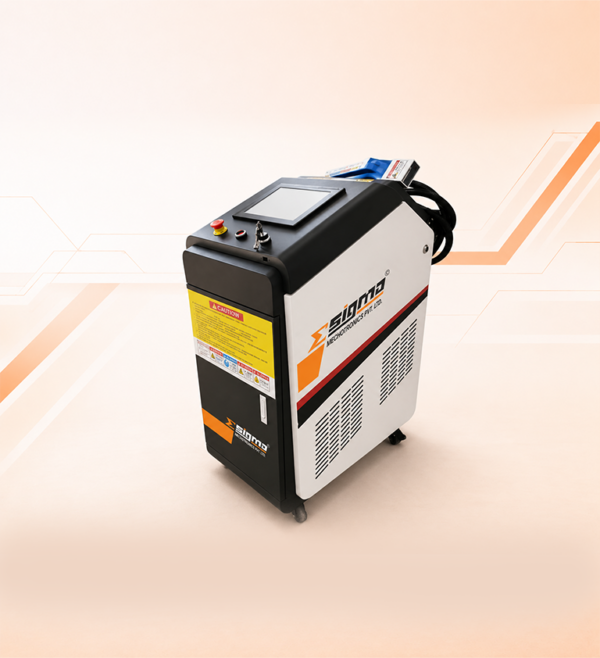
Fiber Laser Cleaning Machine for Rust, Paint and Scale Removal – 1500 W to 3000 W
A laser cleaning machine removes rust, paint, oxide scale, oil and coating residue from metal with a laser beam. The beam lifts the contamination off as vapour and fine dust and leaves the metal underneath in place. There is no grit, no shot, no solvent and no acid, so there is no spent media or effluent to dispose of. Sigma Mechotronics Pvt. Ltd. manufactures fiber laser cleaning machines at 1500 W, 2000 W and 3000 W at its own plant in Ahmedabad. Sigma is ISO & CE Certified, and every machine comes with a 1-year warranty, free installation, free operator training and 24/7 support.
- Power range
- 1500W-3000W
- Power tiers
- 3
- Highest tier
- 3000 W
- Machine format
- Handheld
Laser cleaning turns surface preparation from a running cost into a one-time cost. Blasting and chemical stripping cost money every time you use them: media, chemicals, booth upkeep and waste disposal. A laser cleaning machine is paid for once, and after that it needs electricity, filters and a protective lens. The more hours a week the gun actually runs, the stronger that trade becomes.
Two questions decide the right machine, and neither is about watts. First, what is on the surface: light rust and four coats of old paint are very different jobs, and lead, chromate or zinc in an old coating changes the extraction you need. Second, how many square metres you have to clear in a shift. Answer those two and the power tier follows.
At a Glance
Key Takeaways
Six points to know before you choose a laser cleaning machine.
The Beam Removes the Layer, Not the Metal
Rust, scale and paint lift off at far lower energy than clean steel. Set correctly, the beam removes the layer and leaves the metal alone.
Energy on the Surface Matters More Than Watts
What decides the result is the energy per square centimetre. Spot size, scan speed and overlap change it as much as laser power does.
Continuous-Wave Is Built for Area
Kilowatt continuous-wave machines clear rust and coatings over large areas quickly. Low-power pulsed units are gentler but much slower.
It Cleans, It Does Not Profile
Laser cleaning exposes the surface profile already on the steel. If a coating needs a new anchor profile, blasting still creates it.
The Fume Is Finer Than Blast Dust
Laser cleaning produces very fine particles that stay in the air. Capture the fume at the gun and filter it through a HEPA stage.
Sigma Builds 1500 W, 2000 W and 3000 W
Fiber laser cleaning machines made at our Ahmedabad plant. ISO & CE Certified, with a 1-year warranty, free installation and training, and 24/7 support.
Definition
What Is a Fiber Laser Cleaning Machine?
A fiber laser cleaning machine is a laser cleaning machine that uses a fiber laser source to remove rust, paint, scale and residue from metal. The beam is absorbed by the contamination, which breaks up and leaves as vapour and fine dust, while the metal underneath stays in place. Nothing touches the part except light, which is why the same machine is also called a laser rust removal machine or a laser descaling machine.
It works because every material needs a minimum amount of energy before it lifts off a surface. Rust, mill scale, paint and oil need far less than clean steel, so the beam removes the layer and then has little left to act on. Steel is the easiest metal to clean. Aluminium, copper and brass reflect more of the beam and carry heat away faster, so their settings need more care.
The laser works in the near-infrared at 1064 nm, the same family used for fiber laser cutting, welding and marking. The beam travels through an armoured fiber cable to a handheld scanning gun, while the cabinet holds the laser source, the water cooling and the controls. The beam is invisible, which is why laser safety matters as much as the cleaning itself.
The Four Settings That Decide the Result
01
Energy, Not Wattage
The energy delivered to each square centimetre. It has to be high enough to lift the contamination and low enough to leave the metal untouched.
02
Beam Mode
Continuous output covers area quickly. Pulsed or modulated output puts less heat into the part.
03
Scan Speed and Overlap
How fast the beam sweeps and how much each pass overlaps the last. Too little leaves stripes; too much wastes time and adds heat.
04
Working Distance
Hold the gun at its designed distance. Moving closer or further changes the energy at the surface, which is the most common cause of uneven results.
Specifications
Laser Cleaning Machine Basic Technical Data
Basic technical data for Sigma’s 1500 W fiber laser cleaning machine. For the 2000 W and 3000 W machines, ask for a quotation on WhatsApp and we will send the complete details.
| Parameter | 1500 W Machine |
|---|---|
| Laser wavelength | 1064 nm ± 10 nm |
| Laser spot width | 0 to 200 mm |
| Aiming | Red light positioning |
| Laser lifetime | Up to 100,000 hours |
| Laser frequency | 50 Hz to 5 kHz |
| Cooling | Water cooling |
| Laser safety class | Class 4 |
| Operating environment | 0 to 40 °C, humidity 20% to 80% |
| Protective gas | Nitrogen (N2), 99.999% purity |
| Output laser stability | Within 3% |
| Machine size and weight | 1100 x 810 x 920 mm, 100 kg |
Standard Parts Included in One Set
| Part | Specification |
|---|---|
| Cabinet | Handheld optical fiber laser cleaning cabinet |
| Fiber laser source | Raycus / Max, 1500 W |
| Handheld laser cleaning head | New generation, 300 mm width |
| Water cooling system | Built-in double cooling |
| Laser control system | Touchscreen |
| Circuit control system | Integrated, with protection against accidental laser emission |
Price and complete details – the price depends on the laser power and the options you choose. For the price and complete technical details of the machine you need, message us on WhatsApp and ask for a quotation. 24/7 support is available.
Where It Fits
Where Laser Cleaning Is the Right Tool
Laser cleaning does not replace every blasting or chemical job. It is clearly better in some situations and the wrong tool in a few.
| Your Situation | Why It Suits | What to Watch For |
|---|---|---|
| Pre-weld joint preparation | Mill scale, primer and oil come off the joint line just before welding, which reduces porosity. | Bare steel rusts again. Clean just before you weld. |
| Heat tint on welded stainless | The tint comes off without pickling paste, acid handling or effluent. | If your specification also calls for passivation, that step still applies. |
| Spot repairs and refurbishment | Strip one panel or one weld line back to metal with no masking. | Check old coatings for lead or chromate first. |
| Moulds, dies and tooling | Release film and carbon come off without media lodging in fine detail. | Test the settings on a spare area of textured or polished tools. |
| Installed plant and structures | The machine goes to the work, so tanks, frames and pipework are cleaned in place. | Each new position needs its own safety area and extraction point. |
| Large areas of heavy scale | Done routinely, where the job competes on square metres per hour. | A blast booth still covers more area per hour and cuts an anchor profile. |
When it pays – a laser cleaning machine is mostly a one-time cost with very low running costs, while blasting is the reverse. The laser wins on work that is frequent, selective, hard to mask, hazardous to dispose of, or impossible to move to a booth. For a one-off large stripping job, hiring a blasting contractor is usually cheaper.
Laser Types
Types of Laser Cleaning Machine: Continuous-Wave vs Pulsed
Two kinds of laser are sold under the same name. Comparing them on price per watt gives a meaningless answer.
| Laser Type | Power and Behaviour | Chosen For |
|---|---|---|
| Continuous-Wave | Usually 1000 W to 3000 W of steady output, water-cooled. | Production rust, scale and coating removal over large areas of steel and other heavy-duty metal parts. |
| Pulsed | Low average power, often 50 W to 500 W, delivered in very short, intense bursts. | Delicate parts, thin sheet, tooling and restoration where heat must stay low. Removal is slow. |
| Modulated CW | A continuous source switched on and off electronically. | A gentler setting on kilowatt machines for heat-sensitive jobs. |
Sigma builds the kilowatt continuous-wave class at 1500 W, 2000 W and 3000 W, all in the same handheld format. Only the laser power changes between the three, so the real decision is how much power your work needs, and that is set by the layer you remove and the area you have to clear. Enclosed cabinets, fixed heads and robot cells use the same technology on high-volume lines. Most fabrication and maintenance shops are well served by the handheld format because it goes to the work.
Sizing the Machine
Sizing the Machine by Square Metres Per Shift
The number that sizes a laser cleaning machine is how many square metres it clears per hour on your surface, not its wattage. That figure can change many times over between jobs on the same machine.
| What Changes the Rate | Effect on Square Metres Per Hour |
|---|---|
| Layer thickness and coats | The biggest factor. Light rust lifts in one pass; several coats of old paint need repeated passes. |
| Type of coating | Thin, dark layers go fastest. Light-coloured, thick or elastic coatings take longer. |
| Metal underneath | Steel is quickest. Aluminium and copper reflect more and need gentler settings. |
| Finish required | Removing visible rust is much quicker than reaching uniformly bare, bright metal. |
| Access and shape | Flat, open panels are fastest. Corners, pipework and overhead work slow the gun. |
| Setup time | Moving the work, the extraction and the safety area at each position is shift time, not cleaning time. |
Do this sum before you enquire – total the area you must clean in a shift, divide it by a rate you have seen on your own material, and add the time to move between positions. If the answer is more than about two-thirds of a shift, choose a higher power tier so the machine does not become a bottleneck. You can book a free demo to see the machine working before you decide.
Standards
Surface Preparation Standards and Your Specification
If the cleaned surface will be painted, coated, bonded or welded to a written specification, define what “clean” means before you buy.
ISO 8501-1 grades how clean prepared steel looks, from Sa 1 to Sa 3 for blast cleaning, and SSPC-SP 10 near-white corresponds to Sa 2 1/2. The anchor profile, the roughness a coating keys into, is a separate property covered by ISO 8503. Laser cleaning can reach a visually clean surface, but it does not cut a new profile; it exposes the one already on the steel. On previously blasted steel that is often an advantage. On smooth plate under a coating that needs a minimum profile, blasting is still required.
In 2024 AMPP published SP21511-1-2024, the first standard written for laser surface preparation of ferrous metals. It covers pulsed, Q-switched lasers and excludes continuous-wave lasers and stainless steel. For continuous-wave machines, write the end state into your specification: the starting rust grade, the cleanliness required, whether a profile is needed, and who checks it.
| If Your Specification Says… | What a Laser Cleaning Machine Does |
|---|---|
| “Remove all visible rust, scale, oil and old coating” | Directly achievable, and the core job of a kilowatt machine. |
| “Prepare to Sa 2 1/2 / SSPC-SP 10” | Check the result against the photographic standard on your own steel before you commit to it. |
| “Achieve a surface profile of X microns” | Not what laser cleaning does. Blast to create the profile. |
| “Remove lead-based or chromate coating” | Achievable, but treat it as a hazardous-material job: capture, filtration and filter disposal come first. |
Before It Arrives
What the Machine Needs From Your Plant
Installations are held up by the electrical supply, cooling, gas and extraction, not by the machine. Arrange them alongside the order.
| Requirement | What You Need | Confirm in Writing |
|---|---|---|
| Electrical supply | A laser turns only part of the electricity it draws into beam; the rest becomes heat, and the cooling draws power too. | Connected load in kW, phase, cable and breaker size, and a stabiliser if your supply fluctuates. |
| Cooling and environment | Built-in double water cooling, with an operating range of 0 to 40 °C and 20% to 80% humidity. | Summer temperature in the working area, and the coolant quality and change interval. |
| Protective gas | Nitrogen (N2) at 99.999% purity. | How the nitrogen will be supplied where the machine works. |
| Fume extraction | Everything removed leaves as fume and very fine dust. | Capture at the gun, the filtration stages, filter change intervals and filter disposal. |
| Space | The machine measures 1100 x 810 x 920 mm and weighs 100 kg. | Where it will work, and room for the safety area around each position. |
| Consumables and spares | Protective lens, nozzles, extraction filters and coolant. | Change intervals, unit costs, and confirmation that spares are held in India. |
Class 4
Laser Safety and Fume Control
A kilowatt laser cleaning machine is a Class 4 laser product under IEC 60825-1, the highest hazard class. The beam is invisible and bare metal reflects it, so the direct beam, its reflection and even scattered light can injure eyes and skin.
| Hazard | The Control That Works |
|---|---|
| Direct and reflected beam | Eye protection rated for 1064 nm for everyone in the area. Welding glasses do not protect at this wavelength, and polished or reflective metals send more of the beam back. |
| Invisible beam path | A marked controlled area with signs, set up again at every new position, with one person responsible for it each shift. |
| Very fine particles | Capture at the gun and filter through a HEPA stage, with activated carbon for solvent-based paints. |
| Hazardous old coatings | Identify lead, chromate, zinc or cadmium before the first pass. They change the extraction and how spent filters are disposed of. |
| Fire and hot parts | Keep solvents, oily rags and packaging out of the area, and let cleaned parts cool before handling. |
Laser cleaning fume is different from blasting dust. Blasting throws heavy debris that falls to the floor. Laser cleaning vaporises the layer, and much of it condenses into ultrafine particles that stay in the air and can reach deep into the lungs. That is why a welding fume unit is not enough and the fume has to be captured at the gun.
Five Steps
How to Choose a Laser Cleaning Machine
Work through these in order. Each step narrows the choice.
- 1
Name the Layer
Write down what is on the surface (rust, scale, primer, paint or oil), how thick it is and how many coats there are. Check whether it contains lead, chromate, zinc or cadmium.
- 2
Fix the Finish You Need
Visible rust removed, bare bright metal, or a named cleanliness grade are different jobs. If a new anchor profile is required, that part stays with blasting.
- 3
Confirm Continuous-Wave Suits the Job
Clearing rust, scale and coatings over area on steel points to a kilowatt continuous-wave machine. Very thin or delicate parts need gentler settings.
- 4
Size the Power to Your Area
Total the area across a full day’s work and choose the tier, 1500 W, 2000 W or 3000 W, that clears it with time to spare.
- 5
Arrange the Site With the Order
Get the connected load, cooling, nitrogen supply and extraction in writing at quotation stage, and plan the safety area and eye protection before delivery.
Avoid These Buying Mistakes
5 Mistakes Buyers Make Choosing a Laser Cleaning Machine
1
Comparing pulsed and continuous-wave machines on price per watt. A 200 W pulsed unit and a 2000 W continuous-wave machine do different jobs, so the comparison means nothing.
2
Not identifying the old coating before stripping it. Lead, chromate and zinc come off easily and become airborne, which changes your extraction and waste handling.
3
Using a welding fume extractor. Laser cleaning fume is much finer, and a welding unit can let it pass straight back into the shop.
4
Writing only “laser cleaned” into a specification. It cannot be measured. Name the starting rust grade, the cleanliness required, whether a profile is needed and who signs it off.
5
Leaving the site work until delivery. Electrical work, cooling space, the nitrogen supply and extraction take time to arrange, so start them when you order.
Where It Is Used
Applications and Materials
Most machines end up doing three or four of these jobs once they are on the floor.
- Pre-Weld Joint Preparation
- Post-Weld Heat Tint Removal
- Rust & Corrosion Removal
- Paint & Coating Stripping
- Mill Scale Removal
- Surface Preparation Before Coating
- Mould, Die & Tooling Cleaning
- Degreasing Before Bonding
- Selective Spot Cleaning Without Masking
- Pipeline & Structure Maintenance
- Foundry & Casting Cleanup
- Restoration & Heritage Metalwork
Steel is where laser cleaning is strongest, and stainless steel is the second big use, mostly for weld heat tint. Aluminium, copper and brass can be cleaned with gentler settings, and cast iron and galvanised steel come up often in maintenance work. Sigma’s laser cleaning machines are specified for metal surfaces.
Manufacturer, Not Trader
Why Buy a Laser Cleaning Machine From Sigma Mechotronics Pvt. Ltd.
We build the machine ourselves, install it with our own team and support it directly.
Built at Our Own Ahmedabad Plant
The machine is engineered, assembled, integrated and tested at our plant at Bakrol, Ahmedabad, with the head office at Odhav. You settle the power tier with the people who build and commission it.
ISO & CE Certified, MSME Registered
A registered Indian private limited company, ISO & CE Certified, MSME and GST registered. Every purchase carries a GST tax invoice under your GSTIN.
1-Year Warranty and 24/7 Support
A 1-year warranty on manufacturing defects, handled directly by Sigma rather than an agent. Protective optics, nozzles, gun components and control electronics are held in India, and 24/7 support is available.
Free Installation, Training and Demo
Our team installs and commissions the machine at your premises, sets it up for your contamination and trains your operators free of charge for 1 to 7 days. You can also book a free demo before you buy.
Straight Answers
Frequently Asked Questions
The questions buyers ask most before choosing a laser cleaning machine.
A fiber laser cleaning machine is a laser cleaning machine that uses a fiber laser source to remove rust, paint, scale, oil and residue from metal. The beam lifts the contamination off as vapour and fine dust and leaves the metal in place, with no media or chemicals. Sigma Mechotronics Pvt. Ltd. manufactures them at 1500 W, 2000 W and 3000 W.
Choose by the layer you remove and the area you must clear per shift, not by the highest wattage. Light rust over modest areas suits the lower tiers, while thick coatings or large areas per shift need more power. Send your surface details on WhatsApp and we will recommend the tier and send a quotation.
It can if the settings are wrong for the section. Cleaning needs far less energy than cutting or welding, but a kilowatt beam held too long in one place or overlapped too heavily still heats thin, unsupported sheet. Use a higher scan speed, less overlap and several light passes, and test on a sample first.
The price depends mainly on the laser power and the options you choose, so we quote against a confirmed specification rather than a list price. For the price and complete details, message us on WhatsApp and ask for a quotation. When comparing quotes, check that each one includes cooling, extraction, eye protection, installation and training.
Free installation and commissioning at your premises, free operator training for 1 to 7 days, a 1-year warranty on manufacturing defects, spares held in India and 24/7 support. You can also book a free demo before you buy.
All three use fiber lasers, but they do different things to the metal. A cutting machine focuses the beam to melt through the material, and a welding machine fuses parts together. A cleaning machine spreads and scans the beam so that it removes only the surface layer and leaves the metal itself unchanged.
The Full Range
Explore More From Sigma Mechotronics Pvt. Ltd.
Hello 👋, welcome to SIGMA MECHOTRONICS PRIVATE LIMITED
Can we help you?
Open Chat