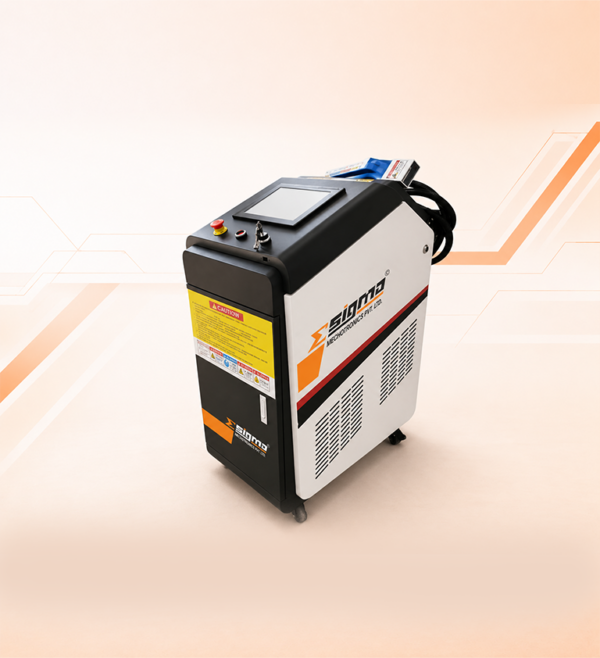
Hand-Held Laser Cleaning Machine
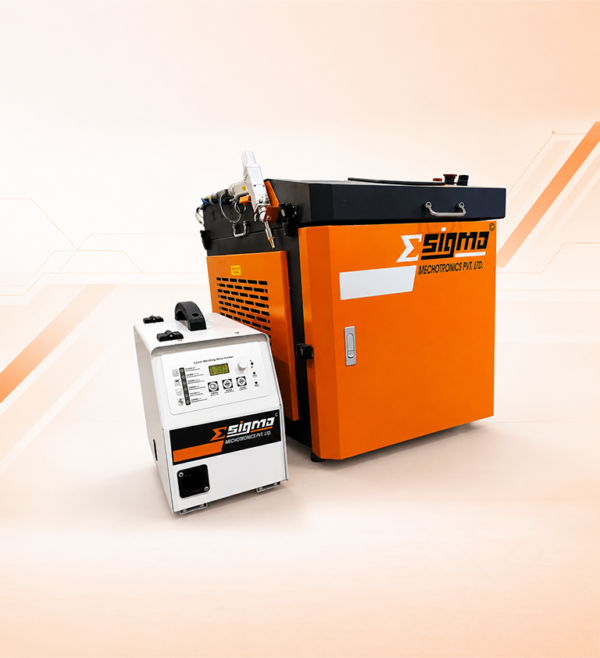
Hand-Held Laser Cleaning Machine by Sigma Mechotronics is a
non-contact laser cleaning solution for fast, chemical-free surface
cleaning on metal.
– Power options: 1500W, 2000W and 3000W
– Removes rust, paint, oil and oxide layers
– No chemicals, solvents or abrasive media required
– Handheld cleaning gun for flexible operation
– No damage to the base material
Send Inquiry
Non-Contact · Chemical-Free · No Media · Made in India · ISO 9001:2015 Certified
Hand-Held Laser Cleaning Machine – Rust, Paint and Oxide Removal Without Media or Chemicals, 1500 W to 3000 W
A hand held laser cleaning machine removes rust, paint, oxide scale, oil residue and other surface contamination by firing a focused laser beam at the surface, which vaporises the contaminant and leaves the metal underneath. Nothing touches the part – no grit, no wire, no chemical – so there is no blasting media to buy and dispose of, no effluent to handle, and no abrasive wearing away the substrate. Sigma Mechotronics Pvt. Ltd. builds it at 1500 W, 2000 W and 3000 W in an ergonomic handheld gun with multi-mode cleaning and a smart control system, backed by a 1-year warranty.
- Power options
- 1500-3000 W
- Operation
- Non-contact
- Blasting media
- None
- Warranty
- 1 year
Every shop that cleans metal has the same three problems with the methods it already uses. Abrasive blasting needs a booth, a compressor, media that has to be bought and then disposed of, and it takes metal off the part along with the rust. Chemical stripping produces effluent that has to be handled and eventually paid for. Wire brushing and flap discs are slow, inconsistent, and hard on the operator. None of those problems is about cleaning quality – they are all about what surrounds the cleaning.
Laser cleaning removes that surrounding entirely. The contaminant absorbs the beam and is vaporised off the surface; the base metal, which reflects far more of it, is largely unaffected when the parameters are set correctly. There is no media to reclaim, no chemical to neutralise and no booth to build. Sigma Mechotronics Pvt. Ltd. manufactures this machine at its own plant in Ahmedabad, at 1500 W, 2000 W and 3000 W.
At a Glance
Key Takeaways
No Media, No Chemicals
Nothing is fired at the part and nothing is applied to it, so there is no grit to buy and reclaim and no effluent to handle or dispose of.
Non-Contact, So No Substrate Loss
Abrasive methods take metal off along with the rust. A correctly set laser removes the contamination and leaves the base material largely untouched.
1500 W, 2000 W or 3000 W
The tier is chosen by how heavy the contamination is and how much area you have to cover per shift – not by what material it sits on.
Multi-Mode Cleaning
Different scanning modes suit different jobs – a broad sweep for area work, a tighter pattern for edges, seams and detail.
Goes to the Work
A portable, compact unit with an ergonomic handheld gun, so structures and installed plant are cleaned where they are, without a booth.
Extraction Is Still Required
Chemical-free does not mean fume-free. The contaminant is vaporised, so it has to be extracted – plan for that as part of the installation.
Definition
What Is a Hand Held Laser Cleaning Machine?
A hand held laser cleaning machine is a fiber laser system that delivers its beam through a handheld gun and uses it to ablate surface contamination – rust, paint, oxide scale, oil and residue – off a base material. The contaminant absorbs the laser energy and is vaporised away; the metal underneath reflects far more of that energy and, at correctly set parameters, is left essentially as it was. The process is non-contact and chemical-free.
That difference in absorption is the entire working principle, and it is worth understanding because it explains both what the machine is brilliant at and where it needs care. Rust, paint and scale are dark and absorptive, so they take the energy readily. Clean steel is comparatively reflective, so once the contamination is gone there is much less for the beam to act on. The process is therefore somewhat self-limiting on the right materials – which is why it can strip a painted panel without eating into the panel the way a flap disc would.
The gun is ergonomic and lightweight, the unit is portable and compact rather than a fixed installation, and a smart control system with built-in safety features sets and holds the cleaning parameters. Multi-mode cleaning lets the operator switch the scanning pattern to suit the job in front of them rather than working every surface the same way.
Technical Specification
| Power options | 1500 W / 2000 W / 3000 W |
| Operation | Non-contact, chemical-free – no abrasive media and no stripping chemicals |
| Gun | Ergonomic handheld laser gun |
| Construction | Portable and compact, built for moving to the work |
| Cleaning modes | Multi-mode cleaning functionality, selected to suit the job |
| Control | Smart control system with built-in safety features |
| Typical materials | Mild and carbon steel, stainless steel, aluminium and other metal substrates |
| Warranty | 1 year |
The Jobs It Does
What a Laser Cleaning Machine Actually Removes
The machine is bought for rust, but rust is only the most visible of the things it takes off. Each of these behaves slightly differently under the beam.
| Contamination | Where It Comes Up |
|---|---|
| Rust and corrosion | Stored stock, structures, plant and equipment, and anything that has been outdoors – the most common reason the machine is bought. |
| Old paint and coatings | Repaint and refurbishment work, and selective stripping where only one area needs to come back to bare metal. |
| Oxide and mill scale | Surface preparation before painting, coating or welding, where scale would otherwise sit under the new layer. |
| Weld seam discolouration | Post-weld cleaning on stainless steel, where heat tint has to come off before the joint is acceptable. |
| Oil, grease and residue | Degreasing before bonding, coating or inspection, without a solvent bath. |
| Mould and die release film | Tooling maintenance, where release agent builds up in the cavity and starts affecting the part. |
Pre-weld and post-weld are the two most under-rated uses – cleaning back to bare metal immediately before welding removes the scale and coating that cause porosity, and taking the heat tint off afterwards finishes a stainless joint without pickling paste. Shops that buy the machine for rust removal frequently end up using it most on either side of the welding bay.
The Real Comparison
Laser Cleaning vs Abrasive Blasting vs Chemical Stripping
Most buyers are not choosing between two lasers – they are deciding whether to replace a blast booth, a chemical process or a man with a grinder. This is the comparison that actually decides it.
| Consideration | Laser Cleaning | Blasting / Chemical Stripping |
|---|---|---|
| Blasting media and chemicals | None – nothing is fired at the part or applied to it | Grit, shot or sand bought continuously; chemicals bought and stored |
| Waste and disposal | Vaporised contaminant captured by extraction | Spent media mixed with the removed coating; chemical effluent needing handling |
| Effect on the substrate | Non-contact; correctly set, the base metal is largely unaffected | Abrasive removes substrate and changes surface profile; chemicals can attack the base |
| Selectivity | Clean one area and leave the surrounding surface untouched | Masking required to protect anything you do not want stripped |
| Containment | Portable gun taken to the work; extraction at the point of cleaning | Booth, cabinet or tank; the part usually has to come to the process |
| Ongoing cost | No media or chemicals to keep buying, and nothing to send for disposal | Media, chemicals, disposal, compressor running cost, booth upkeep |
Where blasting still wins – for very large areas of heavy scale, a blast booth moves more square metres per hour than a handheld gun, and for structural work where a specified surface profile is required before coating, abrasive blasting produces that profile in a way a laser does not. This machine is strongest on selective, precise and mobile cleaning, and on work where substrate damage, masking or waste disposal are the real problems.
1500 W to 3000 W
How to Choose the Power Tier
Power decides two things: how heavy a layer you can remove in one pass, and how much area you can cover in a shift. It does not change what the machine is capable of cleaning – it changes how long that takes.
| Power | Generally Suits | Where It Struggles |
|---|---|---|
| 1500 W | Light to moderate rust, thin coatings, weld seam cleaning, mould and tooling maintenance, smaller areas | Heavy scale and thick multi-coat paint over large areas |
| 2000 W | The general-purpose middle – mixed refurbishment and surface-prep work at commercial speed | Sustained large-area stripping where coverage per shift is the constraint |
| 3000 W | Heavy scale, thick coatings, large-area work and continuous production-rate cleaning | Nothing capability-wise – it is capital and running cost, so buy it where coverage or coating thickness demands it |
The number that actually matters is square metres per shift – not watts. Work out how much area you need to clean in a day and how thick the layer on it is, and let those two figures choose the tier. A machine that cleans beautifully but covers half of what you need is the wrong machine, however good the sample looks.
Set Expectations Correctly
What a Laser Cleaning Machine Is Not
This is a surface-contamination tool, not a bulk material-removal process. Being clear about that before you order is what prevents disappointment afterwards, and it is the part most suppliers leave out.
It does not remove metal. If a part needs material taken off – a weld dressed back, a burr removed, a dimension corrected – that is a grinding job. The laser lifts what sits on top of the metal, not the metal itself.
Very heavy build-up needs multiple passes. Thick scale or several coats of old paint across a large area will not come off in one sweep. It can be done, but the honest planning figure is more passes and therefore more time, which is exactly where the power tier decision bites.
Some surfaces need parameter tuning. Very reflective surfaces give the beam less to work with, and very dark or highly absorptive substrates can take more energy than intended if parameters are not set for them. This is normal and solvable, but it is why a trial on your actual surface is worth more than any published figure.
It does not produce a blast profile. Where a coating specification calls for a defined surface roughness before painting, abrasive blasting creates that profile and laser cleaning generally does not. If your work is governed by a coating standard, check what that standard requires before deciding.
Four Checks
What to Confirm Before You Order
- 1
Define the Layer, Not Just the Job
“Rust removal” covers everything from light surface bloom to years of flaking scale. Describe what is actually on the surface and roughly how thick it is – that, plus the area per shift, is what sets the power tier.
- 2
Calculate Your Area Per Shift
Take the real workload – square metres per day, not per part – and use it to sanity-check the tier. This is the figure that decides whether the machine keeps up with your throughput or becomes a bottleneck.
- 3
Plan Extraction and the Controlled Area
The contaminant is vaporised into fume and fine particulate, so extraction sized for what you are removing is part of the specification – especially for old paint. And with no enclosure, a controlled area with rated eye protection has to be established wherever you work.
- 4
Trial It on Your Actual Surface
Cleaning speed and the result depend heavily on coating thickness, substrate and finish, and no published figure substitutes for a test. Send us a representative sample – rusty, painted, scaled, whatever you actually face – before you commit.
Avoid These Buying Mistakes
6 Mistakes Buyers Make on a Laser Cleaning Machine
1
Judging the machine on a demo sample instead of your own. Light rust on clean plate cleans beautifully at any power. Test the worst surface you actually have to deal with.
2
Choosing the tier on price rather than area per shift. Under-powering is the common error here – the machine cleans perfectly and still cannot cover the day’s work.
3
Assuming chemical-free means fume-free. The contaminant does not disappear – it is vaporised. Extraction sized for what you are removing, particularly old paint, is part of the specification.
4
Expecting it to replace blasting for large-area profile work. Where a coating spec requires a defined surface profile, abrasive blasting produces that and laser cleaning generally does not.
5
Treating eye protection as the operator’s problem alone. The beam is invisible and reflects readily off bare metal, so rated protection is needed for everyone in the area, and the area has to be controlled.
6
Comparing quotes on price alone. A lower-priced machine without India-based spares, service engineers and a real warranty is not a saving the first time the machine needs unplanned attention.
Where It Is Used
Industries and Applications
Used wherever surface preparation, refurbishment or maintenance cleaning is part of the work – and wherever media, masking or effluent are the parts of it people want gone.
- Heavy Engineering & Fabrication
- Shipbuilding & Marine Maintenance
- Automotive & Auto-Ancillary
- Tool, Mould & Die Maintenance
- Railways & Rolling Stock
- Oil, Gas & Process Plant
- Structural Steel & Bridge Maintenance
- Foundry & Casting
- Restoration & Precision Maintenance
- Plant Maintenance & MRO
Typical work is rust and corrosion removal from stock, plant and structures; stripping old paint and coatings during refurbishment; oxide and mill scale removal ahead of painting, coating or welding; weld seam cleaning before and after the joint is made; degreasing before bonding or inspection; mould and die release-residue cleaning; and careful selective cleaning on restoration work where an abrasive method would damage what is underneath. Substrates are mild and carbon steel, stainless steel, aluminium and other metals.
Keeping It Running
Maintenance and Safety in Practice
The construction is durable and the routine is short – there is no media system, no compressor and no chemical handling to look after.
| Routine Task | Typical Frequency |
|---|---|
| Gun optics and nozzle inspection | Per the machine manual, and whenever cleaning performance drops without a parameter change |
| Cable and gun body inspection | Regular – a machine taken to the work is handled far more than a fixed one |
| Extraction and filter check | Regular – filters load quickly when stripping old paint and heavy coatings |
| Cooling system check, full technical inspection | Cooling regularly, especially before continuous running; inspection annually |
Safety, in practice: this is a handheld beam in an open area with no enclosure, and at 1500 W to 3000 W it deserves the same respect as any high-power laser. Wavelength-rated eye protection is required for everyone in the working area rather than the operator alone, because the beam is invisible and reflects readily off bare metal – and since the machine is taken to the work, that controlled area has to be established at each new position. Extraction is not optional: the process vaporises whatever it removes, and stripping old paint in particular releases fume and fine particulate that has to be captured at source. Confirm what the existing coating is before stripping it, since some older coatings need specific handling. Never bypass the gun’s interlocks or safety switch.
Manufacturer, Not Trader
Why Buy This Machine From Sigma Mechotronics Pvt. Ltd.
Built in India
The machine is manufactured at our own Ahmedabad plant rather than imported and rebadged, so the power tier and configuration are specified with the people who build it – not through an overseas supplier.
ISO 9001:2015 Certified, MSME Registered
Sigma Mechotronics Pvt. Ltd. is a registered Indian private limited company, GST registered, ISO 9001:2015 certified and MSME registered. Every purchase comes with a proper GST tax invoice under your GSTIN.
1-Year Warranty, Spares Held in India
A 1-year warranty covers manufacturing defects in the laser source and delivery system, control electronics and the gun. Spares are held locally rather than ordered on an international shipping cycle.
Trials, Installation and Training
We will run a trial on your actual surface before you commit, then install and commission the machine at your premises, set parameters for the contamination you are removing, and train your operators on the modes and on safe working.
Straight Answers
Frequently Asked Questions
It works on a difference in absorption. Rust, paint and scale are dark and absorb the laser energy readily, so they heat and vaporise off the surface. Clean metal underneath is comparatively reflective and absorbs far less, so once the contamination is gone there is much less for the beam to act on. That makes the process somewhat self-limiting on the right materials, and it is why a correctly set laser can strip a painted panel without eating into the panel the way an abrasive disc would.
It is better at different things. Laser cleaning wins where media, masking, waste disposal or substrate damage are the problem: it uses no grit, needs no booth, cleans selectively so surrounding areas stay untouched, and does not erode the base metal. Abrasive blasting still wins on very large areas of heavy scale, where a booth moves more square metres per hour, and where a coating specification calls for a defined surface profile that blasting produces and laser cleaning generally does not. Decide from your actual constraint rather than from the technology.
Yes. Chemical-free refers to the process, not the by-product. Whatever is removed – rust, paint, oil, coating – is vaporised into fume and fine particulate, and that has to be extracted at source. Stripping old paint in particular needs extraction sized properly for it, and you should confirm what the existing coating is before removing it, because some older coatings require specific handling. The advantage over chemical stripping is that there is no liquid effluent to neutralise or dispose of, not that there is nothing to capture.
Decide from two numbers: how thick the layer you are removing is, and how many square metres you need to cover per shift. 1500 W suits light to moderate rust, thin coatings, weld seam cleaning and tooling maintenance. 2000 W is the general-purpose middle for mixed refurbishment and surface-prep work. 3000 W is for heavy scale, thick coatings and sustained large-area or production-rate cleaning. Under-powering is the common mistake – the machine cleans perfectly and still cannot cover the day’s workload.
Rust and corrosion, old paint and coatings, oxide and mill scale, weld seam discolouration and heat tint, oil, grease and residue, and mould or die release film. Two uses that buyers rarely anticipate are pre-weld and post-weld cleaning: taking a joint back to bare metal before welding removes the scale and coating that cause porosity, and removing heat tint afterwards finishes a stainless joint without pickling paste. Many shops buy the machine for rust and end up using it most around the welding bay.
It is a surface-contamination tool, not a bulk material-removal process. It will not take metal off – dressing a weld or correcting a dimension is still a grinding job. Very heavy scale or several coats of old paint over a large area need multiple passes rather than one sweep. Very reflective surfaces give the beam less to work with, and very dark substrates may need parameters set specifically for them. And it does not create the defined surface profile that some coating specifications require before painting.
Mild and carbon steel, stainless steel, aluminium and other metal substrates. Steel is where it is used most and works best, because the contrast in absorption between rust or scale and the clean steel underneath is large. Aluminium and more reflective metals are cleaned successfully but need parameters set for them. If your substrate is unusual, or you are cleaning something delicate where the surface underneath must not be altered at all, send us a sample and we will trial it before you order.
At 1500 W to 3000 W in an open area with no enclosure, this needs proper handling. Wavelength-rated eye protection is required for everyone in the working area, not just the operator, because the beam is invisible and reflects readily off bare metal. Because the machine is taken to the work, that controlled area has to be established at each new position rather than being a fixed part of the layout. Extraction is required, and the gun’s interlocks and safety switch must never be bypassed. We cover the whole setup during installation and training.
The construction is durable and the routine is short, since there is no media system, no compressor and no chemical handling to look after – which removes the biggest recurring costs that come with blasting and chemical stripping. The routine itself is: gun optics and nozzle inspection per the machine manual, cable and gun body checks because the machine is handled constantly, extraction filter changes – which load quickly when stripping old paint – cooling system checks, and an annual technical inspection. We go through the full schedule for your configuration during installation and training.
Price depends mainly on the power tier – 1500 W, 2000 W and 3000 W sit at clearly different points – along with any options specified with the order. We quote against a confirmed specification rather than publishing a fixed figure, because the right tier depends on what you are removing and how much area you have to cover. Send us a description of the contamination, the substrate and your area per shift for a detailed quotation, and mention if you need multi-machine pricing.
A 1-year warranty covering manufacturing defects in the laser source and delivery system, control electronics and the gun, handled directly by Sigma Mechotronics Pvt. Ltd. rather than through an agent or overseas supplier. Installation and commissioning at your premises, parameter setting for the contamination you are actually removing, and operator training on the cleaning modes and safe working are part of the supply. Spares are held in India, and every purchase comes with a GST tax invoice under your GSTIN.
Yes, and on this machine it matters more than on any other in the range. Cleaning speed and the finished result depend heavily on coating thickness, substrate and surface condition, and no published figure substitutes for seeing it on your own material. Send or bring a representative sample – the worst surface you actually have to deal with, not the easiest – and tell us what the surface has to look like afterwards. Facility visits to our Ahmedabad plant are welcome by appointment.
The Full Range
Related Machines From Sigma Mechotronics Pvt. Ltd.
Send Us Your Surface, Not Just Your Requirement
Tell us what you are removing and how thick it is, what the substrate is, how many square metres you need to clean per shift, and what the surface has to look like afterwards. We will confirm the right power tier and run a trial on your actual material before you commit – because on a cleaning machine, that trial is worth more than any specification sheet.
Reviews
There are no reviews yet.