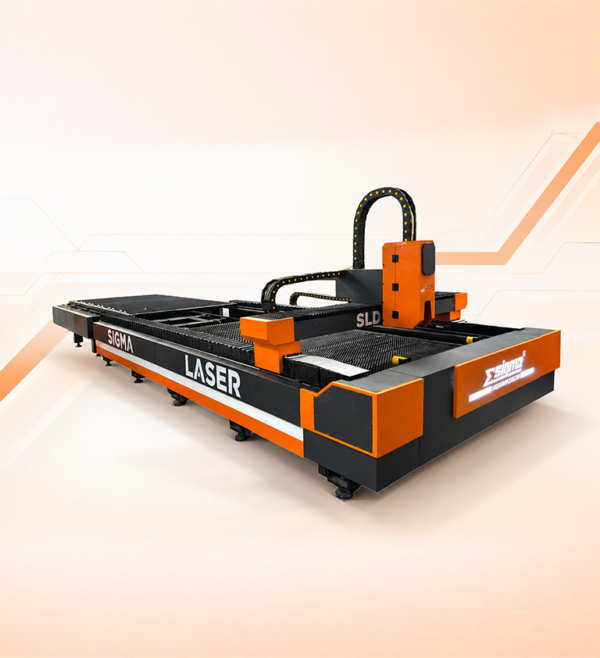
Fiber Laser Cutting Machine – Open Type with Auto Pallet Changer
Fiber Laser Cutting Machine with Auto Pallet Changer by Sigma
Mechotronics enables continuous production by loading the next sheet
while cutting is in progress.
– Power options from 1.5 kW to 20 kW
– Auto pallet changer eliminates loading downtime
– Bed sizes: 3200×1600, 4000×2000, 6000×2000, 6300×2000, 6500×2000
and 6500×2500 mm
– Standard and customized bed sizes available
– Cuts stainless steel, mild steel, aluminium and brass
Send Inquiry
Auto Pallet Changer · Double Pallet · Made in India · ISO 9001:2015 Certified
Auto Pallet Changer Fiber Laser Cutting Machine – Double Pallet, 1.5 kW to 20 kW
A laser cutting machine with an auto pallet changer runs two working beds instead of one. While the laser cuts on the pallet inside the machine, your operator loads the next sheet and strips finished parts off the second pallet outside the cutting zone – and when the program ends, the machine swaps the beds itself and starts the next cycle without waiting for anybody. The laser source, the most expensive component in the machine, keeps working through time that would otherwise be dead. Sigma Mechotronics Pvt. Ltd. manufactures this configuration from 1.5 kW to 20 kW, on six standard bed sizes from 3200 x 1600 mm up to 6500 x 2500 mm, with custom bed sizes built to a customer’s drawing. This page covers how the changer earns its cost, how to size the bed, how to select power, and what to check before you order.
- Power range
- 1.5kW-20kW
- Largest standard bed
- 6500×2500 mm
- Standard bed sizes
- 6
- Working beds
- 2 (auto swap)
The auto pallet changer – also called a double pallet or shuttle table machine – is the configuration buyers move to when the machine has stopped being a job-work tool and become a production asset. On a single bed, the cycle is cut, stop, unload, load, cut. Every minute in the middle of that sequence is a minute the laser is powered up and earning nothing. On a double pallet machine, loading and unloading happen in parallel with cutting rather than after it, so the same laser source produces more parts per shift.
That is the whole mechanism, and it is worth understanding before comparing quotes, because the size of the gain depends entirely on your job mix. A shop running repeat batches with short programs and frequent sheet changes gets the most from it. A shop running long single-sheet programs gets less, because the load and unload were already finishing well inside the cutting cycle.
Sigma Mechotronics Pvt. Ltd. manufactures this machine at its own plant in Ahmedabad, so the bed size, the power and the pallet system are specified around your work rather than pulled from a fixed catalogue. This page is written for engineers and owners specifying a double pallet machine for production: how the changer works, how to size the bed against your largest job, when a custom bed makes sense, and the mistakes that cost buyers the most after commissioning.
At a Glance
Key Takeaways
The essentials, before the detail below.
Two Beds, One Laser
Loading and unloading happen on the second pallet, outside the cutting zone, while the laser keeps cutting on the first. The machine swaps beds automatically.
Built for Repeat-Batch Volume
The gain is largest where sheet changes are frequent and programs are short – exactly the profile of production and contract cutting work.
1.5 kW to 20 kW
The full power band is available on the double pallet configuration. Bed size does not restrict which laser source you can specify.
Metals, Sheet and Plate
Mild and carbon steel, stainless steel and aluminium are the core materials, with titanium, brass and copper cut on a reflective-rated head.
Six Standard Beds, Plus Custom
3200×1600, 4000×2000, 6000×2000, 6300×2000, 6500×2000 and 6500×2500 mm, with custom bed sizes manufactured to a customer’s drawing.
Plan the Floor, Not Just the Machine
A shuttle table needs clear space at the loading end for the pallet to travel out. Confirm that against your bay before you order.
Definition
What Is an Auto Pallet Changer Laser Cutting Machine?
An auto pallet changer laser cutting machine is a fiber laser cutting machine fitted with two interchangeable working pallets and a mechanism that swaps them automatically. One pallet sits under the cutting head inside the machine; the other sits at the loading station outside it. When the cutting program on the active pallet finishes, the machine exchanges the two beds on its own and begins the next program, while the operator works on the pallet that has just come out.
It is also referred to as a double pallet machine or a shuttle table machine – the same configuration under three names. Everything about the cutting process is identical to our single pallet open type machine: the same fiber laser source across the 1.5 kW to 20 kW band, the same CNC gantry and cutting head, the same assist-gas system, the same six bed sizes, and the same materials – mild and carbon steel, stainless steel and aluminium sheet and plate. What the pallet changer adds is not cutting capability but machine utilisation.
The arithmetic is simple enough to do on your own shop floor. Time one full sheet change on your current machine, from beam off to beam on: crane or manual unload of cut parts, skeleton removal, new sheet positioning, clamping, program start. Multiply that by the number of sheet changes in a shift. On a single bed, that total is time the laser is idle. On a double pallet machine, most of it is absorbed into the cutting cycle running on the other bed. That recovered time is the entire commercial case for the configuration, and it is why the machine is specified by production shops rather than by capability alone.
How the Cycle Works
01
Cut
The laser runs the program on Pallet A inside the machine, with the cutting zone guarded and the operator clear of it.
02
Prepare in Parallel
At the same time, the operator strips finished parts and skeleton from Pallet B at the loading station and loads the next sheet.
03
Auto Swap
Program complete, the changer exchanges the two pallets automatically – no crane call, no operator waiting on the machine.
04
Cut Again Immediately
The next program starts on the freshly loaded bed while the cut parts are unloaded outside. The laser stays productive.
The Commercial Case
Where an Auto Pallet Changer Pays Back Fastest
The pallet changer converts idle time into cutting time. How much it converts depends on your job mix – so it is worth checking your own numbers against this before you specify.
| Your Work Profile | What the Changer Recovers |
|---|---|
| Repeat batches, frequent sheet changes | The largest gain. Short programs mean many sheet changes per shift, and every one of them is idle time on a single bed. |
| Contract and job-work cutting at volume | Strong gain. Where you sell machine hours, converting idle minutes into cut parts goes straight to output per shift. |
| Multi-shift running | Compounding gain. Recovered minutes multiply across every shift, every day the machine is on the floor. |
| Heavy plate, slow programs | Smaller gain per cycle, because load and unload already finish inside a long cutting cycle – but it also removes the operator from the machine’s critical path. |
| Highly variable one-off work | Smallest gain. Long, unique setups per job eat into the overlap, so time your own setups before assuming the full benefit. |
Do this before you specify – stopwatch one full sheet change on your existing machine and compare it against your typical cutting cycle. If the sheet change is a meaningful share of the cycle, the pallet changer recovers most of it on every sheet. If it already finishes well inside the cutting cycle, size your expectation accordingly and put the budget into power or bed size instead. Either way, the number should come from your floor, not from a brochure.
Standard & Custom
Bed Sizes: Six Standard Options, Plus Custom Beds Built to Order
Sigma Mechotronics Pvt. Ltd. manufactures the auto pallet changer in six standard bed sizes and also builds custom bed sizes to a customer’s drawing. Both pallets are the same size, so the bed dimension you choose applies to each of the two beds.
Standard Bed Sizes
| Bed Size (mm) | Typically Suits | Practical Note |
|---|---|---|
| 3200 x 1600 | Smaller batch production, panel and enclosure work, compact shop floors | The compact option. Takes the widely used 3000 x 1500 mm plate format with margin at every edge, and needs the least shuttle travel space. |
| 4000 x 2000 | General sheet metal production – the most common all-round choice | Takes standard 4 ft x 8 ft sheet comfortably. On repeat-batch work this size and the pallet changer are the classic pairing. |
| 6000 x 2000 | Long structural parts, ducting, chassis rails, larger panel work | The entry point into 6 metre work, and where the pallet changer starts to matter most – large sheets are slower to handle manually. |
| 6300 x 2000 | 6 metre stock where end clamping or nesting margin is tight | The extra 300 mm is working margin, not extra capacity – useful when your parts genuinely run the full 6 metres. |
| 6500 x 2000 | Long-format production with generous nesting allowance | More length at the same 2000 mm width. Chosen where sheet is fed long and nested tightly to cut scrap. |
| 6500 x 2500 | Heavy fabrication, wide plate, the largest work in the standard range | The maximum standard bed. Specify it where your width requirement genuinely exceeds 2000 mm – it also asks the most of your floor plan. |
How to read this table – the bed dimension is the machine’s working envelope, not a sheet size. Your usable cutting area is the bed minus the clamping, edge margin and nesting allowance your parts need. Size against your largest regular job rather than your average one – a machine sized for typical work becomes a bottleneck the first time an oversized order arrives.
Custom Bed Sizes
Where none of the six standard beds suits the work or the building, Sigma Mechotronics Pvt. Ltd. manufactures the auto pallet changer to a customer-specified bed size. This is a build-to-drawing job rather than a catalogue variant, so the specification and the pallet travel are agreed before manufacture.
| When a Custom Bed Is Justified | Why the Standard Range Falls Short |
|---|---|
| Your part length or width sits between two standard sizes | Stepping up a full size buys capacity you never use and pays for it in floor area and machine cost for the machine’s whole life. |
| The building, not the work, sets the limit | Bay width, column spacing, shutter opening or crane path can rule out a standard footprint – and a shuttle table needs travel clearance at the loading end on top of the machine body. |
| The machine sits inside an existing production line | Where fixed upstream and downstream equipment feeds the machine, the bed and the pallet station have to match that flow rather than the reverse. |
| You cut one dominant blank format at volume | A bed sized around one repeating blank cuts nesting waste and handling time on every single cycle, which compounds fastest on a machine that is already built for volume. |
What to send us for a custom bed – your largest and smallest regular part dimensions, your typical incoming sheet or plate size, material and thickness range, and a shop-floor drawing showing available space including crane access and the clear length at the loading end. That is enough for our engineering team to confirm whether a standard bed already covers you or a custom build is genuinely warranted.
1.5 kW to 20 kW
How to Select Laser Power
Power is decided by material, thickness and the cutting speed you need – not by bed size and not by budget. The pallet changer has no bearing on power selection: the same 1.5 kW to 20 kW range is available on the double pallet configuration as on our other open type machines.
| Power Band | Generally Suits | Where It Struggles |
|---|---|---|
| 1.5 kW – 3 kW | Thin to medium gauge sheet, panel and enclosure work, lower-volume batch production | Thick plate, and any job where cycle time on medium plate is the bottleneck |
| 4 kW – 8 kW | The broad production middle – mixed sheet and medium plate at commercial speed | Heavy structural plate at high throughput |
| 10 kW – 20 kW | Thick plate, structural steel and high-speed thick-section cutting at volume | Nothing capability-wise – it is capital and running cost, so buy it where thickness or throughput demands it |
Power is also the one specification that has to account for what the installation around the machine can support – connected electrical load, chiller and cooling capacity, assist gas consumption and supply arrangement, and extraction sizing all scale with the laser source you choose. Our engineering team works through those points with you before quoting, so the machine that arrives suits the plant it has to run in.
Expert note on assist gas and reflective metals – oxygen gives the most economical cut on mild steel, nitrogen gives a clean, oxide-free edge on stainless steel and aluminium at higher gas cost, and compressed air suits thinner gauge work. Aluminium, brass and copper are highly reflective at the fiber wavelength, so confirm your cutting head is back-reflection protected before running these regularly. Exact cutting thickness and speed depend on material grade, gas and configuration – treat the table above as a starting reference and ask us for a material-specific recommendation.
The Range
How This Machine Sits Against Our Other Cutting Configurations
The Sigma Mechotronics Pvt. Ltd. fiber laser cutting machine range shares the same power band across configurations. What separates them is body type, automation and the stock format each one is built to hold.
| Configuration | Body & Automation | Built For |
|---|---|---|
| Auto Pallet Changer | Open type, two beds, automatic pallet swap | Repeat-batch and volume production where machine utilisation drives cost per part |
| Single Pallet | Open type, one bed, manual load/unload | Mixed-batch job shops and crane-loaded awkward stock |
| Close Body | Fully enclosed cabin, manual load/unload | Shared floors where beam and fume containment are the priority |
| Flat Bed + Pipe Attachment | Flat bed with tube and pipe cutting attachment | Flat sheet plus occasional to moderate tube and pipe work on one machine |
| Dedicated Tube Cutting | Chuck-fed, for 3 metre and 6 metre lengths | Volume tube, pipe and profile fabrication – this one does not cut flat sheet |
Four Checks
How to Specify the Right Double Pallet Machine
Work through these in order. Each narrows the specification, and taking them out of order is how buyers end up with a machine that fits the brochure but not the floor.
- 1
Measure Your Sheet Change Against Your Cutting Cycle
This one number sets your expectation for the whole machine. Time a full sheet change on your current setup and compare it with a typical program run time. The bigger that ratio, the more the pallet changer recovers on every cycle, and the faster it pays for itself.
- 2
Size the Bed Against Your Largest Regular Job
Not your average job. Leave margin for clamping and nesting, and remember both pallets carry the same size. If your requirement falls between two standard beds, ask about a custom bed rather than defaulting upward and paying for capacity you will not use.
- 3
Set Power From Material and Thickness
Decide the thickest material you must cut and the speed you need on your highest-volume thickness. Those two numbers set the power band. Under-specifying to afford another option usually costs more in cycle time over the machine’s life than it saved at purchase.
- 4
Plan the Floor for a Shuttle, Not a Box
A double pallet machine needs clear travel space at the loading end for the pallet to come fully out, plus operator working room around that station, the control cabinet, the chiller and the extraction run. Confirm this against your bay drawing before you sign, not at commissioning.
Avoid These Buying Mistakes
6 Mistakes Buyers Make on a Pallet Changer Machine
1
Planning floor space around the machine body alone. The pallet has to travel fully out of the machine to be loaded. Space that works on paper for a single bed can leave you unable to use the changer at all.
2
Buying the changer but keeping single-bed working habits. The gain only appears if the second pallet is being loaded during the cut. If the operator waits for the swap before starting work, you have paid for automation you are not using.
3
Under-specifying power to afford the changer. These are separate decisions. A machine that cuts too slowly for your thickness does not become faster because the beds swap automatically.
4
Sizing the bed for today’s largest job rather than the next two years. The pallet changer is bought by shops whose volume is growing. Size the bed for where that growth is heading, since the bed is the one thing you cannot upgrade later.
5
Treating fume extraction as an accessory. Extraction sized for your material – and particularly for coated, painted or galvanised stock – is part of the specification. An open type machine also needs a demarcated, guarded safety zone around the working area.
6
Comparing quotes on machine price alone. A lower-priced machine without India-based spares, service engineers and a real warranty is not a saving the first time it stops – and on a production machine, downtime costs more per hour than on a job-work machine.
Where It Is Used
Industries and Applications
The double pallet configuration is specified wherever cut parts per shift, rather than machine capability alone, is what the operation is measured on.
- Sheet Metal & General Fabrication
- Automotive & Auto-Ancillary
- Contract & Job-Work Laser Cutting Units
- Electrical Panel & Switchgear
- Structural Steel Fabrication
- Agricultural Equipment Manufacturing
- Pump, Valve & Industrial Engineering
- Elevator, Racking & Storage Systems
- Stainless Steel Furniture & Kitchen Equipment
- Defence & Aerospace Components
Typical output covers the full range of flat-sheet fabrication work: brackets, mounting and base plates, machine frames, panel and enclosure blanks, gears, discs, gaskets and profile-cut components in mild and carbon steel, stainless steel and aluminium, with titanium, brass and copper also cut where the head is rated for reflective material. Fiber laser is the correct technology for these metals and is not the right cutting technology for plastics, rubber, wood or glass – for plastic sheet, a CO2 laser cutter is the correct machine.
Keeping It Running
Maintenance and Safety in Practice
A double pallet machine carries everything a single bed machine needs, plus the changer mechanism itself – which is the part most often left off a maintenance schedule.
| Routine Task | Typical Frequency |
|---|---|
| Protective window and lens cleaning, nozzle check and replacement | Daily to weekly, depending on usage |
| Pallet changer mechanism inspection – drive, guides, stops and sensors | Scheduled, per machine manual – this is the moving system a single bed machine does not have |
| Pallet slat and dross tray cleaning on both beds | Regular – build-up affects sheet seating and swap alignment |
| Rail and guide lubrication | Per machine manual schedule |
| Extraction and filter check | Regular, and sized for the material being cut |
| Chiller and cooling system check, full technical inspection | Cooling regularly, especially before multi-shift runs; inspection annually |
Safety, in practice: this is an open type machine, so the working area needs a demarcated and guarded safety zone with wavelength-rated eye protection, since the beam is not contained by a housing. The pallet changer adds a second consideration – the loading station is a moving-machinery zone, so the swap sequence must be clear of people and stock every cycle, and the machine’s interlocks and guards exist to enforce that. Interlocks are never to be bypassed for convenience, including during setup. Consumables in normal operation are assist gas, nozzles and protective windows.
Manufacturer, Not Trader
Why Buy the Auto Pallet Changer From Sigma Mechotronics Pvt. Ltd.
Building our own machines shows in how they are engineered, how they hold up under Indian production conditions, and how they are supported for as long as they are on your floor.
Built in India, Including Custom Beds
Because the machine is manufactured at our own Ahmedabad plant rather than imported and rebadged, a custom bed size is an engineering conversation with the people who build the machine – not a change request routed through an overseas supplier.
ISO 9001:2015 Certified, MSME Registered
Sigma Mechotronics Pvt. Ltd. is a registered Indian private limited company, GST registered, ISO 9001:2015 certified and MSME registered. Every purchase comes with a proper GST tax invoice under your GSTIN for ITC claims and capital equipment accounting.
2-Year Warranty, Spares Held in India
A 2-year warranty covers manufacturing defects in the machine body, laser delivery system, control electronics and motion system – including the pallet changer mechanism. Critical spares are held locally rather than ordered on an international shipping cycle, which matters most on a machine bought for uptime.
Consultation, Installation and Training
We confirm the specification against your material, part sizes and shop drawing before you order, then install and commission the machine at your premises, set parameters for your material, and train your operators to work the two-pallet cycle properly – which is what turns the changer into actual output.
Straight Answers
Frequently Asked Questions
The questions manufacturers ask most before ordering an auto pallet changer laser cutting machine.
It is a mechanism that runs two working beds and exchanges them automatically. While the laser cuts on the pallet inside the machine, the operator unloads finished parts and loads the next sheet on the second pallet at the loading station outside. When the program finishes, the machine swaps the two beds itself and starts cutting again, so loading happens in parallel with cutting instead of after it. Sigma Mechotronics Pvt. Ltd. builds this configuration from 1.5 kW to 20 kW.
Yes. Double pallet, auto pallet changer and shuttle table all describe the same configuration – a machine with two interchangeable beds and an automatic swap mechanism. The terms are used interchangeably across the industry, so a quotation headed any of the three is describing this machine.
It depends on your job mix, and the honest way to find out is to measure it on your own floor. Time one full sheet change – unload, skeleton removal, new sheet positioning, clamping, restart – and compare it with a typical program run time. The changer recovers most of that sheet-change time on every cycle, so shops running short programs with frequent sheet changes gain the most, and shops running long single-sheet programs gain less. Multiply the recovered time by sheet changes per shift to get a figure that means something for your operation.
No. The laser source, cutting head, motion system and assist-gas system are the same as on our other open type machines, so material range, thickness capability and edge quality are unchanged. Cut quality is set by power, assist gas, nozzle condition and parameter setting. The pallet changer affects how much of the shift the machine spends cutting, not how it cuts.
Choose against your largest regular part rather than your average one, leaving margin for clamping and nesting – and note that both pallets are the same size. As a guide: 3200 x 1600 mm for compact floors and panel work, 4000 x 2000 mm as the common all-round production size, 6000 x 2000 mm and 6300 x 2000 mm for long-format parts, 6500 x 2000 mm where nesting allowance on 6 metre stock is tight, and 6500 x 2500 mm where your width requirement genuinely exceeds 2000 mm.
Yes. Sigma Mechotronics Pvt. Ltd. manufactures the auto pallet changer in customer-specified bed sizes as well as the six standard ones. A custom bed makes sense when your requirement falls between two standard sizes, when the building rather than the work sets the limit, when the machine has to fit an existing production line, or when one dominant blank format would cut nesting waste on every cycle. Send your part dimensions, material and thickness range, and a shop-floor drawing with clearances, and our engineering team will confirm the right build.
More than the machine body, and in a specific direction: the pallet has to travel fully out of the machine at the loading end, so you need clear length there plus operator working room around that station. Add the demarcated safety zone an open type machine requires, the control cabinet, the chiller unit and the extraction ducting run. We confirm exact footprint and clearance against your shop drawing during the pre-order consultation, since it varies by bed size.
Mild and carbon steel, stainless steel and aluminium sheet and plate are the core materials, with titanium, brass and copper also cut – the last two being highly reflective at the fiber wavelength, so a back-reflection protected cutting head should be confirmed if you run them regularly. Fiber laser is not the correct cutting technology for plastics, rubber, wood, leather or glass; for plastic sheet, a CO2 laser cutter is the right machine.
The changer adds one system to the schedule: the swap mechanism itself – its drive, guides, stops and position sensors – inspected per the machine manual, plus slat and dross tray cleaning on both beds rather than one, since build-up affects how the sheet seats and how the pallets align on the swap. Everything else is standard fiber laser maintenance: lens and nozzle checks, rail lubrication, extraction and filter checks, cooling system checks and an annual technical inspection.
Price depends on laser power, bed size, whether the bed is standard or custom, and the options specified with the machine – a 1.5 kW machine on a 3200 x 1600 mm bed and a 20 kW machine on a 6500 x 2500 mm bed sit at very different points in the same range. We quote against a confirmed specification rather than publishing a fixed figure, because an incorrectly specified machine is a poor investment at any price. Send your material, thickness, part sizes and required power for a detailed quotation, and mention if you need multi-machine pricing.
A 2-year warranty covering manufacturing defects in the machine body, laser delivery system, control electronics, motion system and pallet changer mechanism, handled directly by Sigma Mechotronics Pvt. Ltd. rather than through an agent or overseas supplier. Installation and commissioning at your premises, parameter setting for your material and operator training are part of the supply, and spares are held in India. Every purchase comes with a GST tax invoice under your GSTIN.
Yes, and where edge quality on a specific grade or thickness decides the purchase, we recommend it. A sample trial on your actual material and thickness is the most reliable way to confirm the machine meets your specification before committing capital. Facility visits to our Ahmedabad plant are welcome by appointment – contact us with your material, thickness and required outcome to arrange one.
The Full Range
Related Machines From Sigma Mechotronics Pvt. Ltd.
Get a Double Pallet Machine Specified for Your Production
Send us your material and thickness range, your largest and smallest regular part size, your sheet changes per shift, and a drawing of the space the machine has to fit into. Our team will confirm the right power, the right standard bed – or whether a custom bed is the better answer – and come back with a specification and quotation built around your actual work.
Reviews
There are no reviews yet.