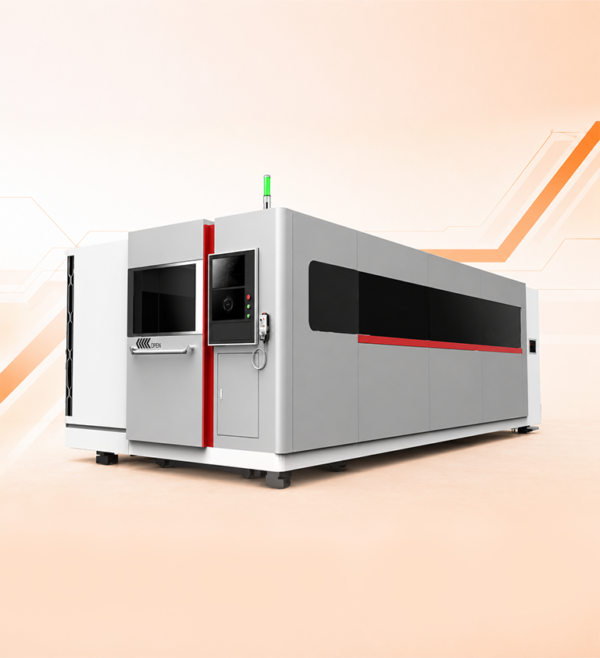
Close Body Laser Cutting Machine
Closed Body Laser Cutting Machine by Sigma Mechotronics is a fully
enclosed fiber laser cutting system designed for safe, high-precision
sheet metal cutting.
– Fully enclosed cabin for operator safety and laser containment
– Integrated dust and fume extraction
– Cuts stainless steel, mild steel, aluminium and brass
– Suitable for continuous production environments
Send Inquiry
Close Type Body · Fully Enclosed Cabin · Made in India · ISO 9001:2015 Certified
Close Body Fiber Laser Cutting Machine – Fully Enclosed Cabin, 1.5 kW to 20 kW
A close body laser cutting machine is a fiber laser cutting machine whose bed, gantry and cutting head sit inside a fully enclosed cabin with a viewing window and interlocked access doors, so the beam, the cutting fume and the dust stay inside the machine instead of on your shop floor. Sigma Mechotronics manufactures this configuration from 1.5 kW to 20 kW, on six standard bed sizes from 3200 x 1600 mm up to 6500 x 2500 mm, with custom bed sizes built to a customer’s drawing. It cuts exactly what our open type machines cut – mild steel, stainless steel and aluminium sheet and plate – so this configuration is chosen for the enclosure, not for a difference in cutting capability. This page covers what the enclosure changes, how to pick a bed size, when a custom bed is justified, and what to check before you order.
- Power range
- 1.5kW-20kW
- Standard bed sizes
- 6
- Largest standard bed
- 6500×2500 mm
- Body type
- Fully enclosed
The close type body is the configuration buyers move to when the shop floor around the machine matters as much as the machine itself. On an open type bed, the beam is contained by a demarcated safety perimeter and the operating discipline of the people working near it. On a close type body, it is contained by the machine housing and its interlocks, which is a different level of protection and one that is easier to demonstrate to a safety auditor or an insurer.
The same logic applies to fume and dust. Cutting generates particulate at the kerf, and the amount rises sharply on coated, galvanised or painted stock. An enclosure keeps that plume inside a defined volume, so it can be ducted to a single extraction point rather than drifting across adjacent workstations. On a multi-operator floor, that is often the deciding factor rather than beam safety.
Sigma manufactures fiber laser machines at its own plant in Ahmedabad. This page is written for engineers and owners specifying a close body machine for production use: what the enclosure genuinely changes, how the six standard bed sizes map to real stock sizes, when a custom bed is worth building, how to select power between 1.5 kW and 20 kW, and the mistakes that cost buyers the most after commissioning.
At a Glance
Key Takeaways
The essentials, before the detail below.
Chosen for the Enclosure
Cutting capability matches Sigma’s open type machines exactly. What you are buying is beam containment, fume containment and a quieter, cleaner working area.
1.5 kW to 20 kW
The full power band is available in the close type body – the enclosure does not limit which laser source you can specify.
Six Standard Bed Sizes
3200×1600, 4000×2000, 6000×2000, 6300×2000, 6500×2000 and 6500×2500 mm, sized around commonly available sheet and plate stock.
Custom Beds Built to Drawing
Where a standard bed does not suit the part or the floor space, Sigma manufactures the close type body to a customer-specified bed size.
The Door Is the Constraint
The enclosure that protects your operators also decides how large and how awkward your loadable stock can be. Check this before you order.
ISO Certified, 2-Year Warranty
Manufactured in Ahmedabad, ISO 9001:2015 certified and MSME registered, with a 2-year warranty and spares held in India.
Definition
What Is a Close Body Laser Cutting Machine?
A close body laser cutting machine is a fiber laser cutting machine in which the working bed, the gantry and the cutting head are housed inside a sealed cabin fitted with a viewing window and interlocked access doors. The interlocks stop the beam firing whenever an access point is opened, so the laser radiation is confined by the machine housing rather than by a safety perimeter marked out on the floor around it.
Everything below the enclosure is the same machine as an open type. The same fiber laser source in the 1.5 kW to 20 kW band, the same CNC-controlled gantry and cutting head, the same assist-gas system, the same bed sizes. It cuts mild steel, stainless steel and aluminium sheet and plate, producing the same range of work an open type machine does – structural brackets, mounting plates, machine bases, enclosures, discs, gears and profile-cut components. Nobody should buy this configuration expecting it to cut thicker material or hold a tighter profile than the open type equivalent, because it will not.
What changes is the environment around the cut. Three things happen once the process is inside a cabin: operator beam-exposure risk drops, because the beam has a physical barrier rather than a procedural one; cutting fume and particulate stay in a contained volume and can be ducted from a single extraction point; and the noise of the cut and the assist gas is partly damped by the housing. Against that, material has to pass through an access door instead of being craned in over an open bed, and the machine costs more than an equivalent single pallet open type.
What the Enclosure Actually Changes
01
Beam Containment
Interlocked doors and a filtered viewing window keep the beam inside the housing, generally corresponding to a Class 1 enclosed laser safety configuration.
02
Fume Containment
Cutting fume and dust are held in a defined volume and ducted to one extraction point instead of dispersing across the shop floor.
03
Access Discipline
Stock is loaded through a defined door opening, which makes the process repeatable but limits oversized or awkwardly shaped material.
04
Floor Layout
The safety zone that surrounds an open bed is replaced by the machine footprint plus door-swing and loading clearance.
Standard & Custom
Bed Sizes: Six Standard Options, Plus Custom Beds Built to Order
Sigma manufactures the close type body in six standard bed sizes, and also builds custom bed sizes to a customer’s drawing. Bed size is the specification most often got wrong, because buyers size the machine for the job they run every day rather than the largest job they have to accept.
Standard Bed Sizes
| Bed Size (mm) | Typically Suits | Practical Note |
|---|---|---|
| 3200 x 1600 | Smaller job work, panel and enclosure fabrication, workshops with limited floor area | The compact option. Comfortable for the widely used 3000 x 1500 mm plate format with margin at every edge. |
| 4000 x 2000 | General sheet metal fabrication, the most common all-round choice | Takes standard 4 ft x 8 ft sheet comfortably and handles most everyday fabrication work without oversizing the machine. |
| 6000 x 2000 | Long structural parts, ducting, chassis rails, larger panel work | The entry point into 6 metre work. Suits shops whose length requirement exceeds their width requirement. |
| 6300 x 2000 | 6 metre stock where end clamping or nesting margin is tight | The extra 300 mm of length is working margin, not extra capacity – useful when your parts run the full 6 metres. |
| 6500 x 2000 | Long-format production with generous nesting allowance | More length again at the same 2000 mm width. Chosen where sheet is fed long and nested tightly. |
| 6500 x 2500 | Heavy fabrication, wide plate, the largest work in the standard range | The maximum standard bed. Specify this only if your width requirement genuinely exceeds 2000 mm – it costs floor space you cannot get back. |
How to read this table – the bed dimension is the machine’s working envelope, not a sheet size. Your usable cutting area is the bed minus whatever clamping, edge margin and nesting allowance your parts need. If your largest regular part is close to a bed’s stated dimension, move up one size rather than working at the very edge of the envelope on every job.
Custom Bed Sizes
Where none of the six standard beds fits the work or the building, Sigma manufactures the close type body machine to a customer-specified bed size. This is a build-to-drawing job, not a catalogue variant, so the specification is agreed before manufacture rather than selected from a list.
| When a Custom Bed Is Justified | Why the Standard Range Falls Short |
|---|---|
| Your part length or width sits between two standard sizes | Moving up a full size buys capacity you never use, and pays for it in floor area and machine cost for the life of the machine. |
| The building, not the work, sets the limit | Column spacing, a bay width, a shutter opening or a crane path can rule out a standard footprint even when the bed size itself is right. |
| The machine has to sit in an existing production line | Where the machine feeds or is fed by fixed upstream and downstream equipment, the bed has to match that flow rather than the other way round. |
| You cut one dominant part format at volume | A bed sized around a single repeating blank size cuts nesting waste and handling time on every shift, which compounds over years. |
What to send us for a custom bed – your largest and smallest regular part dimensions, your typical incoming sheet or plate size, material and thickness range, and a shop-floor drawing showing available space including crane and door clearance. That is enough for our engineering team to confirm whether a standard bed already covers you or a custom build is genuinely warranted.
1.5 kW to 20 kW
How to Select Power for a Close Body Machine
Power is decided by material, thickness and required cutting speed – not by bed size and not by budget. The enclosure has no bearing on power selection: the same 1.5 kW to 20 kW range is available in the close type body as in Sigma’s open type machines.
| Power Band | Generally Suits | Where It Struggles |
|---|---|---|
| 1.5 kW – 3 kW | Thin to medium gauge sheet, panel and enclosure work, lower-volume job shops | Thick plate, and any job where cycle time on medium plate is the bottleneck |
| 4 kW – 8 kW | The broad production middle – mixed sheet and medium plate at commercial speed | Heavy structural plate at high throughput |
| 10 kW – 20 kW | Thick plate, structural steel, high-speed thick-section cutting at volume | Nothing capability-wise, but it is capital and running cost you should only buy if thickness or throughput demands it |
Expert note on assist gas and reflective metals – oxygen gives the most economical cut on mild steel, nitrogen gives a clean, oxide-free edge on stainless steel and aluminium at higher gas cost, and compressed air suits thinner gauge work. Aluminium, brass and copper are highly reflective at the fiber wavelength – confirm your cutting head is back-reflection protected before running these materials regularly. Exact cutting thickness and speed depend on material grade, gas and configuration, so treat the table above as a starting reference and ask us for a material-specific recommendation.
Configuration Choice
Close Type Body vs. Open Type Cutting Machines
Sigma’s fiber laser cutting machine range covers the same power band across every configuration. What separates them is body type, automation and stock format.
| Configuration | Body & Automation | Best For |
|---|---|---|
| Close Type Body | Fully enclosed cabin, manual load/unload | Multi-operator floors where beam safety and fume containment are the priority |
| Single Pallet | Open type, one bed, manual load/unload | Mixed-batch job shops that crane-load large or awkward stock |
| Auto Pallet Changer | Open type, two beds, automatic pallet swap | Repeat-batch production where idle load/unload time is the cost driver |
| Flat Bed + Pipe Attachment | Flat bed with tube and pipe cutting attachment | Shops needing flat sheet plus occasional to moderate tube work |
| Dedicated Tube Cutting | Chuck-fed, for 3 metre and 6 metre lengths | Volume tube, pipe and profile fabrication – cannot cut flat sheet |
Four Checks
How to Choose the Right Close Body Machine
Work through these in order. Each one narrows the specification, and taking them out of order is how buyers end up with a machine that fits the brochure but not the floor.
- 1
Confirm the Enclosure Is Genuinely What You Need
Ask what the enclosure is solving: operator beam exposure on a shared floor, fume from coated or galvanised stock, an internal safety policy, or an insurer’s requirement. If none of these apply, an open type machine at the same power and bed size does the same cutting work for less.
- 2
Size the Bed Against Your Largest Regular Job
Not your average job. A bed sized for typical work becomes a bottleneck the first time an oversized order arrives, and turning that work away costs more than the size step would have. If your requirement falls between two standard beds, ask about a custom bed rather than defaulting upward.
- 3
Set Power From Material and Thickness
Decide the thickest material you must cut and the speed you need on your highest-volume thickness. Those two numbers set the power band. Under-specifying to save capital cost usually costs more in cycle time over the machine’s life than it saved at purchase.
- 4
Check Access, Extraction and Floor Layout Before You Sign
Confirm the access door opening against your largest regular sheet, the machine footprint plus door-swing clearance against your available bay, and how the enclosure’s extraction will connect to your existing ducting. These are the details that turn into site problems at commissioning if they are left until then.
Avoid These Buying Mistakes
6 Mistakes Buyers Make on a Close Body Machine
1
Ordering the bed size without checking the door opening. A 6500 x 2500 mm bed is only useful if your stock can physically reach it. The enclosure that protects your operators is the same enclosure that limits what you can load.
2
Expecting the enclosure to improve cut quality. It does not. Edge quality is set by power, assist gas, nozzle condition and parameters – the same on an open bed as inside a cabin.
3
Planning floor space around the bed dimension alone. Budget for the machine footprint plus door swing, loading and unloading clearance, the control cabinet, the chiller and the extraction ducting run.
4
Treating fume extraction as an optional add-on. An enclosure concentrates the fume rather than removing it. Extraction sized for your material and coating is part of the specification, not an accessory to shop around for afterwards.
5
Assuming a custom bed is always the answer. A standard size that is slightly larger than your requirement is usually the faster and more economical route. A custom bed is justified when the building, the line or a dominant part format genuinely rules the standard range out.
6
Comparing quotes on machine price alone. A lower-priced machine without India-based spares, service engineers and a real warranty is not a saving the first time it stops. Check what happens after the invoice before comparing the numbers on it.
Where It Is Used
Industries and Applications
The close type body suits any operation cutting sheet or plate where the working environment around the machine has to be controlled – typically shared production floors and facilities with a formal safety policy.
- Sheet Metal & General Fabrication
- Automotive & Auto-Ancillary
- Electrical Panel & Switchgear
- Structural Steel Fabrication
- Agricultural Equipment Manufacturing
- Pump, Valve & Industrial Engineering
- Stainless Steel Furniture & Kitchen Equipment
- Elevator & Storage Systems
- Defence & Aerospace Components
- Contract Job Work & Laser Cutting Service Units
Typical output is the same broad fabrication work an open type machine produces: brackets, mounting and base plates, machine frames, panel and enclosure blanks, gears, discs, gaskets and profile-cut components in mild steel, stainless steel and aluminium. Fiber laser is the correct technology for these metals and is not the right cutting technology for plastics, rubber, wood or glass – for plastic sheet specifically, a CO2 laser cutter is the correct machine.
Keeping It Running
Maintenance and Safety in Practice
| Routine Task | Typical Frequency |
|---|---|
| Protective window and lens cleaning, nozzle check and replacement | Daily to weekly, depending on usage |
| Viewing window and enclosure panel inspection | Periodic – a scratched or damaged window is a safety item, not cosmetic |
| Door interlock function test | Regular – the interlock is the enclosure’s primary protection |
| Rail and guide lubrication | Per machine manual schedule |
| Extraction and filter check, slat and dross tray cleaning | Regular – an enclosure concentrates what extraction has to remove |
| Chiller and cooling system check, full technical inspection | Cooling regularly, especially before multi-shift runs; inspection annually |
Safety, in practice: the interlocks exist to stop the beam firing during an unsafe condition and are never to be bypassed for convenience, including during setup or troubleshooting. The enclosure reduces the demarcated safety zone an open bed requires, but it does not remove the need for wavelength-rated eye protection where the machine is opened for maintenance, or for fume extraction appropriate to the material being cut. Consumables in normal operation are assist gas, nozzles and protective windows.
Manufacturer, Not Trader
Why Buy the Close Body Machine From Sigma
Building our own machines shows in how they are engineered, how they hold up under Indian production conditions, and how they are supported for as long as they are on your floor.
Built in India, Including Custom Beds
Because the machine is manufactured at our own Ahmedabad plant rather than imported and rebadged, a custom bed size is an engineering conversation with the people who build the machine – not a change request routed through an overseas supplier.
ISO 9001:2015 Certified, MSME Registered
Sigma Mechotronics Pvt. Ltd. is a registered Indian private limited company, GST registered, ISO 9001:2015 certified and MSME registered. Every purchase comes with a proper GST tax invoice under your GSTIN for ITC claims and capital equipment accounting.
2-Year Warranty, Spares Held in India
A 2-year warranty covers manufacturing defects in the machine body, laser delivery system, control electronics and motion system. Critical spares – lenses, cutting heads, control boards – are held locally rather than ordered on an international shipping cycle.
Consultation, Installation and Training
We confirm the specification against your material, part sizes and shop drawing before you order, then install and commission the machine at your premises, set parameters for your material, and train your operators before handover.
Straight Answers
Frequently Asked Questions
The questions manufacturers ask most before ordering a close body laser cutting machine.
It is a fiber laser cutting machine whose bed, gantry and cutting head are housed inside a fully enclosed cabin with a viewing window and interlocked access doors, so the beam and the cutting fume are contained by the machine housing rather than by a safety perimeter around an open bed. Sigma manufactures it from 1.5 kW to 20 kW on six standard bed sizes from 3200 x 1600 mm to 6500 x 2500 mm, and in custom bed sizes to a customer’s drawing.
No. At the same power and bed size, the two configurations cut the same materials to the same quality, because the laser source, cutting head, motion system and assist-gas system are identical. Cut quality is decided by power, assist gas, nozzle condition and parameter setting. The close type body is chosen for beam containment, fume containment and a cleaner working area – not for cutting performance.
Choose against your largest regular part, not your average one, and leave margin for clamping and nesting. As a rough guide: 3200 x 1600 mm for compact workshops and panel work, 4000 x 2000 mm as the common all-round fabrication size, 6000 x 2000 mm and 6300 x 2000 mm for long-format parts, 6500 x 2000 mm where nesting allowance on 6 metre stock is tight, and 6500 x 2500 mm only where your width requirement genuinely exceeds 2000 mm.
Yes. Sigma manufactures the close type body in customer-specified bed sizes as well as the six standard ones. A custom bed makes sense when your requirement falls between two standard sizes, when the building rather than the work sets the limit, when the machine has to fit an existing production line, or when one dominant part format would cut nesting waste on every shift. Send your part dimensions, material and thickness range, and a shop-floor drawing with clearances, and our engineering team will confirm whether a custom build is warranted or a standard bed already covers you.
Power follows the thickest material you must cut and the speed you need on your highest-volume thickness. Broadly, 1.5 kW to 3 kW suits thin and medium gauge sheet and lower-volume job work, 4 kW to 8 kW covers the general production middle across sheet and medium plate, and 10 kW to 20 kW is for thick plate and high-speed thick-section cutting at volume. Exact thickness and speed vary with material grade, assist gas and finish, so confirm your specific requirement with our applications team rather than working from a general band alone.
Yes, and this is the main practical trade-off against an open type machine. Stock has to pass through the access door rather than being craned in over an open bed, so oversized, awkwardly shaped or very heavy material can be harder to load. Check the door opening against your largest regular sheet before ordering. If a significant share of your work is oversized or crane-loaded, the open type single pallet configuration is likely the better fit.
Yes. The enclosure concentrates cutting fume and dust into a contained volume rather than eliminating it, which is exactly what makes it easier to extract from a single point. Extraction sized for your material – and particularly for coated, painted or galvanised stock, which produces significantly more fume – is part of the machine specification, not an optional accessory. We confirm the extraction requirement with you during the pre-order technical consultation.
Mild and carbon steel, stainless steel and aluminium sheet and plate are the core materials, with titanium, brass and copper also cut – the last two being highly reflective at the fiber wavelength, so a back-reflection protected cutting head should be confirmed if you run them regularly. Fiber laser is not the correct cutting technology for plastics, rubber, wood, leather or glass; for plastic sheet, a CO2 laser cutter is the right machine.
Budget for meaningfully more than the bed dimension: the enclosure footprint, clearance for the access door swing, loading and unloading space, the control cabinet, the chiller unit and the extraction ducting run. The demarcated safety zone an open bed needs is reduced, but the machine’s own service and access clearances are not. We confirm exact footprint and clearance against your shop drawing as part of the pre-order consultation, since it varies by bed size.
Price depends on laser power, bed size, whether the bed is standard or custom, and the options specified with the machine – a 1.5 kW machine on a 3200 x 1600 mm bed and a 20 kW machine on a 6500 x 2500 mm bed sit at very different points in the same range. We quote against a confirmed specification rather than publishing a fixed figure, because an incorrectly specified machine is a poor investment at any price. Send your material, thickness, part sizes and required power for a detailed quotation, and mention if you need bulk or multi-machine pricing.
A 2-year warranty covering manufacturing defects in the machine body, laser delivery system, control electronics and motion system, handled directly by Sigma rather than through an agent or overseas supplier. Installation and commissioning at your premises, parameter setting for your material and operator training are part of the supply, and spares are held in India. Every purchase comes with a GST tax invoice under your GSTIN.
Yes, and where edge quality on a specific grade or thickness is critical to your decision, we recommend it. A sample trial on your actual material and thickness is the most reliable way to confirm the machine meets your specification before committing capital. Facility visits to our Ahmedabad plant are welcome by appointment – contact us with your material, thickness and required outcome to arrange one.
The Full Range
Related Machines From Sigma Mechotronics
Get a Close Body Machine Specified for Your Floor
Send us your material and thickness range, your largest and smallest regular part size, and a drawing of the space the machine has to fit into. Our team will confirm the right power, the right standard bed – or whether a custom bed is genuinely the better answer – and come back with a specification and quotation built around your actual work.

Reviews
There are no reviews yet.