Laser Tube Cutting Machine
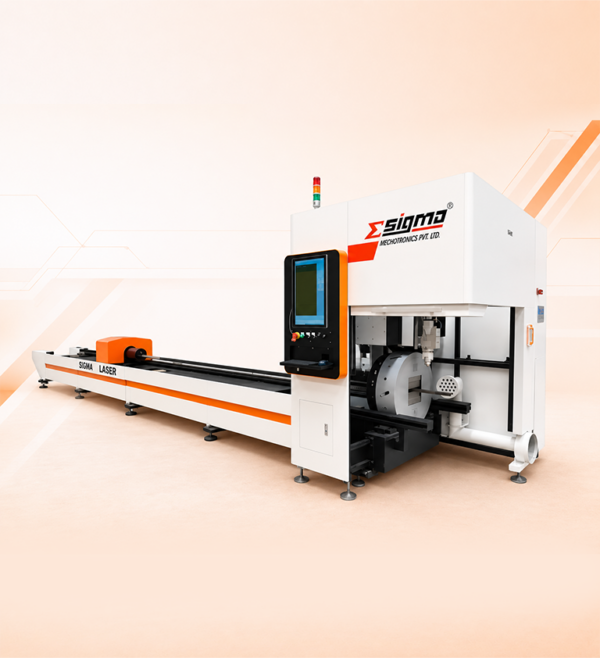
Fiber Laser Tube Cutting Machine by Sigma Mechotronics is engineered
for high-speed, high-precision cutting of metal tubes and profiles.
– Power options from 1.5 kW to 12 kW
– Cuts round, square, rectangular and special-profile tubes
– Automatic loading and chuck clamping
– High-speed cutting with minimal material waste
– Suitable for stainless steel, MS and aluminium tubes
Send Inquiry
Tube · Pipe · Profile Sections · Made in India · ISO & CE Certified
Laser Tube Cutting Machine – 1.5 kW to 12 kW
A laser tube cutting machine is a fiber laser machine built around a chuck-and-feed system instead of a flat bed, so the stock is gripped, fed and rotated under the cutting head rather than laid flat. That is what lets it cut round, square and rectangular tube, open channels in C, H, L and I profile, and special sections – to length, with holes, slots, notches and cope joints anywhere around the section, in one program. Sigma Mechotronics Pvt. Ltd. manufactures it from 1.5 kW to 12 kW, with maximum chuck diameters from 20 Ø to 350 Ø across two chuck models, for 3 metre and 6 metre stock lengths, with ±45° bevel cutting and automatic lubrication as standard, holding ±0.05 mm re-positioning accuracy. This page covers the full technical data, how to select the chuck, length and power, what the machine’s zero-wastage feed and automatic deformation correction change on the floor, and what to plan for before it arrives.
- Laser power
- 1.5kW-12kW
- Chuck diameter
- 20 Ø – 350 Ø
- Tube length
- 3 m & 6 m
- Re-positioning accuracy
- ±0.05 mm
Tube fabrication has traditionally been a sequence of separate operations. The bandsaw cuts to length. Somebody marks out the hole positions. The drill or punch makes the holes. A grinder copes the ends so the joint sits properly against the mating tube. Each step introduces its own tolerance, and by the time the parts reach the welder, the fit-up is only as good as the worst of them.
A laser tube cutting machine collapses that sequence into one. The chuck holds and rotates the section while the head cuts, so length, mitre, notch, cope, slot and hole are all produced in a single program from one datum, repeatable to ±0.05 mm. Parts arrive at the welding bay already fitting, which is where the time actually gets saved – not in the cutting itself, but in everything that no longer has to be corrected afterwards.
Sigma Mechotronics Pvt. Ltd. manufactures this machine at its own plant in Ahmedabad, so the chuck model, stock length and power are specified around the sections you actually run rather than picked from a fixed catalogue. This page is written for engineers and owners specifying a tube cutting machine for production: the complete technical data, how the two chuck models and the 3 or 6 metre length options work, how to select power between 1.5 kW and 12 kW, what ±45° bevel cutting is worth in practice, and what to get right in the floor plan before the machine arrives.
At a Glance
Key Takeaways
The essentials, before the detail below.
Chuck-Fed, Not Flat Bed
Pneumatic self auto-centering chucks grip and rotate the stock under the head, so the beam reaches every face and every angle of the section in one setup.
20 Ø to 350 Ø, Two Chuck Models
Maximum chuck diameters span 20 Ø to 350 Ø across two models. Confirm both your smallest and your largest section against them, not just the largest.
±0.05 mm Re-Positioning Accuracy
Every feature on the bar is placed from the same datum to ±0.05 mm, which is what makes a welded assembly fit without a jig correcting it.
±45° Bevel Cutting
Weld-prep angles are cut on the machine, so edges come off ready to weld instead of going to a second bevelling operation.
Zero Wastage Feed
The bar is worked through to the end rather than leaving a gripped offcut in the chuck. On every bar, on every order, that is material you stop paying for.
Automatic Deformation Correction
Real tube arrives bowed, twisted and slightly out of round. The machine corrects for that as it feeds instead of transferring it into the cut.
Definition
What Is a Laser Tube Cutting Machine?
A laser tube cutting machine is a fiber laser machine purpose-built for tube, pipe and profile stock. Instead of a flat bed, it uses pneumatic self auto-centering chucks with a feed and support arrangement: the chuck grips the section, rotates it under the cutting head, and coordinates that rotation with the head’s travel along the length, so the beam can reach any point on any face of the profile without the part being repositioned by hand.
That single difference is what separates it from cutting tube on a saw or on a flat-bed machine with an attachment. Because the machine knows where the section is rotationally at every moment, it can cut a hole on the top face, a slot on the side, a cope at the end and a mitre on the far end – all referenced to the same datum, all in one program, with no marking out and no re-fixturing between operations. On a fabricated frame with dozens of joints, holding one datum across every feature to ±0.05 mm is what keeps the assembly square.
The machine handles mild and carbon steel, stainless steel and aluminium sections. Brass and copper are highly reflective at the 1064 nm fiber wavelength and need a back-reflection protected cutting head; titanium is a different case again, cutting cleanly but requiring inert gas shielding to avoid an oxidised, embrittled edge. Automatic lubrication keeps the feed system serviced through long runs, and ±45° bevel cutting produces weld-ready edges directly off the machine. It is dedicated to tube, pipe and profile stock and does not cut flat sheet or plate.
The Four Systems That Define It
01
Self-Centering Chucks
Pneumatic and self auto-centering across two chuck models, so a change of section size does not mean a manual re-centring job and features land where the program says.
02
Feed & Support
Carries 3 metre and 6 metre lengths through the machine without sag, corrects deformation in the incoming bar, and works the stock to the end for zero wastage.
03
Bevel Head
Cuts at ±45° to the section face, producing weld-prep geometry and mitred ends as part of the same program rather than as a later operation.
04
Rotary Axis & CNC
60 rpm rotation coordinated with 90 m/min linked travel over a 6050 x 400 x 300 mm working router, with red-light aiming for setup before the beam fires.
Specifications
Technical Data
The published specification for the Sigma Mechotronics laser tube cutting machine.
| Parameter | Specification |
|---|---|
| Laser type | Fiber laser generator |
| Laser power | 1.5 kW to 12 kW |
| Laser wavelength | 1064 nm |
| Tube / pipe length | 3 metre & 6 metre (3000 / 6000 mm) |
| Chuck diameter | Maximum chuck diameters from 20 Ø to 350 Ø, across 2 chuck models |
| Chuck type | Pneumatic self auto-centering |
| Tube diameter – square & round | 20 – 350 mm |
| Tube diameter – rectangular | Longest side ≤ 350 mm |
| Sections cut | Square, rectangular and round tube; open channels in C, H, L and I profile; special sections |
| Bevel cutting | ±45° |
| Working router (Y x X x Z) | 6050 mm x 400 mm x 300 mm |
| Control system | FSCUT 5000 B |
| Frequency | 1 – 5000 Hz |
| Re-positioning accuracy | ±0.05 mm |
| Maximum linked speed | 90 m/min |
| Rotary maximum speed | 60 rpm |
| Lubrication | Automatic, to minimise wear on the feed system |
| Aiming and positioning | Red light |
| Auto loading / unloading | Available (optional) |
| Materials | Mild & carbon steel, stainless steel, aluminium; brass & copper with a back-reflection protected head |
| Warranty | 2 years |
For more details, contact us – the table above is the standard published specification. Cutting capacity in wall thickness, cycle time on your own sections, which of the two chuck models suits your section list, utility and installation requirements and the delivered configuration are all confirmed against your actual work before we quote. Send your section list or call +91 99090 26467 and our engineering team will go through it with you.
Stock Formats
Which Sections the Machine Cuts
Closed tube and open channel behave differently under a laser, and a machine that handles both covers most of what a structural or fabrication shop buys.
| Section | Capacity | Typical Application |
|---|---|---|
| Round | 20 – 350 mm diameter, within the chuck range | Railing, handrails, frames, fluid and structural pipework |
| Square | 20 – 350 mm across flats | Furniture and equipment frames, gates, light structural work |
| Rectangular | Longest side ≤ 350 mm | Chassis and base frames, racking, machine structures |
| C & L | Open channel and angle profile | Purlins, brackets, supports, bracing and frames built from open section |
| H & I | Beam profiles with parallel flanges and a web | Structural members needing holes, notches and end preparation |
| Special | Non-standard and customer-specific profiles | Proprietary extrusions and rolled sections used in your own product |
Check both ends of your section list – the diameter buyers remember is the largest one, but the two chuck models cover different parts of the 20 Ø to 350 Ø range, so the smallest section you run regularly decides as much as the biggest. Send us your full list with shape, size and wall thickness – and a profile drawing for any special section, since clamping and support have to be confirmed against the actual geometry before a machine is specified.
Key Advantages
Five Things That Change What the Machine Costs to Run
Every tube laser cuts tube. These are the features that decide what each bar actually costs you once the machine is in production.
| Feature | What It Does | Why It Matters on the Floor |
|---|---|---|
| Zero wastage | The feed system works the bar through to the end instead of leaving a gripped remnant behind in the chuck. | On a tube machine the end-of-bar offcut is a cost you pay on every single bar, not once. Over a year of production it is the difference that shows up in material spend, and it is the specification most buyers never think to ask about. |
| Automatic deformation correction | Compensates for bow, twist and out-of-round in the incoming bar as it feeds, rather than passing it into the cut. | Mill-supplied tube is never perfectly straight or perfectly round. Without correction, a bent bar puts every feature slightly off position and the ±0.05 mm the machine is capable of never reaches the part. |
| High-speed tube change | Easy feeding and quick changeover between bars and between section sizes, with self auto-centering chucks removing the manual re-centring step. | In job work the machine is idle during changeover, not during cutting. Shortening the change is what lifts real output on short runs and mixed batches. |
| Automatic lubrication | Services the feed system on schedule without operator intervention, minimising wear across continuous production. | It removes a manual routine that is easy to skip on a busy shift – and skipped lubrication is one of the quiet ways a machine loses the accuracy it was bought for. |
| Auto loading / unloading | Optional automatic loading and unloading, specified with the machine rather than added later. | On single-shift job work manual loading is usually fine. On multi-shift or repeat-batch production, loading becomes the constraint long before the laser does – and this is decided at order, not afterwards. |
The red-light aiming and positioning system belongs in the same list for a different reason. Before the beam fires, the operator can see exactly where the cut will land on the section. On a first-off part, on an unfamiliar profile, or on expensive stainless stock, that is the difference between confirming a setup and scrapping a bar to find out.
Weld Preparation
What ±45° Bevel Cutting Is Worth in Practice
Bevel cutting means the head can cut at an angle to the section face rather than square to it, through ±45°. In fabrication terms, that is weld preparation: the angled edge that lets a welder achieve full penetration on a thicker-wall joint, produced on the laser as part of the cutting program instead of by a grinder afterwards.
The saving is not only the grinding time. A hand-prepared bevel varies from part to part, and that variation shows up as inconsistent weld penetration and rework on the joints that matter most. A cut bevel is the same on the first part and the five hundredth, which is what makes weld quality repeatable across a batch rather than dependent on who prepared the edge.
The same capability produces mitred ends for corner joints and angled cuts for frames that are not square – work that would otherwise mean a second setup on another machine. It is also the feature least often available on competing tube machines at this level, where bevel is commonly an extra-cost option restricted to the top of a model range rather than part of the standard build. If your drawings contain angled joints, bevelled edges or full-penetration welds on section, this is the capability that decides how much of the job stays on one machine.
Worth checking before you order – look through your current drawings for how many joints are hand-prepared today. Shops that have never had bevel capability design around not having it, so the value only becomes visible once the drawings are reviewed with the machine in mind. Send us a typical assembly drawing and we will point out which features the machine would produce directly, and confirm the bevel angle achievable on your specific wall thickness and section.
1.5 kW to 12 kW
How to Select Laser Power
On a tube cutting machine, power is set by wall thickness and the cutting speed you need – not by the diameter of the section. A 300 Ø thin-wall tube asks less of the laser than a 60 Ø heavy-wall one, so specify against the thickest wall you must cut regularly.
| Power Band | Generally Suits | Where It Struggles |
|---|---|---|
| 1.5 kW – 3 kW | Thin-wall tube and light section – railing, furniture, gates, general light fabrication | Heavy-wall structural section and thick pipe, and any job where cycle time on medium wall is the bottleneck |
| 4 kW – 6 kW | The general production middle – structural tube, pipe and open channel at commercial speed | The heaviest sections at high throughput |
| 8 kW – 12 kW | Heavy-wall structural section, thick pipe and high-volume production – the fastest cycle times available in the range | Very thin wall, where the useful gain over a lower band is small and the cut has to be managed more carefully rather than simply run faster |
Why Power on Tube Is Not the Same Decision as Power on Sheet
This is the part of the specification buyers most often get wrong, and it is worth understanding before you compare quotations. On flat sheet, the beam cuts through the material and continues into the slat bed below, so more power straightforwardly means more thickness and more speed. On tube, the beam that passes through the near wall is still travelling inside a closed section, and it reaches the opposite inner wall. The industry calls that back-wall strike, and controlling it is what separates a tube machine from a flat-bed machine with a rotary attachment bolted on.
What it means for you as a buyer is straightforward. Do not read a tube machine’s power figure the way you would read a plate machine’s, and do not assume the top of the band is automatically the safer choice. On tube, power buys wall thickness and speed up to the point your work actually needs – beyond that it is capital and running cost you carry for the life of the machine, on a cut that has to be controlled rather than simply pushed. Specify the band from the thickest wall you must cut regularly and the cycle time you need on your highest-volume section, and let us confirm it against your section list before you commit.
Power is also the specification that decides what the installation around the machine has to support – connected electrical load, chiller and cooling capacity, assist gas consumption and supply arrangement, and extraction sizing all scale with the laser source you choose. Our engineering team works through those points with you before quoting, so the machine that arrives suits the plant it has to run in.
Expert note on assist gas and reflective metals – oxygen gives the most economical cut on mild steel, nitrogen gives a clean, oxide-free edge on stainless steel and aluminium at higher gas cost, and compressed air suits thinner-wall work. Brass and copper are highly reflective at 1064 nm, so confirm a back-reflection protected cutting head before running these regularly, and titanium needs inert shielding rather than reflection protection. Exact cutting thickness and speed depend on material grade, wall thickness, gas and configuration – ask us for a section-specific recommendation before you fix the power band.
Price & Quotation
What a Laser Tube Cutting Machine Costs, and What Decides It
There is no single price for this machine. Any supplier who quotes one before seeing your sections is quoting a different machine from the one you need. Here is exactly what moves the number, in the order it moves it.
The laser power you specify between 1.5 kW and 12 kW is the largest single factor in the price – two machines identical in every other respect sit a long way apart on that one line. Chuck model and stock length come next, then automatic loading, then the supporting equipment specified around the machine. Settle those and the quotation follows from them.
| What You Specify | Effect on Price | How to Decide It |
|---|---|---|
| Laser power – 1.5 kW to 12 kW | The largest single factor. The laser source is the most expensive assembly in the machine, so the step from the bottom of the band to the top is the biggest difference between two otherwise identical machines. | From the thickest wall you must cut regularly and the cycle time you need – never from tube diameter, and never by defaulting to the top of the range because it sounds safer. |
| Chuck model and stock length | A 6 metre machine is a physically longer structure than a 3 metre one – longer rails, a longer feed and support system, more material and more assembly time. | Match the length your bar is supplied in, and give us both ends of your section list so the right chuck model is priced rather than the largest one. |
| Automatic loading / unloading | A significant addition when specified, and it is specified at order rather than retro-fitted later. | From your shift pattern rather than volume alone. Single-shift mixed job work rarely needs it; multi-shift repeat-batch production usually does. |
| Supporting equipment | Chiller capacity, extraction sizing and compressed air all scale with the power band and the materials you cut, so they move together with the first decision. | Tell us what you already have on site. Some plants need nothing added; others need all three sized properly, and it is far cheaper to know that before you order than after. |
What a Sigma Quotation Covers
| Part of the Supply | Confirmed Against Your Site When We Quote |
|---|---|
| The machine built to the specification agreed with you | Electrical supply and connected load at the machine’s connection point |
| Installation and commissioning at your premises | Assist gas type and supply arrangement – cylinder, bulk or generator |
| Cutting parameter setting for your material and your sections | Fume extraction sizing, set against the worst material you cut rather than the average one |
| Operator training on chuck setup, bevel programming and section handling | Floor preparation and the clear infeed and outfeed run along the machine |
| 2 years warranty, with service handled directly by us | Automatic loading and unloading, if you choose to specify it |
| GST tax invoice raised under your GSTIN | Consumables beyond the set supplied with the machine |
Want a price? Send us six lines and we will quote – your section shapes and sizes with the smallest and largest, your thickest wall thickness, your material and grade, the length your stock arrives in, your rough monthly volume, and whether you want automatic loading. That is enough for a real quotation rather than a range. WhatsApp us or call +91 99090 26467 and we will come back with a specification and a price built around your actual work – not a figure that has to be revised the moment we see your drawings.
The Range
How This Machine Sits Against Our Other Cutting Configurations
The Sigma Mechotronics Pvt. Ltd. fiber laser cutting machine range covers several configurations. What separates them is body type, automation and the stock format each one is built to hold.
| Configuration | Body & Stock Format | Built For |
|---|---|---|
| Dedicated Tube Cutting | Chuck-fed, tube and profile only, 3 m and 6 m, 1.5-12 kW | Volume tube, pipe and profile fabrication with bevel and section work at ±0.05 mm – this one does not cut flat sheet |
| Flat Bed + Pipe Attachment | Open type flat bed plus rotary tube attachment | Shops whose drawings contain both flat parts and section, on one machine |
| Single Pallet | Open type, one bed, manual load/unload | Mixed flat job work, crane-loaded and awkward stock |
| Auto Pallet Changer | Open type, two beds, automatic pallet swap | Repeat-batch flat production where machine utilisation drives cost per part |
| Close Body | Fully enclosed cabin, manual load/unload | Shared floors where beam and fume containment are the priority |
Four Checks
How to Specify the Right Laser Tube Cutting Machine
Work through these in order. Each narrows the specification, and taking them out of order is how buyers end up with a machine that fits the brochure but not the floor.
- 1
Write Down Your Section List, Both Ends of It
Every section you cut regularly – shape, outside size and wall thickness – with your smallest and your largest identified. This decides the chuck model, and the smallest section matters as much as the largest: a machine that grips 350 Ø is not automatically the right one for your 25 Ø work.
- 2
Match the Length Option to Your Supplied Stock
If your tube arrives in 6 metre lengths, a 6 metre machine takes it as delivered. Choosing 3 metre to save floor space means cutting every bar down first, which adds an operation, creates offcuts, and works directly against the zero-wastage feed you are paying for.
- 3
Set Power From Wall Thickness, Not Diameter
Take the thickest wall you must cut regularly and the speed you need on your highest-volume section. Those two numbers set the band between 1.5 kW and 12 kW. Diameter is a chuck question, not a power question, and on tube the top of the band is not automatically the safe default.
- 4
Draw the Full Run Into the Floor Plan
The working router is 6050 mm along the bar, and the machine needs clear infeed length for loading full bars and clear outfeed for finished parts – well beyond its own footprint. Add the safety zone, a staging area for bar stock, the control cabinet, the chiller, the extraction run, and the space for auto loading if you specify it.
Avoid These Buying Mistakes
6 Mistakes Buyers Make on a Laser Tube Cutting Machine
1
Specifying the chuck on your largest section only. The two chuck models cover different parts of the 20 Ø to 350 Ø range. Give us both ends of your section list, or you risk a machine that handles your biggest job and fights your most common one.
2
Reading a tube machine’s power figure like a plate machine’s. On tube the beam has an opposite wall to reach, so power behaves differently from the way it behaves on sheet. Buy the band your wall thickness needs, not the biggest number on the page.
3
Planning space for the machine but not the bar. A 6 metre length needs clear infeed and outfeed beyond the machine body. This is the most common layout error on tube machines, and it is discovered at installation when it is expensive to fix.
4
Ignoring the quality of the tube you buy. The machine holds ±0.05 mm and corrects deformation as it feeds, but severely bowed, twisted or badly out-of-round stock still limits what any machine can deliver. Cheap mill tube can quietly cost more than it saves.
5
Keeping the old drawings after buying the machine. Parts designed around a bandsaw and a grinder do not use notching, coping, ±45° bevel or tab-and-slot joints. Review the drawings with the machine’s capability in mind or you keep paying for operations it would have removed.
6
Deciding on auto loading after the machine is installed. Automatic loading and unloading is specified with the machine and needs its own floor space. Retro-fitting it to a line already built around manual loading is a far bigger job than choosing it at order.
Where It Is Used
Industries and Applications
Wherever a product is welded up from section rather than sheet, this machine covers the whole cutting list from one setup.
- Structural Steel Fabrication
- Railing, Gates & Architectural Metalwork
- Steel Furniture & Frame Manufacturing
- Gym & Fitness Equipment
- Agricultural Equipment Manufacturing
- Automotive & Auto-Ancillary
- Elevator, Racking & Storage Systems
- Machine Building & Job Work
- Pipe, Fitting & Fluid Handling
- Scaffolding & Formwork Systems
Typical output is section cut to length with mitred and bevelled ends, cope joints, notches, slots and holes positioned anywhere around the profile – frames, chassis, railings, purlins, brackets, supports and structural members that arrive at the welding bay ready to assemble. The capability worth designing for is interlocking geometry: once features can be placed to ±0.05 mm anywhere on the section, tab-and-slot joints let a frame locate itself during assembly instead of relying on a jig, and that is usually where the largest single saving in a welded product sits.
Materials are mild and carbon steel, stainless steel and aluminium, with brass and copper cut on a back-reflection protected head. Fiber laser is the correct technology for these metals and is not the right cutting technology for plastics, rubber, wood or glass.
Keeping It Running
Maintenance and Safety in Practice
Automatic lubrication removes one routine from the list, but the chuck and the feed system are the parts that decide whether ±0.05 mm still means ±0.05 mm in three years’ time.
| Routine Task | Typical Frequency |
|---|---|
| Protective window and lens cleaning, nozzle check and replacement | Daily to weekly, depending on usage |
| Chuck jaw inspection and cleaning – worn or dirty jaws let the section slip, and slip becomes position error | Weekly, and after any run of heavily scaled stock |
| Feed and support system check, swarf and offcut clearing along the run | Daily on multi-shift production |
| Automatic lubrication system – reservoir level and delivery check | Monthly – the system services the machine, but it still needs topping up and verifying |
| Pneumatic supply – pressure, water separation and air quality at the chuck | Weekly, and part of every service visit |
| Extraction and filter check, sized for the material being cut | Weekly, more often on coated or galvanised section |
| Chiller and cooling system check | Weekly, and before any multi-shift run |
| Full technical inspection and accuracy verification | Annually |
Safety, in practice: a rotating 6 metre bar turning at up to 60 rpm is moving machinery along its whole length, so the infeed and outfeed run must be clear of people, stock and obstructions before a program starts – the hazard zone is the full run, not just the cutting head. Long bars need proper support rather than improvised packing, since an unsupported end that whips is dangerous as well as inaccurate. Wavelength-rated eye protection for 1064 nm and a demarcated, guarded working area apply as they do across the range, and fume extraction matters wherever coated, painted or galvanised section is cut. Interlocks and guards exist to stop the beam firing during an unsafe condition and are never to be bypassed, including during setup. Consumables in normal operation are assist gas, nozzles and protective windows.
Manufacturer, Not Trader
Why Buy the Laser Tube Cutting Machine From Sigma Mechotronics Pvt. Ltd.
Building our own machines shows in how they are engineered, how they hold up under Indian production conditions, and how they are supported for as long as they are on your floor.
Built at Our Own Ahmedabad Plant
The machine is designed and manufactured in India rather than imported and rebadged. The frame, bed and structure are built here, every component is selected and integrated by our own engineers, and stage inspection runs through the build – so the chuck model, the length and the clamping for a special profile are an engineering conversation with the people who make the machine, not a change request routed through an overseas supplier.
ISO & CE Certified, MSME Registered
Sigma Mechotronics Pvt. Ltd. is a registered Indian private limited company, GST registered, ISO and CE certified and MSME registered. Every purchase comes with a proper GST tax invoice under your GSTIN for ITC claims and capital equipment accounting.
2 Years Warranty, Spares Held in India
A 2 years warranty covers manufacturing defects in the machine body, laser delivery system, control electronics, motion system and the chuck and feed mechanism. Critical spares are held locally rather than ordered on an international shipping cycle, and service is handled directly by us rather than through an agent.
Consultation, Installation and Training
We confirm the specification against your section list, material and shop drawing before you order, then install and commission the machine at your premises, set cutting parameters for your material, and train your operators on chuck setup, bevel programming and section handling before handover.
Verify Before You Commit
Who You Are Buying From, and How to Check It
A laser tube cutting machine is capital equipment that will sit on your floor for a decade. You should not have to take any supplier’s word for anything. Here is the company on paper, and four ways to verify it yourself before you release an order.
| Legal entity | Sigma Mechotronics Pvt. Ltd., a registered Indian private limited company |
| Certification | ISO & CE Certified |
| Registration | MSME Registered and GST Registered |
| Manufacturing | Designed and built at our own plant at Plot No. 58-59-60, Gopal Charan Industrial Hub, Bakrol, Ahmedabad, Gujarat. The frame, bed and structure are manufactured here, every component is selected and integrated by our own engineers, and stage inspection runs through the build rather than only at the end. |
| Warranty | 2 years on manufacturing defects, covering the machine body, laser delivery system, control electronics, motion system and the chuck and feed mechanism |
| Service model | Handled directly by Sigma Mechotronics Pvt. Ltd. rather than routed through a dealer, an agent or an overseas principal. Critical spares are held in India. |
| Invoicing | GST tax invoice raised under your GSTIN, suitable for ITC claims and capital equipment accounting |
| Supply | Nationwide across India, with installation, commissioning and operator training carried out at your premises by our own team |
| Contact | +91 99090 26467 for phone and WhatsApp · info@sigmalaser.in · Ahmedabad, Gujarat |
Four Ways to Check Us Before You Release an Order
01
Visit the Plant
Come to Ahmedabad and see machines part-built on the floor. A trader cannot show you a build in progress, and one visit tells you more than any brochure will.
02
Run a Trial on Your Own Sections
Bring your actual tube rather than a similar size, and bring an assembly drawing. Cutting your own geometry is the only test that proves the specification for your work.
03
Ask for the Documents
Company registration, GST and MSME papers, certification, and the written warranty scope. Ask any supplier for these before you pay an advance – a manufacturer will send them.
04
Talk to Service, Not Only Sales
Ask who attends a breakdown, from where, and which spares sit in India. How a supplier answers that tells you what year three of ownership actually looks like.
Get all of it in writing before you pay – the machine specification with power, chuck model, length and every option listed line by line; the warranty term and exactly what it covers; what installation, commissioning and training include; and the delivery commitment. We put all of that in the quotation as a matter of course, and you should expect the same from every supplier you are comparing us against.
Straight Answers
Frequently Asked Questions
The questions manufacturers ask most before ordering a laser tube cutting machine.
A laser tube cutting machine is a fiber laser machine built around pneumatic self auto-centering chucks rather than a flat bed. The chuck grips and rotates the section under the cutting head while the head travels along its length, so the beam can reach any face and any angle of the profile in one setup – cutting to length, mitring, notching, coping, slotting and drilling in a single program. Sigma Mechotronics Pvt. Ltd. builds it from 1.5 kW to 12 kW, with maximum chuck diameters from 20 Ø to 350 Ø across two chuck models, for 3 metre and 6 metre stock, holding ±0.05 mm re-positioning accuracy.
Maximum chuck diameters run from 20 Ø to 350 Ø across two chuck models that cover different parts of that range between them, so round and square tube from 20 mm to 350 mm and rectangular tube up to 350 mm on its longest side. Beyond closed tube it also cuts open sections – C, H, L and I profile – plus special sections. Because of the two chuck models, the right question is not only how large your biggest section is but how small your smallest one is: send us both ends of your section list and we will confirm which model suits your work, and send a profile drawing for any special section.
3 metre and 6 metre lengths, matching the lengths tube and pipe are normally supplied in, so bar can be loaded as received rather than cut down first. The working router along the bar is 6050 mm. Choose the option that matches your incoming stock, and remember that a 6 metre machine needs clear infeed and outfeed space along its whole run, well beyond the machine’s own footprint.
Power follows wall thickness and the speed you need, not section diameter – a large thin-wall tube is an easier cut than a small heavy-wall one. Broadly, 1.5 kW to 3 kW suits thin-wall tube and light section such as railing and furniture work, 4 kW to 6 kW covers the general production middle across structural tube, pipe and open channel, and 8 kW to 12 kW is for heavy-wall section and high-volume production. One thing worth understanding: on a closed section the beam that passes through the near wall reaches the opposite inner wall, so power on tube is a different judgement from power on plate and the top of the band is not automatically the safer choice. Confirm your specific sections with our applications team before you fix it.
It lets the head cut at an angle to the section face rather than square to it, through ±45°. That produces weld preparation – the angled edge needed for full penetration on thicker-wall joints – and mitred ends for corner joints, directly on the machine instead of at a grinder afterwards. Beyond the time saved, a cut bevel is identical on every part, so weld penetration stays consistent across a batch rather than varying with whoever prepared the edge. Send us an assembly drawing and we will confirm the bevel angle achievable on your specific wall thickness and section.
Re-positioning accuracy is ±0.05 mm. In practice that is what lets every feature on a bar – holes, slots, notches, copes and the cut length itself – be placed from a single datum, so a frame with dozens of joints assembles square without a jig correcting it. Two things decide whether you actually see that on the part: the machine’s automatic deformation correction, which compensates for bow and twist in the incoming bar, and the quality of the tube you buy, since badly out-of-round or heavily bowed stock limits what any machine can deliver.
It means the feed system works the bar through to the end instead of leaving a gripped remnant behind in the chuck. On a tube machine that end-of-bar offcut is a cost you pay on every bar, not once – and it is the specification most buyers never think to ask a supplier about. Over a year of production it is a real line in your material spend, and it is one of the reasons matching the machine’s length option to your supplied stock length matters as much as it does.
Mill-supplied tube is never perfectly straight or perfectly round – there is always some bow along the length, some twist, and some ovality in the section. The machine compensates for that as the bar feeds rather than transferring it into the cut. Without correction, a bent bar puts every feature slightly off position and the ±0.05 mm the machine is capable of never reaches the finished part. It does not turn bad stock into good stock, but it removes the most common practical reason a tube laser underperforms its specification.
Yes, as an option specified with the machine. Whether you need it depends on your shift pattern rather than your volume alone: on single-shift job work with mixed sections, manual loading combined with the machine’s fast tube change is usually sufficient. On multi-shift or repeat-batch production, loading becomes the constraint long before the laser does. Decide it at order stage – automatic loading needs its own floor space, and retro-fitting it to a line already built around manual loading is a much bigger job.
No. This machine is dedicated to tube, pipe and profile stock – the chuck-and-feed system is what gives it the section capability, and it replaces the flat bed rather than sitting alongside one. If your drawings contain flat parts as well as section, tell us at the inquiry stage and we will go through the options in our cutting range with you.
Mild and carbon steel, stainless steel and aluminium sections are the core materials. Brass and copper are highly reflective at the 1064 nm fiber wavelength, so a back-reflection protected cutting head should be confirmed if you run them regularly. Titanium is a separate case – it cuts cleanly but needs inert gas shielding to avoid an oxidised, embrittled edge, so tell us if it is part of your work. Fiber laser is not the correct cutting technology for plastics, rubber, wood, leather or glass.
Considerably more than the machine body, and the requirement is length rather than area. The working router runs to 6050 mm along the bar, and on top of that you need clear infeed to load a full bar, clear outfeed for finished parts, the demarcated safety zone along the run, a staging area for bar stock, plus the control cabinet, chiller and extraction ducting – and the auto loading system if you specify it. We confirm the exact footprint and clearance against your shop drawing during the pre-order consultation, since it varies with the 3 metre or 6 metre option.
Automatic lubrication services the feed system on schedule without operator intervention, which minimises wear and removes a manual routine that is easy to skip on a busy shift – but the system itself still needs its reservoir level and delivery checked monthly. Beyond that, the routine that matters most is the chuck and the feed run: chuck jaws need weekly inspection and cleaning, because worn or dirty jaws let the section slip and slip becomes position error, and swarf and offcuts have to be cleared along the feed run daily on multi-shift production. Add lens and nozzle checks daily to weekly, pneumatic supply and air quality weekly, extraction and cooling checks weekly, and a full technical inspection with accuracy verification annually.
There is no single price, because the machine is configured to your work. The laser power you specify between 1.5 kW and 12 kW is the largest single factor, followed by the chuck model and the 3 metre or 6 metre length option, then whether automatic loading and unloading is included, then the supporting equipment specified around the machine. A 1.5 kW machine on the smaller chuck for 3 metre stock and a 12 kW machine on the larger chuck for 6 metre stock with auto loading sit at very different points in the same range. We quote against a confirmed specification rather than publishing a fixed figure, because an incorrectly specified machine is a poor investment at any price. Send your section list, wall thickness, material and stock length on WhatsApp or call +91 99090 26467 and we will send a detailed quotation.
Come and see it. Sigma Mechotronics Pvt. Ltd. builds these machines at its own plant at Plot No. 58-59-60, Gopal Charan Industrial Hub, Bakrol, Ahmedabad, and facility visits are welcome by appointment – a trader cannot show you a machine part-built on the floor. Beyond the visit, ask us for the company registration, GST and MSME papers, the ISO and CE certification and the written warranty scope, and ask to speak to the service team rather than only to sales about who attends a breakdown and which spares are held in India. Those are the questions worth putting to every supplier you are comparing, not only to us.
A 2 years warranty covering manufacturing defects in the machine body, laser delivery system, control electronics, motion system and the chuck and feed mechanism, handled directly by Sigma Mechotronics Pvt. Ltd. rather than through an agent or overseas supplier. Installation and commissioning at your premises, cutting parameter setting for your material, and operator training on chuck setup, bevel programming and section handling are part of the supply, and spares are held in India. Every purchase comes with a GST tax invoice under your GSTIN.
Yes, and on this machine we particularly recommend bringing your actual sections rather than a similar size, since shape, wall thickness and how the profile clamps are what decide the result. If you have an assembly with notched or bevelled joints, bring that drawing too – a trial on your own material and geometry is the most reliable way to confirm the machine meets your specification before committing capital. Facility visits to our Ahmedabad plant are welcome by appointment.
The Full Range
Related Machines From Sigma Mechotronics Pvt. Ltd.
Get a Laser Tube Cutting Machine Specified for Your Sections
Send us your section list with shapes, sizes and wall thickness, your smallest and largest diameters, the length your stock arrives in, your material and grade, and a drawing of the space the machine has to fit into including the clear run for infeed and outfeed. Our team will confirm the right chuck model, length and power – and whether automatic loading is worth specifying – and come back with a specification and quotation built around your actual work.

Reviews
There are no reviews yet.