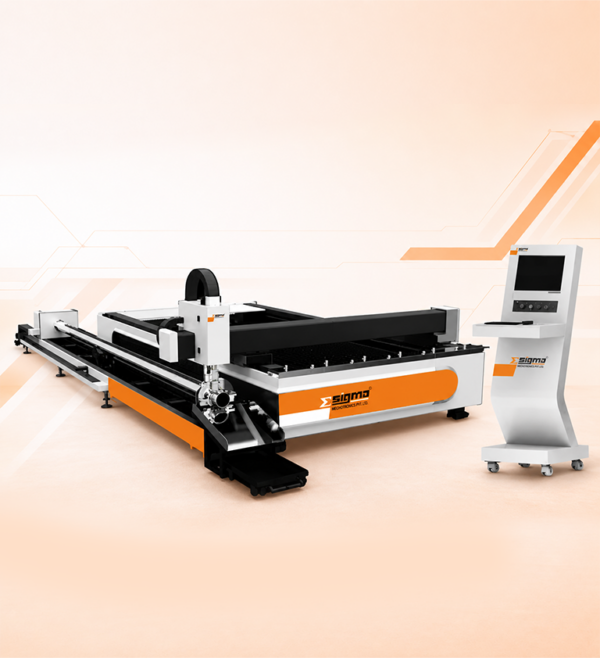
Laser Cutting Machine With Tube/Pipe Cutting Attachment
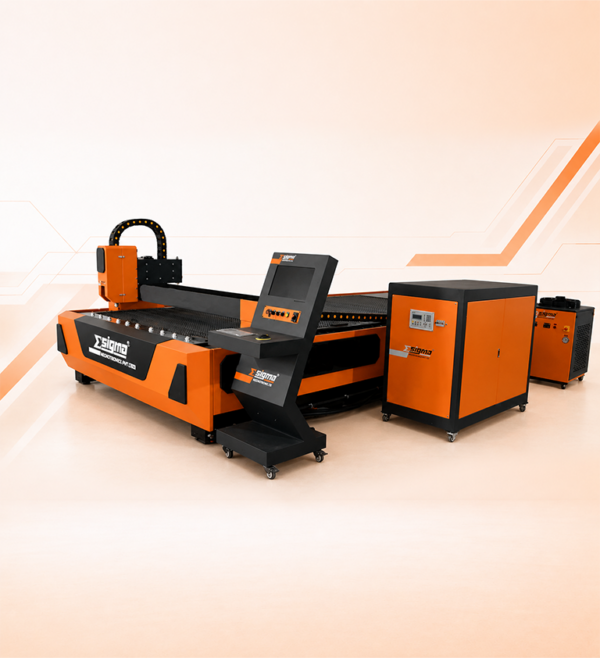
Laser Cutting Machine with Tube/Pipe Cutting Attachment by Sigma
Mechotronics is a fiber laser cutting solution for both sheet metal
and tube/pipe processing in a single machine.
– Power options from 1.5 kW to 20 kW
– Handles 3-meter and 6-meter tube lengths
– Standard and customized bed sizes available
– Precise, high-speed cutting for industrial manufacturing
Send Inquiry
Sheet + Tube on One Machine · Made in India Since 1997 · ISO 9001:2015 Certified
Fiber Laser Cutting Machine with Tube & Pipe Cutting Attachment – 1.5kW to 20kW
A laser cutting machine with tube pipe cutting attachment is a standard flat-bed fiber laser machine fitted with a rotary tube attachment, so the same machine cuts flat sheet and round, square or rectangular tube without a second machine on your floor. Sigma Mechotronics Pvt. Ltd. builds this configuration from 1.5kW to 20kW, on six standard bed sizes from 3200×1600 mm to 6500×2500 mm, handling tube and pipe stock in 3-metre and 6-metre lengths. Custom bed sizes are built to order. This page covers the specifications, how the standard and custom bed options differ, when this configuration is the right choice against a dedicated tube cutting machine, and what to confirm before you order.
- Power range
- 1.5kW-20kW
- Standard bed sizes
- 6
- Tube length
- 3m & 6m
- Manufacturing since
- 1997
Most fabrication shops start with sheet work and pick up tube and pipe jobs later – railing, frames, furniture legs, structural members, handles and stands. At that point the choice is either to sub-contract the tube cutting out, buy a second machine, or add a tube attachment to the flat-bed machine you already run. This configuration exists for the third option, and for shops buying their first machine who already know tube work is part of the order book.
Sigma Mechotronics Pvt. Ltd. manufactures this machine at its Ahmedabad facility, using the same bed, gantry and cutting head as our standard open-type flat-bed machines, with the rotary tube attachment mounted alongside the bed. Because it is one machine, you buy one power supply, one chiller, one control system and one footprint instead of two – and you get one service relationship rather than two.
At a Glance
Key Takeaways
The essentials, before the detail below.
One Machine, Two Stock Formats
A flat bed for sheet and plate, plus a rotary attachment for tube and pipe – one capital purchase, one footprint, one service contract.
1.5kW to 20kW as Standard
The same power band as the other open-type cutting machines built by Sigma Mechotronics Pvt. Ltd. Power is chosen by material and thickness, not by the attachment.
Six Standard Bed Sizes
3200×1600 mm through 6500×2500 mm. Any other bed size is manufactured to your drawing as a custom build.
3-Metre and 6-Metre Tube
The attachment handles standard mill lengths, so you cut from full-length stock instead of pre-cutting it down.
Round, Square and Rectangular
The attachment handles all three common section types, in mild steel, stainless steel and aluminium.
Not a Tube Machine Replacement
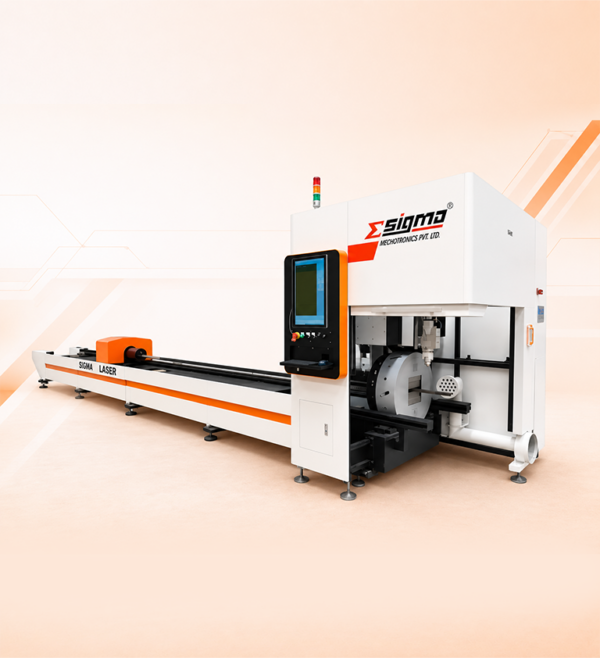
If tube work is the majority of your order book, a dedicated tube cutting machine outperforms this on throughput and bevel work.
Definition
What Is a Laser Cutting Machine with Tube Pipe Cutting Attachment?
It is a standard flat-bed fiber laser cutting machine with a rotary chuck attachment mounted alongside the bed, allowing the same cutting head to process tube, pipe and profile stock as well as flat sheet. The bed, gantry, laser source and CNC control are shared between both operations – only the material holding and rotation system is added.
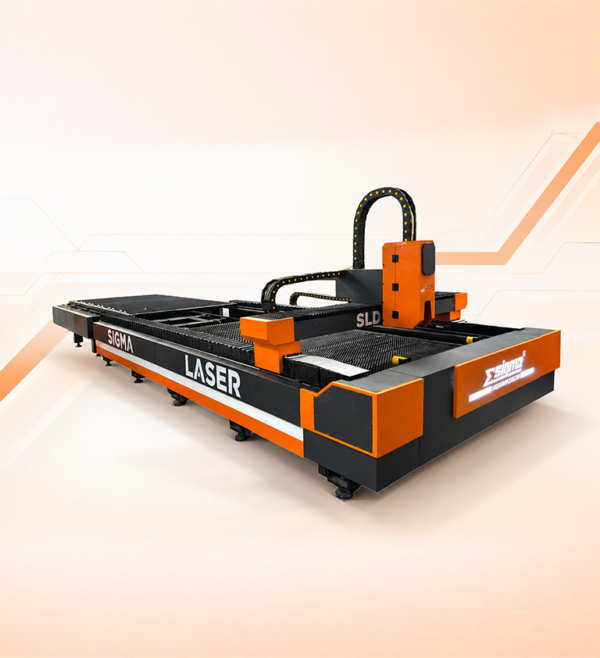
On flat work the machine behaves exactly like an open-type single pallet fiber laser cutting machine: sheet or plate is loaded onto the bed and the head travels across it on a gantry. For tube work, the stock is clamped in the rotary attachment, which turns the tube under the cutting head while the head moves along its length. Rotation plus linear travel is what lets the machine cut holes, slots, copes, notches and end profiles all the way around a section, not just straight cut-offs.
The attachment handles round, square and rectangular tube in 3-metre and 6-metre lengths – standard Indian mill supply lengths – so you cut from full stock rather than hacksawing it down first. Material range follows the machine, not the attachment: mild steel, stainless steel and aluminium are all standard, with aluminium, brass and copper needing a back-reflection-protected cutting head because they are highly reflective at the fiber wavelength.
Why it exists – a second machine means a second laser source, second chiller, second control system, second AMC and a second slot of floor space. For a shop where tube work is real but not dominant, the attachment delivers the capability without doubling the capital and running cost.
Specifications
Machine Specifications
| Power range | 1.5kW – 20kW |
| Standard bed sizes | 3200×1600 · 4000×2000 · 6000×2000 · 6300×2000 · 6500×2000 · 6500×2500 mm |
| Custom bed sizes | Manufactured to order, to your drawing |
| Tube / pipe length | 3 metre & 6 metre |
| Tube / pipe sections | Round, square and rectangular |
| Tube diameter range | [NEED: min and max tube/pipe diameter the attachment supports] |
| Body type | Open type flat bed with rotary tube attachment |
| Materials | Mild steel, stainless steel, aluminium (reflective metals need a rated head) |
| Warranty | 2 years, handled directly by Sigma Mechotronics Pvt. Ltd. |
Expert note on assist gas – oxygen is the most economical choice on mild steel, nitrogen gives a clean oxide-free edge on stainless steel and aluminium at higher gas cost, and compressed air suits thinner gauge work. Tube cutting typically consumes more gas per part than flat cutting on the same material, because the cut path wraps around the section – factor that into running cost, not just capital cost.
Bed Sizing
Standard Bed Sizes and Custom Bed Sizes
Sigma Mechotronics Pvt. Ltd. manufactures six standard bed sizes for this configuration, from 3200×1600 mm to 6500×2500 mm. If none of them matches your sheet size or your floor plan, we build the bed to your dimensions as a custom machine – a standard part of what we do, not an exception.
Standard Bed Sizes
| Bed Size (mm) | Suits Sheet Format | Typically Chosen By |
|---|---|---|
| 3200×1600 | Standard 8×4 ft sheet with margin | Smaller job shops, limited floor space, first machine purchase |
| 4000×2000 | Standard 4×2 m sheet | General fabrication – the most common all-round choice |
| 6000×2000 | Long 6 m sheet and plate | Structural work, long panels, ducting, silo and tank fabrication |
| 6300×2000 | 6 m sheet with working margin at both ends | Shops running 6 m stock where edge clearance matters for clamping |
| 6500×2000 | Oversize 6 m stock | Heavier structural fabrication with non-standard plate lengths |
| 6500×2500 | Widest and longest standard format | Large-format plate work – the maximum standard bed in this range |
Custom Bed Sizes – Built to Your Drawing
Standard sizes cover most requirements, but not all of them. Shops with an awkward bay width, a low crane hook, a fixed column position, or a regular sheet format that does not match any standard bed end up compromising on one of two things: buying a bed too small and splitting jobs, or buying a bed too large and paying for space they never cut on. Neither is a good outcome on a capital machine you will run for a decade or more.
Sigma Mechotronics Pvt. Ltd. manufactures the bed, frame and gantry in-house at Ahmedabad, which is what makes custom sizing practical rather than a special-order headache. Send us your maximum sheet size and a shop-floor drawing with your available bay dimensions, crane clearance and access route, and we will confirm the bed size, machine footprint and the clearance you need around it before anything is quoted.
| Standard Bed Size | Custom Bed Size | |
|---|---|---|
| Sizes | Six fixed options, 3200×1600 to 6500×2500 mm | Built to your specified length and width |
| Best when | Your sheet format and bay space fit an existing size | Bay width, crane clearance or sheet format doesn’t fit a standard bed |
| Lead time | Shorter – a proven, repeat-built configuration | Longer – confirmed at quotation against your drawing |
| What we need from you | Material, thickness, power and bed size preference | The above plus max sheet size and a shop-floor layout drawing |
Buying tip – size the bed against your largest regular job, not your average one. A bed that fits 90% of your work becomes a bottleneck the first time the other 10% arrives, and retro-fitting a longer bed is not a practical upgrade on a fiber laser machine.
Honest Comparison
Attachment vs. Dedicated Tube Cutting Machine
This is the single most important decision on this page, and the answer depends entirely on what share of your work is tube.
| Flat Bed + Tube Attachment | Dedicated Tube & Pipe Cutting Machine | |
|---|---|---|
| Cuts flat sheet | Yes – full flat-bed capability | No – tube, pipe and profile only |
| Power range | 1.5kW – 20kW | 1.5kW – 12kW |
| Tube holding | Rotary attachment alongside the bed | Purpose-built chuck & clamp, 20⌀-350⌀ across two chuck models |
| Bevel cutting | Not available in this configuration | ±45° – ready-to-weld edges off the machine |
| Profile sections | Round, square, rectangular tube | Above plus C, H, L and I sections and special profiles |
| Changeover | Setup time to switch between sheet and tube mode | None – the machine only does tube |
| Right when | Tube is occasional to moderate; sheet is your main work | Tube is your main work, at volume |
The practical test is changeover time. Every switch between sheet mode and tube mode costs setup minutes, and those minutes multiply by how often you switch. A shop that runs a tube batch once a week loses almost nothing. A shop switching three times a day is paying a daily tax that a second machine would remove. Count your actual switches over a normal month before you decide.
Buying tip – if tube and pipe work is a growing share of your order book rather than an occasional job, compare this configuration against our dedicated laser tube cutting machine before committing. The attachment is the correct answer for mixed work and the wrong answer for a dedicated tube line.
Four Checks
How to Specify This Machine Correctly
- 1
Work Out Your Sheet-to-Tube Ratio First
Before anything else, estimate what percentage of your monthly hours is tube work. Under roughly a third, the attachment is comfortably the right call. Approaching half and rising, price a dedicated tube machine alongside it before you decide.
- 2
Set Power by Material and Thickness
Power is decided by your thickest regular material and your required cut speed, not by the attachment. Lower power in the 1.5kW-20kW band suits thin-to-medium gauge; higher power suits thick plate and high-speed thick-section cutting. Ask for a trial cut on your actual material and grade.
- 3
Match the Bed to Your Largest Job and Your Bay
Check your largest regular sheet against the six standard sizes. If nothing fits cleanly, ask for a custom bed rather than compromising – and send your bay dimensions, because a 6.5 m bed needs loading and unloading clearance at both ends, not just its own footprint.
- 4
Specify the Attachment With the Original Order
The tube attachment is meaningfully more cost-effective specified at purchase than retrofitted later. If tube work is anywhere in your one-year plan, include it now rather than reopening the machine afterwards.
Avoid These Buying Mistakes
Five Mistakes Buyers Make on This Configuration
1
Assuming the attachment matches a dedicated tube machine. It adds real tube capability to a sheet machine. It does not replicate chuck-based positioning, profile-section handling or bevel cutting – and a quotation that implies otherwise is worth questioning.
2
Ignoring changeover time in the throughput calculation. Buyers compare cutting speed and forget setup. If you switch modes several times a day, changeover – not cut speed – is what actually decides your parts-per-shift.
3
Sizing the bed to the average job. Bed size cannot be upgraded later. Buy for your largest regular sheet, or specify a custom bed – do not plan to split oversize jobs indefinitely.
4
Forgetting 6-metre stock needs 6 metres of clearance. Full-length tube has to be fed in and taken out. Machine footprint is not the same as the space the machine actually needs on your floor.
5
Buying power on price instead of on material. Under-specifying to save capital usually costs more in cycle time and rework than it saved. Over-specifying wastes capital and raises your running cost with nothing to show for it.
Applications
Who Runs This Configuration
Typically shops whose work is mostly sheet but regularly includes tube, pipe or frame sections.
- Sheet Metal & General Fabrication
- SS Railing & Balustrade
- Tube Furniture Manufacturing
- Gym & Fitness Equipment
- Agricultural Equipment
- Automotive & Auto-Ancillary
- Structural & Frame Fabrication
- Kitchen Equipment & Display Racks
- Electrical Panel & Switchgear
- Job Shops & Contract Fabricators
Manufacturer, Not Trader
Why Buy This Machine From Sigma Mechotronics Pvt. Ltd.
Built In-House Since 1997
Sigma Mechotronics Pvt. Ltd. is an ISO 9001:2015 certified, MSME-registered Indian manufacturer building fiber laser machines at its Ahmedabad facility since 1997 – not a trading house importing unbranded machines. That is also why custom bed sizes are practical for us to quote.
2-Year Warranty, Spares Held in India
A 2-year warranty covering the machine body, laser delivery system, control electronics and motion system, handled directly by Sigma Mechotronics Pvt. Ltd. Critical spares – lenses, cutting heads, control boards – are stocked in India rather than ordered on a 6-12 week overseas shipping cycle.
Installation, Training & GST Invoice
We install and commission the machine at your premises, set parameters for your material and application, and train your operators before handover. Every purchase comes with a GST tax invoice under your GSTIN – compliant for ITC claims and capital equipment accounting.
Straight Answers
Frequently Asked Questions
Yes. The flat bed handles sheet and plate exactly as a standard open-type machine does, and the rotary attachment holds and turns tube or pipe under the same cutting head. You switch between the two modes with a setup changeover rather than moving to a second machine. What you should not expect is dedicated-tube-machine performance on tube work – the attachment adds the capability, it does not match a purpose-built chuck-fed machine on throughput or bevel cutting.
3 metre and 6 metre – the standard mill supply lengths in India – in round, square and rectangular sections. Cutting from full-length stock removes a pre-cutting step from your process. Remember to plan infeed and outfeed clearance for 6-metre stock in your shop layout; the space the machine occupies and the space it needs to work are two different numbers.
Six standard bed sizes are available: 3200×1600, 4000×2000, 6000×2000, 6300×2000, 6500×2000 and 6500×2500 mm. Custom bed sizes are manufactured to order – we build the bed, frame and gantry in-house at Ahmedabad, so a non-standard size is a normal build rather than a special exception. Send your maximum sheet size along with a shop-floor drawing showing bay dimensions and crane clearance, and we will confirm the bed size and full footprint before quoting.
Decide on the share of your work that is tube. If sheet is your main business and tube is occasional to moderate, this configuration gives you both capabilities on one capital purchase and one footprint. If tube, pipe and profile work is your main business, the dedicated machine is better – it holds stock in a purpose-built chuck system covering 20⌀ to 350⌀ across two chuck models, cuts C, H, L and I profiles that the attachment does not handle, and offers ±45° bevel cutting for ready-to-weld edges. The dedicated machine cannot cut flat sheet at all, which is the trade-off going the other way.
Mild steel, stainless steel and aluminium are standard, in both sheet and tube form. Aluminium, brass and copper are highly reflective at the fiber laser wavelength, so confirm your cutting head is back-reflection protected before running them regularly. Assist gas depends on material and finish: oxygen for economical mild steel cutting, nitrogen for a clean oxide-free edge on stainless and aluminium, compressed air for thinner gauge work. Fiber laser is not the correct technology for cutting plastics, wood or glass.
Price depends on laser power, bed size (standard or custom), the tube attachment specification and any optional systems – a 1.5kW machine on a 3200×1600 bed and a 20kW machine on a 6500×2500 custom bed sit at very different price points. We do not publish fixed pricing because an incorrectly specified machine is a poor investment at any price. Send your material, thickness, sheet size, tube requirement and expected volume and we will quote against that specification.
Yes, and for a capital purchase of this size we recommend it. A trial on your actual material, grade and thickness – both a sheet part and a tube part – is the most reliable way to confirm edge quality, cut speed and changeover time before you commit. Facility visits at our Ahmedabad plant are welcome by appointment. Contact us with your material and part drawings to arrange a trial.
Related Machines
Compare Other Machines from Sigma Mechotronics Pvt. Ltd.
Tell Us Your Sheet Size, Tube Size and Thickness
Send your material, maximum sheet size, tube or pipe section and length, thickness and monthly volume – and a shop-floor drawing if you need a custom bed. We will come back with the right power, the right bed size and a quotation built to your actual requirement, not a generic spec sheet.

Reviews
There are no reviews yet.