Hand-Held Laser Welding Machine
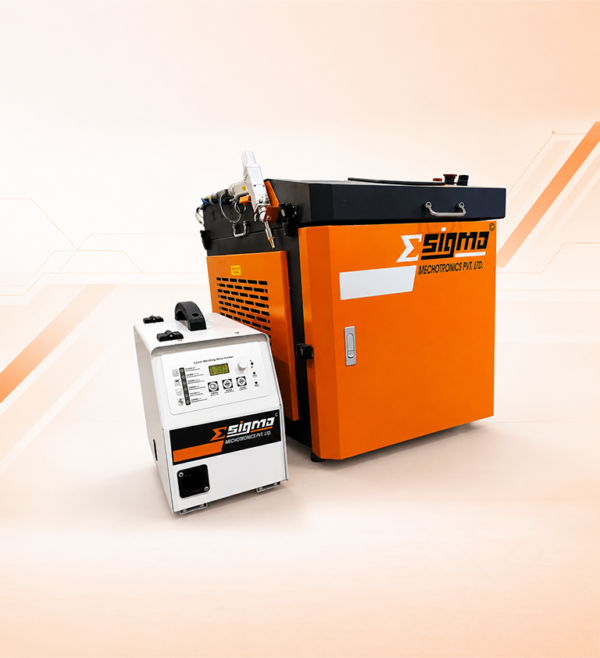
Hand-Held Laser Welding Machine (4-in-1) by Sigma Mechotronics
combines welding, cutting, weld seam cleaning and rust removal in
one compact machine.
– Power options: 1500W, 2000W and 3000W
– Lightweight handheld welding gun
– Intuitive HMI with preset welding parameters
– Adjustable spot size from 0.5 to 5 mm
– Water cooled for continuous industrial operation
– Optional dual wire feeder for deeper penetration
Send Inquiry
4 in 1 · Weld · Cut · Seam Clean · Rust Clean · Made in India · ISO 9001:2015 Certified
Hand-Held Laser Welding Machine (4 in 1) – Weld, Cut, Clean Seam and Remove Rust from One Gun
A hand held laser welding machine is a fiber laser system that delivers the beam through a lightweight gun the operator holds, fusing joint edges directly rather than melting a filler rod into them. This one runs a 4-in-one laser control system, so the same gun welds, cuts, cleans the weld seam and removes rust – four jobs selected from the HMI instead of four machines on the floor. Sigma Mechotronics Pvt. Ltd. builds it at 1500 W, 2000 W and 3000 W, with a single-axis wobble adjustable from 0 to 5 mm, a water cooling system for continuous working, and an optional dual wire-feeder for gap filling and deeper penetration.
- Power options
- 1500-3000 W
- Operating modes
- 4
- Wobble line spot
- 0-5 mm
- Cooling
- Water-cooled
The reason handheld laser welding spread so quickly through Indian fabrication is not speed on its own – it is what the weld looks like afterwards. A laser puts its energy into a narrow, concentrated zone, so the surrounding metal stays comparatively cool. On thin stainless steel that means far less of the buckling, warping and burn-through that makes an arc weld on a 1 mm panel a job for your most experienced hand, and far less grinding and polishing before the part can be finished.
The 4-in-one control system is what makes this a workshop tool rather than a welding-only machine. The same gun that welds a joint will also cut thin sheet, clean the oxide discolouration off the seam it just made, and strip rust off a surface before you weld it – selected from the HMI, with no change of equipment. Sigma Mechotronics Pvt. Ltd. manufactures it at its own plant in Ahmedabad, so the power tier and the wire-feeder option are specified around the work you actually do.
At a Glance
Key Takeaways
Four Jobs, One Gun
Weld, cut, weld seam clean and rust clean are four modes on one 4-in-one laser control system, selected from the HMI.
1500 W, 2000 W or 3000 W
Three power tiers. The tier is chosen by the thickness you weld most often, not by the mode you use most.
0-5 mm Adjustable Wobble
Single-axis wobble widens the melt pool, which makes the bead smoother and far more forgiving of imperfect fit-up.
Pre-Set HMI Parameters
Material and thickness presets mean an operator produces usable welds far sooner than the training curve a TIG torch demands.
Water-Cooled for Continuous Work
Built for continuous running rather than short bursts, and rated for both spot welding and continuous seam welding.
Optional Dual Wire-Feeder
Adds filler for gap filling, deeper penetration and joint strength. Specify it with the order rather than retrofitting later.
Definition
What Is a Hand Held Laser Welding Machine?
A hand held laser welding machine generates a fiber laser beam in a source cabinet and delivers it through a flexible cable to a lightweight gun. The operator points the gun at the joint and the focused beam melts both edges so they fuse as the pool cools. Unlike arc welding, no electrode is consumed and no arc is struck – the heat is optical, concentrated into a narrow zone, and controlled by parameters set on the HMI rather than by the welder’s hand alone.
That concentration is the whole point. Because the energy goes where the beam goes and very little spreads sideways, the heat-affected zone is narrow and the parent metal stays comparatively cool. In practical terms that means less distortion on thin material, a narrower and neater bead, and much less post-weld grinding and polishing – which is why it is used so heavily on stainless steel railing, kitchen equipment, furniture and decorative work where the joint is visible in the finished product.
4 in 1
The Four Modes, and What Each One Is For
This is the feature that separates the machine from a welding-only gun. All four run from the same 4-in-one laser control system, on the same gun, with no change of equipment between them.
| Mode | What It Does | When You Use It |
|---|---|---|
| Weld | Melts and fuses the joint edges into one, with optional filler wire | The primary job – sheet metal, stainless fabrication, railing, frames and repair joints |
| Cut | Separates thin sheet material with the same beam | Trimming, adjusting and fitting on site, where taking the part to a cutting machine is not practical |
| Weld Seam Clean | Removes oxide discolouration and heat tint from the seam just welded | Stainless steel work where the finished joint is visible and has to look clean without pickling paste |
| Rust Clean | Ablates rust, oxide and surface contamination off the base metal | Preparing a rusty or scaled surface before welding, and general clean-up afterwards |
Why this matters on a real job – a single railing repair normally means a wire brush or grinder to clean the rust, a welder to make the joint, and a flap disc or pickling paste to clean the seam. Here it is one operator, one gun and three mode changes on the HMI – which is where the time is actually saved, rather than in raw welding speed.
Specifications
Standard Specification and Available Options
| Power options | 1500 W / 2000 W / 3000 W |
| Control system | 4-in-one – Weld / Cut / Weld Seam Clean / Rust Clean |
| Wobble | Single axis, adjustable line spot 0-5 mm |
| Interface | Intuitive HMI with pre-set parameters |
| Cooling | Water cooling system, for continuous working |
| Welding modes | Suitable for both spot and continuous welding |
| Gun | Handheld, lightweight, minimal consumables |
| Option | Dual wire-feeder, for enhanced penetration, gap filling and utmost strength |
Standard against optional – the four modes, the 0-5 mm wobble, the pre-set HMI and the water cooling system are all part of the standard build at every power tier. The dual wire-feeder is the one item specified separately, and it is more economical included in the original order than retrofitted afterwards.
Two Features Worth Understanding
What the Wobble and the Wire-Feeder Actually Do
These are the two specifications that decide how forgiving the machine is in a real workshop, and both are easy to skip past on a spec sheet. Wobble governs how wide and how tolerant the weld is; the wire-feeder governs what happens when the two parts do not meet perfectly.
Single-axis wobble, 0 to 5 mm. A bare laser spot is very small, which makes it precise but unforgiving – move a fraction off the joint line and the beam misses one edge entirely. Wobble oscillates the spot into a line up to 5 mm wide, so the melt pool covers both edges even when the gun wanders slightly. The result is a wider, smoother bead, better tolerance of a joint that is not perfectly aligned, and a far shorter learning curve for the operator. Set it near zero for fine, precise work and wider for general fabrication.
The dual wire-feeder option. Laser welding without filler works only when the two edges actually touch. Where there is a visible gap – common in repair work, retrofit and site fabrication where nothing was cut to fit – there is no material to fill it, and the joint either fails to bridge or thins out. The wire-feeder adds filler into the pool, which fills that gap, builds up the joint and gives deeper penetration on thicker sections. If your fit-up is consistent, you may never need it; if it is not, it is the difference between a sound weld and a re-do.
Decide the wire-feeder before you order – think about how your parts arrive at the welding bay. If they are laser-cut and fit tightly, the standard gun covers it. If they are hand-cut, site-measured or salvaged, specify the dual wire-feeder with the machine.
1500 W to 3000 W
How to Choose the Power Tier
Power is decided by the material and thickness you weld most often, and by how much penetration the joint needs. All three tiers run the same four modes, the same wobble range and the same water cooling – the tier changes what the machine can get through, not what it can do.
| Power | Generally Suits | Where It Struggles |
|---|---|---|
| 1500 W | Thin gauge sheet and light stainless work – railing, decorative fabrication, kitchen equipment, light repair | Thicker sections and joints needing deep penetration |
| 2000 W | The general-purpose middle – mixed sheet metal and stainless fabrication at commercial speed | The heaviest sections in a mixed workload |
| 3000 W | Thicker sections, wider gaps needing more penetration, and higher-duty continuous production | Nothing within the range – it is capital and running cost, so buy it where thickness or duty demands it |
On materials – stainless steel and mild or carbon steel are where this machine is strongest. Aluminium welds well but is reflective at the fiber wavelength and needs correctly rated parameters. Brass and copper are highly reflective and need to be discussed before you specify – tell us at the inquiry stage if they are part of your regular work. Exact thickness capability depends on grade, joint design and fit-up, so ask us for a recommendation against your actual joints rather than a general figure.
Four Checks
How to Specify the Right Machine
- 1
Start From Your Thickest Regular Joint
Not your average one. Take the thickest material and the deepest joint you weld regularly, along with the grade, and let that set the power tier. Specifying down to save capital shows up later as joints the machine cannot properly penetrate.
- 2
Look Honestly at Your Fit-Up
Walk to the welding bay and look at how the parts actually meet. Tight, laser-cut joints need no filler. Visible gaps, hand-cut edges or site-fitted work mean the dual wire-feeder should be on the order.
- 3
Count Which of the Four Modes You Will Use
Most buyers come for welding and then find seam cleaning and rust cleaning change how they work. Knowing which modes matter to you helps us set the right presets on the HMI during commissioning, so the machine is useful from day one.
- 4
Plan the Safety Setup Before Delivery
A handheld gun puts the beam closer to the operator than any fixed machine in the range. Wavelength-rated eye protection for everyone in the area, a defined working position and fume extraction are part of the installation, not an accessory to sort out afterwards.
Avoid These Buying Mistakes
6 Mistakes Buyers Make on a Handheld Laser Welder
1
Skipping the dual wire-feeder to save on the order. It is the option most often regretted. Retrofitting it later costs more than including it, and gap-filling is not something you can add with technique.
2
Treating eye protection as optional PPE. The beam is closer to the operator than on any fixed machine here. Wavelength-rated protection for everyone in the working area is a requirement, not a preference.
3
Expecting it to replace heavy structural welding. At 1500-3000 W this is built for sheet metal, stainless fabrication and precision joints. Heavy plate structural work is still conventional arc territory.
4
Assuming no training is needed because it looks simple. The HMI presets shorten the curve considerably, but weld consistency still depends on travel speed and gun angle. Budget the operator training time.
5
Ignoring fume extraction because there is no arc. Laser welding and rust cleaning both generate fume and fine particulate, and rust cleaning vaporises whatever coating is on the surface. Extraction is part of the specification.
6
Comparing quotes on price alone. A lower-priced machine without India-based spares, service engineers and a real warranty is not a saving the first time a protective lens or a control board is needed.
Where It Is Used
Industries and Applications
Strongest wherever the weld is visible in the finished product, or where distortion on thin material has always been the problem.
- Stainless Steel Railing & Balustrades
- Kitchen Equipment & Catering Fabrication
- Steel Furniture & Decorative Metalwork
- Sheet Metal & General Fabrication
- Doors, Gates & Architectural Metal
- Electrical Panel & Enclosure Manufacturing
- Automotive & Auto-Ancillary Repair
- Machine Building & Maintenance Workshops
- Signage & Display Fabrication
- On-Site Repair & Retrofit Work
Typical work is thin to medium gauge stainless steel and mild steel: railing joints and posts, kitchen counters and sinks, furniture frames, enclosure and panel seams, door and gate sections, and repair welds on installed equipment where the part cannot be moved. The laser welding machine range and the standalone laser cleaning machine sit alongside each other – this gun carries seam cleaning and rust cleaning as built-in modes, while the dedicated cleaning machine is built for surface cleaning as its primary job.
Keeping It Running
Maintenance and Safety in Practice
Consumables are minimal compared with arc processes, but “minimal” is not “none” – here is what to actually budget for.
| Routine Task | Typical Frequency |
|---|---|
| Protective lens inspection and replacement | On schedule or at visible degradation – the main consumable on the gun |
| Nozzle and gas diffuser check | Periodic, and whenever weld quality changes without a parameter change |
| Wire-feed mechanism upkeep, where the option is fitted | Regular – feed problems show up as inconsistent filler in the bead |
| Water cooling system – level, flow and condition check | Regular, especially before continuous or multi-shift running |
| Cable and gun inspection, full technical inspection | Cable regularly, since it is handled constantly; inspection annually |
Safety, in practice: a handheld gun puts the beam closer to the operator than any fixed machine, so wavelength-rated eye protection is mandatory for the operator and for anyone else in the working area – a laser reflection off a stainless surface travels. Use a defined working position rather than welding wherever the part happens to be, keep the gun’s interlocks and safety switch functional and never bypassed, and run fume extraction: welding produces fume, and rust cleaning vaporises the coating and contamination it removes. Consumables in normal operation are protective lenses, shielding gas, and filler wire where the wire-feeder is fitted.
Manufacturer, Not Trader
Why Buy This Machine From Sigma Mechotronics Pvt. Ltd.
Built in India
The machine is manufactured at our own Ahmedabad plant rather than imported and rebadged, so the power tier and the wire-feeder option are specified with the people who build it – not through an overseas supplier.
ISO 9001:2015 Certified, MSME Registered
Sigma Mechotronics Pvt. Ltd. is a registered Indian private limited company, GST registered, ISO 9001:2015 certified and MSME registered. Every purchase comes with a proper GST tax invoice under your GSTIN.
1-Year Warranty, Spares Held in India
A 1-year warranty covers manufacturing defects in the laser source and delivery system, control electronics and the gun. Protective lenses and other spares are held locally rather than ordered on an international shipping cycle.
Installation, Presets and Training
We install and commission the machine at your premises, set HMI parameters for your material and joints, and train your operators on all four modes and on safe handheld working before handover.
Straight Answers
Frequently Asked Questions
Four operating modes on one 4-in-one laser control system, using the same gun: weld, cut, weld seam clean and rust clean. You select the mode on the HMI rather than changing equipment. In practice that means one operator can strip rust off a joint, weld it, and clean the oxide discolouration off the finished seam without putting the gun down – work that would otherwise involve a grinder, a welder and a flap disc or pickling paste.
On thin to medium gauge sheet and stainless steel, a correctly set laser weld is typically narrower, lower-distortion and faster than the equivalent TIG weld, with the wobble widening the melt pool for a more forgiving seam. The dual wire-feeder extends its range on wider gaps and thicker joints. For very thick sections and heavy structural plate, conventional arc processes are generally still the better fit – this machine is built for sheet metal, stainless fabrication and precision joints.
Choose against the thickest joint you weld regularly, not your average one. Broadly, 1500 W suits thin gauge and light stainless work such as railing and decorative fabrication, 2000 W is the general-purpose middle for mixed sheet metal and stainless fabrication, and 3000 W is for thicker sections, wider gaps needing more penetration and higher-duty continuous production. All three run the same four modes and the same wobble range. Exact thickness depends on grade, joint design and fit-up, so send us your joints for a specific recommendation.
A bare laser spot is very small, so a slight wander off the joint line means the beam misses an edge. The single-axis wobble oscillates the spot into a line adjustable from 0 to 5 mm, widening the melt pool so it covers both edges even when the gun is not perfectly steady. That gives a smoother, wider bead, better tolerance of imperfect alignment and a much shorter learning curve. Set it near zero for fine precise work and wider for general fabrication.
It depends entirely on your fit-up. Laser welding without filler works when the two edges actually touch, so if your parts are laser-cut and meet tightly, the standard gun covers it. Where there are visible gaps – repair work, retrofit, site fabrication, hand-cut edges – the wire-feeder adds filler to bridge the gap, build up the joint and give deeper penetration on thicker sections. It is more economical specified with the original order than retrofitted later, so decide before you sign.
Stainless steel and mild or carbon steel are where it is strongest, and they cover most of the work it is bought for. Aluminium welds well but is reflective at the fiber wavelength and needs correctly rated parameters. Brass and copper are highly reflective and should be discussed before you specify the machine – tell us at the inquiry stage if they are part of your regular work so we can confirm the right configuration.
Much less than TIG, but not none. The HMI carries pre-set parameters for material and thickness, and the wobble makes the weld forgiving of small hand movements, so an operator who is not a time-served welder produces usable welds far sooner than with a torch. What still matters is consistent travel speed and gun angle, plus safe handling of a handheld beam. We train your operators on all four modes and on safe working during commissioning.
Wavelength-rated eye protection for the operator and anyone else in the working area is mandatory – a laser reflection off a stainless surface travels, so this is not only about the person holding the gun. Work from a defined position rather than wherever the part happens to sit, keep the gun’s interlocks and safety switch functional and never bypassed, and run fume extraction sized for what you are welding and cleaning. We cover the full safety setup during installation.
Minimal compared with arc welding. The main one is the protective lens on the gun, replaced on schedule or when it degrades visibly. Beyond that: shielding gas, filler wire if the dual wire-feeder is fitted, and periodic nozzle and gas diffuser checks. There are no electrodes or contact tips to burn through. The water cooling system needs its level, flow and condition checked regularly, particularly before continuous running.
Price depends on the power tier and whether the dual wire-feeder is included – a 1500 W standard gun and a 3000 W machine with the wire-feeder sit at different points in the range. We quote against a confirmed specification rather than publishing a fixed figure, because the right tier depends on your joints. Send your material, thickness, joint types and an idea of your fit-up for a detailed quotation, and mention if you need multi-machine pricing.
A 1-year warranty covering manufacturing defects in the laser source and delivery system, control electronics and the gun, handled directly by Sigma Mechotronics Pvt. Ltd. rather than through an agent or overseas supplier. Installation and commissioning at your premises, HMI parameter setting for your material and joints, and operator training on all four modes are part of the supply, and spares including protective lenses are held in India. Every purchase comes with a GST tax invoice under your GSTIN.
Yes, and on this machine we recommend it, because weld appearance and how forgiving the gun feels are things you judge by seeing them rather than reading a specification. Bring your actual material and, if you can, a typical joint with your normal fit-up – that is what shows whether you need the wire-feeder. Facility visits to our Ahmedabad plant are welcome by appointment.
The Full Range
Related Machines From Sigma Mechotronics Pvt. Ltd.
Get the Right Power Tier and Options for Your Work
Send us the material and thickness you weld most often, the joint types, and an honest description of how your parts fit together. Our team will confirm the right power tier, whether the dual wire-feeder belongs on your order, and come back with a specification and quotation built around your actual joints.

Krunal Kotadiya –
Best Machine Quality Low Maintenance satisfied with service