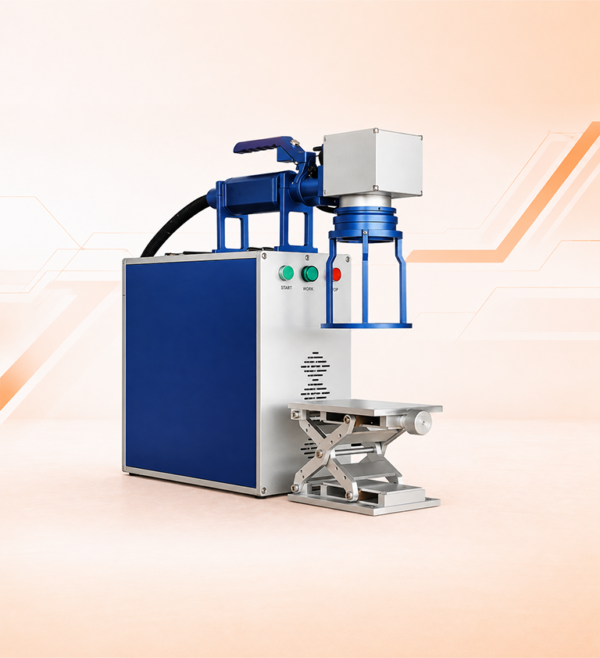
Hand Held Laser Marking Machine
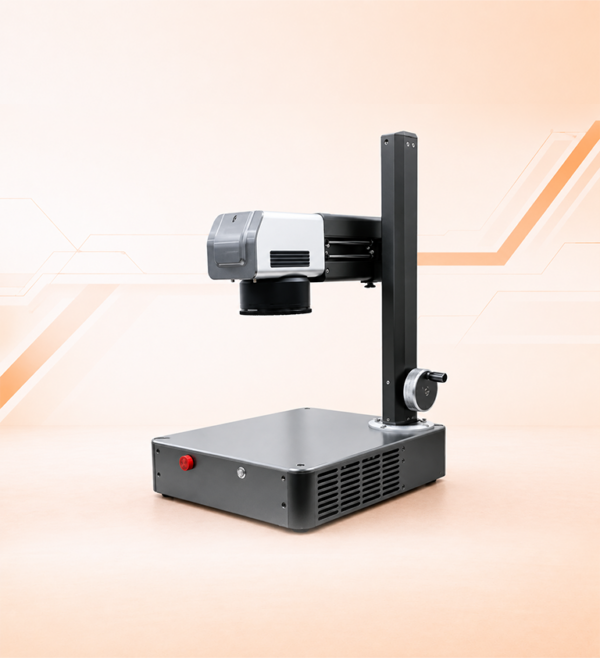
Hand Held Laser Marking Machine by Sigma Mechotronics is a handheld
fiber laser marking solution for fast, precise and permanent marking
on metal and selected non-metal materials.
– 20W, 30W and 50W power options
– Marking areas: 150×150, 175×175, 200×200 and 300×300 mm
– Ideal for large, heavy or fixed components
– Marks QR codes, barcodes, serial numbers and logos
– Air cooled, no consumables required
Send Inquiry
Handheld Head · Marks in Place · Made in India · ISO 9001:2015 Certified
Handheld Laser Marking Machine – Carry the Marking Head to the Part, 20 W to 50 W
A handheld laser marking machine puts the galvo marking head into a compact unit the operator holds, connected by cable to the laser source. That one change solves a problem a bench machine cannot touch: marking parts that are already installed, already assembled, or simply too big and too heavy to carry to a workstation. Sigma Mechotronics Pvt. Ltd. builds it from 20 W to 50 W with the same marking areas as our bench system – 150 x 150, 175 x 175, 200 x 200 and 300 x 300 mm – so the mark quality does not change, only where you can make it.
- Power range
- 20 W – 50 W
- Marking areas
- 4
- Largest field
- 300 x 300 mm
- Operation
- Handheld
The jobs this machine is bought for share one thing: moving the part is either impossible or absurdly expensive. A pump housing bolted into a line. A pressure vessel that has to carry an identification plate. Structural steel already erected. A machine on a customer’s floor that needs an asset tag during commissioning. In every case the marking has to travel, because the part is not going to.
What you are trading for that is positional precision. On a bench system the part sits on a motorised table and the head never moves, so the mark lands identically every cycle. Here the operator holds and positions the head, so placement is as good as the hand and the fixture guiding it. For asset tags, plant identification, field traceability and MRO records that is entirely sufficient – and for high-count batch work on small parts, a bench station is what that job is built around. Sigma Mechotronics Pvt. Ltd. manufactures both at its own plant in Ahmedabad.
At a Glance
Key Takeaways
The Marking Goes to the Part
Installed equipment, erected steel and assembled machines get marked where they stand – no dismantling, no crane, no line stoppage to move a part.
Same Fields as the Bench System
150 x 150, 175 x 175, 200 x 200 and 300 x 300 mm. The field is set by the lens at purchase, so choose it once.
20 W to 50 W
Lower power for surface marks and asset tags; higher power where the mark needs depth to survive weather, abrasion or repainting.
Mobile Only as Far as the Cable
The head is tethered to the source unit. Cable length and how easily that unit moves are the specifications that decide real-world reach.
Positioned by Hand
Placement depends on the operator rather than a motorised table – right for asset tags and field IDs, not for micron-repeatable batch positioning.
1-Year Warranty
Backed by a 1-year warranty, installation and training, with spares and service engineers based in India.
Definition
What Is a Handheld Laser Marking Machine?
A handheld laser marking machine splits the system in two: the fiber laser source, power supply and controller stay in a floor or trolley unit, and the galvo scanning head sits in a compact handheld body connected to it by cable. The operator carries that head to the part, holds it at the correct standoff distance, and the beam is steered across the surface exactly as it would be on a bench machine – etching, annealing or ablating a permanent mark without touching the part.
The optics and the marking process are the same as the bench configuration, which is the point worth understanding: mark quality is not what you give up by going handheld. A 20 W handheld head produces the same class of mark on the same steel as a 20 W bench system. What changes is how the head is positioned – by an operator rather than by a fixed frame and a motorised Z-axis – and therefore how repeatably a mark lands in exactly the same spot on part after part.
It marks mild and carbon steel, stainless steel, aluminium including anodised finishes, brass, copper and titanium, plus dark or filled engineering plastics. Getting the standoff distance right matters more here than on a bench, because focus is held by hand: most operators work with a spacer or locating fixture on the head so the distance is set physically rather than judged by eye.
The Real Use Cases
Where a Handheld Head Earns Its Place
This configuration is not bought for throughput. It is bought for access – situations where the alternative is dismantling something, hiring a crane, or accepting a stamped tag that will not last.
| Situation | What the Handheld Head Solves |
|---|---|
| Installed and in-service equipment | Pumps, valves, motors, gearboxes and panels already bolted into a line are marked in position, with no downtime spent removing them. |
| Asset tagging and MRO records | Permanent asset IDs and QR codes go straight onto the equipment, so the identity cannot fall off, fade or be swapped like an adhesive label. |
| Large fabricated and erected structures | Structural members, tanks, frames and skids that could never sit on a bench get member marks and identification where they are. |
| Marking after assembly | Where a serial number or compliance mark is only fixed once the unit is built and tested, the mark can be made at the end of the line instead of the start. |
| On-site commissioning and installation | Traceability marks are applied at the customer’s premises during handover, rather than being planned back at the factory. |
Four Field Sizes
Marking Area: How to Choose the Field
The marking area is the square the head can reach in one position without being moved. It is set by the lens fitted at purchase, so it is a one-time decision – and on a handheld head it also determines how often you reposition.
| Marking Area | Typically Suits | Practical Note |
|---|---|---|
| 150 x 150 mm | Compact asset tags, serial plates, small data-matrix codes and component IDs | The smallest field concentrates the same power into a smaller area, so it resolves the finest detail – best where codes must scan reliably. |
| 175 x 175 mm | Slightly larger tags and identification blocks | A modest step up that buys positioning margin, which matters more when the head is held by hand than on a bench. |
| 200 x 200 mm | Equipment nameplates, valve and pump bodies, panel identification | The common all-round choice for field marking – most nameplate content fits in one position with no repositioning. |
| 300 x 300 mm | Large plant identification, structural member marks and full-size nameplates | The largest field, and the one that keeps the head still on big marks – fewer repositions means fewer visible joins in the mark. |
The handheld trade-off is different from a bench machine’s – on a bench, the smallest field that covers your mark is usually right, because it gives the finest detail. Handheld, there is a second consideration: every time the mark is larger than the field you have to reposition the head by hand, and a repositioned mark rarely lines up perfectly. If your marks are large, the larger field is worth more here than it would be on a bench.
20 W to 50 W
How to Choose the Power
Power is decided by what the mark has to survive, not by the material it goes onto. A tag that only has to be read indoors and a member mark that must still be legible after years outdoors and a repaint are different specifications.
| Power | Generally Suits | Where It Struggles |
|---|---|---|
| 20 W | Surface marking on metals and plastics – asset tags, serial numbers, QR codes, plant identification | Marks needing real depth, and hardened tool steel |
| 30 W | The general-purpose middle – surface marking with more speed, and shallow engraving on site | Genuine depth work on hard materials |
| 50 W | Deep engraving to measurable depth, hardened steel, and marks that must survive abrasion, weathering or being painted over | Nothing within the range – it is capital cost, so buy it where depth or speed demands it |
Field work makes a case for depth – outdoor and plant equipment gets weathered, wiped down, knocked and repainted. A surface mark relies on contrast, and contrast can be covered by a coat of paint; an engraved mark still has physical depth underneath it. If your marks live outdoors or on painted plant, weigh the higher end of the range more seriously than you would for indoor bench work.
One Head, Five Results
The Mark Types It Can Produce
Changing power, frequency and pulse width changes what happens at the surface. On field work the choice is usually driven by what the surface already has on it.
| Mark Type | What Happens | Typical Use |
|---|---|---|
| Surface Etching | Removes a few microns of surface – fast, high contrast | Asset IDs, serial numbers and QR codes on bare metal |
| Annealing | Oxidises the surface below melting point – no material removed, surface stays sealed | Stainless steel equipment in food, pharma and washdown areas |
| Deep Engraving | Multiple passes remove material to measurable depth | Outdoor plant, structural members and anything that will be repainted |
| Ablation | Removes a coating or plating layer to reveal the base material | Painted, powder-coated, plated and anodised equipment – very common in the field |
| Foaming / Carbonisation | Causes a colour-change reaction in the polymer surface | Dark or filled plastic housings, covers and enclosures |
Before You Order
Four Things to Check for Real Site Work
These are the details that decide whether the machine is genuinely usable where you intend to use it – and they are the ones most often left until after delivery.
- 1
Cable Length Against Your Actual Layout
The head is only as mobile as the cable connecting it to the source. Walk the route you will actually use – around a machine, up a gantry, along a bay – and confirm the cable reaches with slack to spare. This is the single most common reason a handheld unit disappoints on site.
- 2
How the Source Unit Moves
Wherever the cable ends, the source unit has to follow. Check how it is moved – wheeled, lifted, trolleyed – and whether it clears your doorways, gets up to a mezzanine and stands safely on the floor where the work is. A handheld head tethered to an immovable box is not mobile.
- 3
Power Supply Where You Will Work
Field locations do not always have a suitable point close by. Confirm the electrical requirement against what is available at the places you intend to mark, and plan extension or supply arrangements before the machine arrives rather than on the day.
- 4
Surface Condition and the Controlled Area
Field surfaces are painted, coated, oily or rusty, which changes the parameter set and often means ablation rather than etching. And because there is no enclosure in the field, you need a way to establish a controlled area with rated eye protection wherever you set up.
The Marking Range
How This Sits Against Our Other Marking Machines
All three configurations in the fiber laser marking machine range mark the same materials in the same 20 W to 50 W band. What separates them is one question: does the part come to the machine, or does the machine go to the part?
| Configuration | How It Works | Built For |
|---|---|---|
| Hand-Held Marking | Handheld head on a cable, carried to the part by the operator | Field marking, asset tagging and installed equipment that cannot be moved |
| Marking System (Desktop) | Fixed workstation with a motorised Z-axis table; the part is loaded onto it | Batch and line-side marking where positional repeatability decides whether codes scan |
| Portable Marking | Head on a height-adjustable column with a movable base, wheeled to the work | Large fabricated assemblies and heavy castings, with the head supported rather than hand-held |
Avoid These Buying Mistakes
6 Mistakes Buyers Make on a Handheld Marking Machine
1
Not checking the cable length against the real route. A handheld head is only as mobile as its tether. Measure the actual path around your equipment, not the straight-line distance.
2
Forgetting the source unit has to move too. Doorways, steps, mezzanines and floor space at the work position all matter. Plan how the box travels, not just the head.
3
Expecting bench-level positional repeatability. Placement is by hand here. For asset tags and field IDs that is fine; for high-count batch work on identical small parts, a bench station is what that job is built around.
4
Buying 20 W for marks that live outdoors. Weather, wipe-downs and repainting all attack a contrast-only surface mark. If the mark must survive those, it needs depth.
5
Treating eye protection as the operator’s problem alone. In the field there is no enclosure. The beam is invisible and reflects off bright metal, so rated protection is needed for everyone in the area, and the area itself has to be controlled.
6
Not testing on a real field surface. A trial on clean bench steel proves very little about a painted, rusty or oily surface. Test on a sample that looks like what you will actually mark.
Where It Is Used
Industries and Applications
Used wherever the part that needs an identity is already in place – in a plant, on a structure or in a customer’s facility.
- Plant Maintenance & MRO
- Pump, Valve & Industrial Engineering
- Structural Steel & Fabrication
- Oil, Gas & Process Plant
- Automotive & Auto-Ancillary
- Electrical Panel & Switchgear
- Machine Building & Commissioning
- Railways & Heavy Engineering
- Asset Management & Facilities
- Defence & Aerospace Components
Typical output is asset IDs and QR or data-matrix codes on installed equipment, equipment nameplates and rating information, serial and part numbers applied after assembly, structural member identification, and compliance or traceability marks applied during commissioning. Materials are mild and carbon steel, stainless steel, aluminium including anodised finishes, brass, copper and titanium, plus dark or filled engineering plastics. Painted, powder-coated and plated surfaces are marked by ablation, which lifts the coating to reveal the base material – the most common field situation of all.
Keeping It Running
Maintenance and Safety in Practice
There is no assist gas and no nozzle to replace on a marking machine, so the list is short. The lens is the consumable to budget for, and the cable is the part that field use is hardest on.
| Routine Task | Typical Frequency |
|---|---|
| Lens cleaning, and replacement when it degrades | Cleaning periodically and more often after dusty site work – a dirty or worn lens shows up as a weak, uneven mark |
| Cable inspection along its whole length | Regular – field use drags, bends and pinches the cable far more than bench use does |
| Head body and standoff fixture check | Regular – a damaged or loose spacer changes focus height and quietly weakens every mark |
| Source unit cleaning, extraction check, full technical inspection | Cleaning and extraction regularly; inspection annually |
Safety, in practice: this configuration puts the beam in the operator’s hand, in an open area, with no enclosure between it and the people nearby. The beam is invisible at the fiber wavelength and reflects readily off bright metal, so wavelength-rated eye protection is required for everyone in the working area rather than the operator alone – and in the field, that area has to be established deliberately with a barrier or exclusion zone each time you set up, because unlike a workshop it is not permanently defined. Fume extraction or at minimum good ventilation is needed wherever coated, painted, plated or plastic surfaces are marked, since the process vaporises that layer. The head’s interlocks and safety switch must never be bypassed.
Manufacturer, Not Trader
Why Buy This Machine From Sigma Mechotronics Pvt. Ltd.
Built in India
The machine is manufactured at our own Ahmedabad plant rather than imported and rebadged, so the power tier, the marking field and the cable arrangement are specified with the people who build it – not through an overseas supplier.
ISO 9001:2015 Certified, MSME Registered
Sigma Mechotronics Pvt. Ltd. is a registered Indian private limited company, GST registered, ISO 9001:2015 certified and MSME registered. Every purchase comes with a proper GST tax invoice under your GSTIN.
1-Year Warranty, Spares Held in India
A 1-year warranty covers manufacturing defects in the laser source and delivery system, control electronics and the marking head. Lenses and other spares are held locally rather than ordered on an international shipping cycle.
Installation, Parameters and Training
We install and commission the machine at your premises, develop parameter sets for the actual surfaces you mark – including painted and coated ones – and train your operators on handling, standoff and safe field working before handover.
Straight Answers
Frequently Asked Questions
The mark itself is the same. The laser source, the galvo head and the optics work identically, so a 20 W handheld head produces the same class of mark on the same steel as a 20 W bench system, with the same five mark types available. What differs is positioning: the operator holds the head rather than a fixed frame and motorised table, so the mark’s exact placement depends on the hand and any locating fixture guiding it. Mark quality is unchanged; positional repeatability is what you trade.
As far as the cable reaches, and no further – which is why cable length is the specification to confirm before you order rather than after. Walk the route you actually intend to use, around equipment and up any steps or gantries, and measure that path rather than the straight-line distance. Beyond the cable, the source unit itself has to be moved to a new position, so how easily it travels matters just as much. Tell us your site layout and we will confirm the right arrangement.
150 x 150 mm suits compact asset tags and small codes and gives the finest detail; 175 x 175 mm adds positioning margin; 200 x 200 mm is the common all-round choice for equipment nameplates and plant identification; 300 x 300 mm suits large plant marks and full-size nameplates. On a handheld head there is an extra consideration beyond detail: any mark larger than the field means repositioning by hand, and a repositioned mark rarely lines up perfectly – so if your marks are large, size up.
It depends on what the mark has to survive. 20 W covers surface marking on metals and plastics – asset tags, serial numbers, QR codes and plant identification read indoors. 50 W is for deep engraving to measurable depth, hardened steel, and marks that must stay legible through weathering, abrasion or repainting. 30 W sits in between. Field marking makes a stronger case for depth than bench work does, because outdoor plant gets painted over and a contrast-only mark disappears underneath.
Yes, and painted or coated surfaces are the most common field case. The mark is made by ablation, which removes the coating layer to reveal the base material underneath and produces strong contrast without cutting into the metal. Rusty, oily or heavily scaled surfaces are more variable and usually need the area cleaned back first for a consistent result. Because field surfaces differ so much, we develop the parameter sets against the actual surfaces you mark during commissioning.
Mild and carbon steel, stainless steel, aluminium including anodised finishes, brass, copper and titanium, plus dark or filled engineering plastics. Metals are where fiber laser marking is strongest. On stainless steel used in food, pharmaceutical or washdown environments, ask for annealing – it produces a dark mark without removing material, so the surface stays smooth and sealed rather than carrying a groove that can trap residue.
More thought than a workshop machine, because there is no enclosure. The beam is invisible at the fiber wavelength and reflects off bright metal, so wavelength-rated eye protection is required for everyone in the area, not just the operator – and in the field you have to establish that controlled area deliberately each time, with a barrier or exclusion zone, since it is not permanently defined the way a workshop is. Ventilation or extraction is needed where coated, painted or plastic surfaces are marked. The head’s interlocks and safety switch must never be bypassed. We cover the full setup during training.
The consumable to budget for is the lens – cleaned regularly and replaced when it degrades, and it needs cleaning more often after dusty site work than it would on a bench. There is no assist gas, no nozzle and no ink, so beyond the lens the running cost is essentially electricity. The other item field use is hard on is the cable, which gets dragged, bent and pinched far more than a bench machine’s, so inspect it along its whole length regularly. Add the standoff fixture check, extraction checks and an annual technical inspection.
Price depends on the power tier and the marking area fitted – a 20 W head with a 150 x 150 mm field and a 50 W head with a 300 x 300 mm field sit at different points in the range. We quote against a confirmed specification rather than publishing a fixed figure, because the right configuration depends on your surfaces, your mark size and what the mark has to survive. Send those details along with your site layout for a detailed quotation.
A 1-year warranty covering manufacturing defects in the laser source and delivery system, control electronics and the marking head, handled directly by Sigma Mechotronics Pvt. Ltd. rather than through an agent or overseas supplier. Installation and commissioning at your premises, parameter development for the surfaces you actually mark, and operator training on handling, standoff and safe field working are part of the supply. Lenses and other spares are held in India, and every purchase comes with a GST tax invoice under your GSTIN.
Yes, and for this machine bring a sample that looks like what you will really mark – painted, coated, rusty or weathered, not a clean piece of bench steel. Field surfaces behave very differently from workshop samples, and a trial on a realistic surface is the only reliable way to confirm the result before committing. If the code has to be machine-readable, bring your scanner as well. Facility visits to our Ahmedabad plant are welcome by appointment.
The Full Range
Related Machines From Sigma Mechotronics Pvt. Ltd.
Get a Handheld Marking Machine Specified for Your Site
Send us what you need to mark and where it sits, the surface condition – bare, painted, coated or weathered – the size of your largest mark, what the mark has to survive, and a description of the route the head has to reach. Our team will confirm the power tier, the marking field and the right cable arrangement, and come back with a specification and quotation built around your actual site.
Reviews
There are no reviews yet.