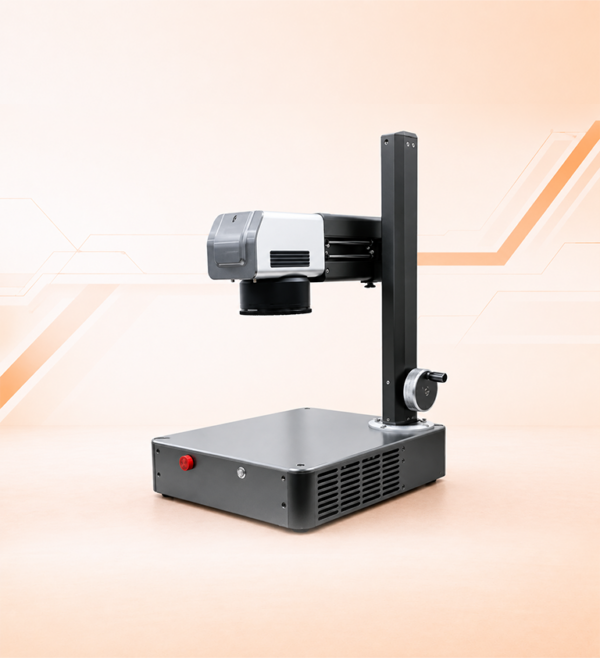
Portable Laser Marking Machine
Portable fiber laser marking machine for permanent marking on
metal and plastic. Available in 20W, 30W and 50W with a 100 x 100 mm
marking area.
– Marks QR codes, barcodes, serial numbers and logos
– Compact and easy to move between workstations
– Air cooled, no consumables required
– 2-year warranty
Send Inquiry
Column-Mounted Head · Wheels to the Part · Made in India · ISO 9001:2015 Certified
Portable Laser Marking Machine – Column-Mounted Head That Comes to the Part, 20 W to 50 W
A portable laser marking machine mounts the marking head on a height-adjustable column with a movable base, so the machine is wheeled around the part instead of the part being lifted onto a bench. The head swings, tilts and locks in position, which means it reaches flat, curved and angled surfaces on something that is never going to move – a heavy casting, a welded assembly, a structural member, a machine already in place. Sigma Mechotronics Pvt. Ltd. builds it from 20 W to 50 W with a 100 x 100 mm marking area, backed by a 1-year warranty.
- Power range
- 20 W – 50 W
- Marking area
- 100 x 100 mm
- Mounting
- Column, movable
- Warranty
- 1 year
There is a category of part that defeats a bench marking machine completely – not because the mark is difficult, but because the part weighs 400 kg, or is welded into a frame, or is already bolted onto a floor. Getting it to a marking station means a crane, two people and half a shift, for a mark that takes eleven seconds. That arithmetic is why this configuration exists.
What separates it from a handheld unit is that the head is carried by the column, not by the operator. Once the column is positioned and the head is locked at the right height and angle, the machine is effectively a bench station standing next to a part that cannot be lifted – steady, hands-free, and repeatable across every part in that batch. Sigma Mechotronics Pvt. Ltd. manufactures it at its own plant in Ahmedabad.
At a Glance
Key Takeaways
A Bench That Comes to the Part
The column carries the head, so once it is locked the machine is as steady as a workstation – standing beside a part that cannot be lifted.
Swings, Tilts and Locks
The head reaches flat, curved and angled surfaces on a fixed part, then holds that position for every piece in the batch.
100 x 100 mm Marking Area
One fixed field on this configuration – concentrated into a small square, which is what gives it fine detail on codes and small text.
20 W to 50 W
Lower power for surface marks and identification; higher power where the mark needs depth to survive handling, weather or repainting.
No Crane, No Handling
Heavy castings, welded assemblies and installed machines are marked where they stand, removing the lifting and the risk that comes with it.
1-Year Warranty
Backed by a 1-year warranty, installation and training, with lenses, spares and service engineers based in India.
Definition
What Is a Portable Laser Marking Machine?
A portable laser marking machine is a fiber laser marking system built onto a movable stand rather than a fixed bench. The laser source and controller travel with the base; the galvo marking head sits on a height-adjustable column that swings, tilts and locks. You wheel the machine to the workpiece, set the head over the surface to be marked, lock it, and mark – with the head held by the machine rather than by hand.
The marking process is identical to a bench system: the same fiber source, the same galvo head steering the beam through an F-Theta lens, the same permanent change to the surface. Nothing about mark quality is compromised by the machine being mobile. What the configuration buys you is access to parts that will never see a workstation, and what it costs you is a fixed 100 x 100 mm marking field and a machine you have to physically move into position.
It marks mild and carbon steel, stainless steel, aluminium including anodised finishes, brass, copper and titanium, plus dark or filled engineering plastics. Because the head is height-adjustable and locks, focus is set once for a given surface and then held – which matters when you are marking twenty identical castings and want twenty identical marks.
Technical Specification
| Laser type | Pulsed fiber laser |
| Wavelength | 1064 nm |
| Laser power | 20 W / 30 W / 50 W |
| Marking area | 100 x 100 mm |
| Configuration | Height-adjustable column on a movable base; head swings, tilts and locks |
| Mark types | Surface etching, annealing, deep engraving, ablation, foaming / carbonisation |
| Materials | Mild & carbon steel, stainless steel, aluminium and anodised aluminium, brass, copper, titanium; dark or filled engineering plastics |
| Laser source life | Rated 100,000 hours of operation |
| Warranty | 1 year |
The Real Difference
Why the Column Is the Whole Point
Both this machine and a handheld unit go to the part. The difference is what holds the head once it gets there – and that single mechanical fact changes what the machine is good at.
| What the Column Does | Why It Matters in Practice |
|---|---|
| Carries the weight of the head | The operator is not supporting anything, so there is no hand fatigue on a long batch and no drift in the mark as the shift goes on. |
| Holds a set focus height | Focus is set once for a surface and then locked, instead of being judged by hand for each part – which is what makes twenty castings come out identical. |
| Swings and tilts, then locks | The head is squared up to a curved, sloped or awkwardly angled face and stays there, rather than being held at that angle by the operator. |
| Adjusts through a height range | The same machine reaches a mark on a low base plate and one on top of a tall casting without any packing or improvised support. |
| Rolls on a movable base | The machine is repositioned along a row of large parts, so a batch is marked in sequence without any of them being lifted. |
The practical consequence – this configuration gives you bench-like steadiness at a part that could never reach a bench. That is what makes it suitable for repeat batch marking on heavy parts, where a hand-positioned head would give you a slightly different result on every piece.
One Fixed Field
The 100 x 100 mm Marking Area, and How to Work With It
The marking area on this configuration is 100 x 100 mm, and it is fixed rather than selectable. That is the square the head can cover from one locked position, and it is the specification to check your marks against before anything else.
The upside is optical. Concentrating the same 20 W to 50 W into a smaller square gives a smaller focused spot, and a smaller spot resolves finer detail. For the work this machine is bought for – part numbers, serial numbers, heat and cast numbers, data-matrix codes and identification blocks on large components – 100 x 100 mm is generally more than the mark needs, and the detail it produces is excellent.
The thing to check honestly is whether any of your marks are physically larger than that square. A full equipment nameplate laid out at size, or a long single line of text, can exceed 100 mm and would then need the head repositioning and a second pass – and two passes rarely line up perfectly. Measure your largest actual mark, laid out the way it will be marked, before you specify.
A layout tip that solves most cases – marks that look too wide for a 100 mm square usually are not, once they are laid out over two or three lines instead of one. Stacking a part number, a batch code and a date over three short lines fits comfortably where a single long line would not. Send us your mark content and we will lay it out against the field before you order.
20 W to 50 W
How to Choose the Power
Power is decided by what the mark has to survive, not by the material it goes onto. The parts this machine marks are typically heavy, handled roughly and often painted afterwards, which pushes the decision differently than it would for small bench components.
| Power | Generally Suits | Where It Struggles |
|---|---|---|
| 20 W | Surface marking on metals and plastics – part numbers, serial numbers, QR codes and identification read indoors | Marks needing real depth, and hardened steel |
| 30 W | The general-purpose middle – surface marking with more speed in hand, and shallow engraving | Genuine depth work on hard materials |
| 50 W | Deep engraving to measurable depth, hardened steel, and marks that must survive shot blasting, handling, weather or being painted over | Nothing within the range – it is capital cost, so buy it where depth or cycle time demands it |
Ask what happens to the part after marking – large fabricated and cast components are frequently shot blasted, primed and painted after the identification is applied. A contrast-only surface mark can disappear under that process, while an engraved mark still has physical depth beneath the paint. If your parts get finished after marking, weigh the higher end of the range seriously.
One Machine, Five Results
The Mark Types It Can Produce
Changing power, frequency and pulse width changes what happens at the surface. On large components the choice is usually driven by what happens to the part after it is marked.
| Mark Type | What Happens | Typical Use |
|---|---|---|
| Surface Etching | Removes a few microns of surface – fast, high contrast | Part and serial numbers, QR codes on bare machined faces |
| Annealing | Oxidises the surface below melting point – no material removed, surface stays sealed | Stainless steel assemblies in food, pharma and washdown environments |
| Deep Engraving | Multiple passes remove material to measurable depth | Castings and structural parts that get blasted, primed and painted afterwards |
| Ablation | Removes a coating or plating layer to reveal the base material | Already-painted, powder-coated or plated assemblies |
| Foaming / Carbonisation | Causes a colour-change reaction in the polymer surface | Large plastic housings, covers and moulded components |
The Marking Range
How This Sits Against Our Other Marking Machines
All three configurations in the fiber laser marking machine range mark the same materials in the same 20 W to 50 W band. What separates them is how the head is held and where the part has to be.
| Configuration | How the Head Is Held | Built For |
|---|---|---|
| Portable Marking | Height-adjustable column on a movable base; head swings, tilts and locks | Large fabricated assemblies, heavy castings and structural work, marked in place with a steady head |
| Hand-Held Marking | Handheld head on a cable, carried and positioned by the operator | Field marking and asset tagging where the head has to reach into and around installed equipment |
| Marking System (Desktop) | Fixed workstation with a motorised Z-axis table; the part is loaded onto it | Batch and line-side marking of parts small enough to bring to a station |
Four Checks
What to Confirm Before You Order
- 1
Measure Your Largest Mark, Laid Out
Not the part – the mark. Write out your longest part number, batch code and date the way they will actually appear and measure that block. If it exceeds 100 mm in any direction, try stacking it over more lines before assuming the field is too small.
- 2
Check the Height Range Against Your Parts
The column has a working height range. Take the lowest surface you need to mark and the highest one – a base plate and the top face of a tall casting – and confirm both fall inside it, rather than only checking the average.
- 3
Walk the Route the Machine Has to Travel
The base rolls, but it still needs a floor it can roll on. Check for door widths, thresholds, cable runs, drainage channels and swarf around the machines you will be marking beside – a wheeled stand is only mobile over a surface that allows it.
- 4
Decide What Happens After the Mark
If parts are blasted, primed or painted after marking, say so at the inquiry stage. It moves the decision toward engraved depth rather than surface contrast, and it changes the parameter set we develop during commissioning.
Avoid These Buying Mistakes
6 Mistakes Buyers Make on a Portable Marking Machine
1
Checking the part size instead of the mark size. The 100 x 100 mm field has nothing to do with how big the part is – only with how big the mark is. Measure the mark, laid out as it will appear.
2
Not checking the column height against your tallest and shortest surfaces. A range that suits your average part can leave you packing up a low one or unable to reach a high one.
3
Assuming “portable” means it goes anywhere. It rolls, but it needs a floor it can roll across. Thresholds, swarf, cable runs and drainage channels all stop a wheeled base.
4
Buying 20 W for parts that get painted afterwards. A contrast-only mark can vanish under primer and topcoat. If the part is finished after marking, the mark needs depth.
5
Treating eye protection as the operator’s problem alone. There is no enclosure around a part on the shop floor. The beam is invisible and reflects off bright metal, so rated protection is needed for everyone in the area.
6
Not trialling on a real surface. A cast, forged, machined or already-painted face behaves very differently from clean bench steel. Test on the surface you will actually mark.
Where It Is Used
Industries and Applications
Used wherever the parts that need identification are heavy, bulky or already assembled – and lifting them to a bench is the expensive part of the job.
- Heavy Engineering & Fabrication
- Foundry & Casting
- Structural Steel Fabrication
- Pump, Valve & Industrial Engineering
- Machine Building & Machine Tools
- Automotive & Auto-Ancillary
- Railways & Rolling Stock
- Agricultural Equipment Manufacturing
- Electrical Panel & Switchgear
- Defence & Aerospace Components
Typical output is part and drawing numbers on castings and fabrications, heat and cast numbers for material traceability, serial numbers applied after assembly, machine and equipment identification, QR and data-matrix codes for traceability systems, and rating or nameplate information marked directly onto the body rather than onto a plate that can come off. Materials are mild and carbon steel, stainless steel, aluminium including anodised finishes, brass, copper and titanium, plus dark or filled engineering plastics.
Keeping It Running
Maintenance and Safety in Practice
There is no assist gas and no nozzle to replace on a marking machine, so the list is short. The lens is the consumable to budget for, and a machine that lives on the shop floor collects more dust than one on a bench.
| Routine Task | Typical Frequency |
|---|---|
| Lens cleaning, and replacement when it degrades | Cleaning periodically and more often on a dusty floor – a dirty or worn lens shows up as a weak, uneven mark |
| Column, lock and tilt mechanism check | Regular – a lock that slips lets the head drift and quietly ruins the marks that follow |
| Base, castor and cable inspection | Regular – a machine that is wheeled around the floor takes knocks a bench machine never sees |
| Extraction check, full technical inspection | Extraction regularly where coated or plastic parts are marked; inspection annually |
Safety, in practice: marking a part where it stands means there is no enclosure between the beam and the people working nearby. The beam is invisible at the fiber wavelength of 1064 nm and reflects readily off bright metal, so wavelength-rated eye protection is required for everyone in the area, not the operator alone – and because the machine moves, that controlled area has to be re-established at each new position rather than being a fixed part of the layout. Ventilation or extraction is needed wherever coated, painted, plated or plastic surfaces are marked, since the process vaporises that layer. Make sure the base is stable and the column locked before firing, and never bypass the machine’s interlocks or safety switch.
Manufacturer, Not Trader
Why Buy This Machine From Sigma Mechotronics Pvt. Ltd.
Built in India
The machine is manufactured at our own Ahmedabad plant rather than imported and rebadged, so the power tier and the column arrangement are specified with the people who build it – not through an overseas supplier.
ISO 9001:2015 Certified, MSME Registered
Sigma Mechotronics Pvt. Ltd. is a registered Indian private limited company, GST registered, ISO 9001:2015 certified and MSME registered. Every purchase comes with a proper GST tax invoice under your GSTIN.
1-Year Warranty, Spares Held in India
A 1-year warranty covers manufacturing defects in the laser source and delivery system, control electronics and the marking head. Lenses and other spares are held locally rather than ordered on an international shipping cycle.
Installation, Parameters and Training
We install and commission the machine at your premises, develop parameter sets for the actual surfaces you mark – cast, machined, painted or blasted – and train your operators on positioning, locking and safe working before handover.
Straight Answers
Frequently Asked Questions
Both go to the part; the difference is what holds the head. On the portable machine the head sits on a height-adjustable column that swings, tilts and locks, so the machine carries it and the operator’s hands are free – which gives a steady, repeatable mark across a batch of heavy parts. On a handheld machine the operator holds the head on a cable, which reaches into and around installed equipment more easily but means placement depends on the hand. Portable suits large parts marked in batches; handheld suits reaching awkward positions.
The field limits the size of the mark, not the size of the part – a two-tonne casting is fine, as long as the mark itself fits inside 100 x 100 mm. For part numbers, serial and heat numbers, data-matrix codes and identification blocks, that is usually more than enough. Measure your longest mark laid out as it will actually appear, and remember that content which looks too wide on one line often fits comfortably when stacked over two or three. Send us your mark content and we will lay it out against the field before you order.
It means repositioning the head and marking in a second pass, and two passes rarely align perfectly – there is usually a visible join. For that reason it is worth designing the mark to fit the field rather than planning around multi-pass marking. Stacking content over more lines, shortening a code, or moving to a smaller font are all normal ways of getting there. If your marks genuinely cannot be brought inside 100 mm, tell us at the inquiry stage and we will go through the options in our marking range with you.
It depends on what the mark has to survive. 20 W covers surface marking on metals and plastics – part numbers, serial numbers and QR codes read as they are. 50 W is for deep engraving to measurable depth, hardened steel, and marks that must stay legible after shot blasting, rough handling, weathering or a coat of paint. 30 W sits between them. Because large fabricated and cast parts are so often finished after marking, this configuration makes a stronger case for depth than bench work does.
Yes – that is what the swing and tilt on the head are for. The head is squared up to the face being marked and then locked in that position, so the beam meets the surface at the correct angle and the focus stays correct across the mark. Strongly curved surfaces still have a practical limit, because the focal distance changes across a tight radius, so send us a drawing or photograph of the surface if it is unusual and we will confirm it before you order.
Mild and carbon steel, stainless steel, aluminium including anodised finishes, brass, copper and titanium, plus dark or filled engineering plastics. Metals are where fiber laser marking is strongest. Cast and forged surfaces mark well but behave differently from machined faces, so parameters are developed against your actual surfaces. On stainless steel used in food, pharmaceutical or washdown environments, ask for annealing – it produces a dark mark without removing material, leaving the surface smooth and sealed.
Enough floor beside the part for the base to stand stably, plus clearance for the operator and the controlled area around the marking position. The more important question is the route: the base rolls, but it needs a floor it can roll across, so check door widths, thresholds, cable runs, drainage channels and swarf between where the machine is stored and where it will be used. A wheeled stand is only as portable as the floor allows.
More thought than a bench machine, because there is no enclosure around a part standing on the floor. The beam is invisible at 1064 nm and reflects off bright metal, so wavelength-rated eye protection is required for everyone in the area rather than the operator alone – and since the machine moves, that controlled area has to be re-established at each new position instead of being a permanent part of the layout. Ventilation or extraction is needed where coated, painted or plastic surfaces are marked. Confirm the base is stable and the column locked before firing, and never bypass the interlocks.
The consumable to budget for is the lens – cleaned regularly and replaced when it degrades, and it needs cleaning more often on a shop floor than it would on a bench. There is no assist gas, no nozzle and no ink, so beyond the lens the running cost is essentially electricity. The items specific to this configuration are the column, lock and tilt mechanism, which should be checked regularly because a lock that slips lets the head drift, and the base, castors and cable, which take knocks a bench machine never sees.
Price depends mainly on the power tier – a 20 W machine and a 50 W machine sit at different points in the range – along with any options specified with the order. We quote against a confirmed specification rather than publishing a fixed figure, because the right power depends on your surfaces and on what the mark has to survive. Send your material, mark content and size, and what happens to the part after marking, for a detailed quotation.
A 1-year warranty covering manufacturing defects in the laser source and delivery system, control electronics and the marking head, handled directly by Sigma Mechotronics Pvt. Ltd. rather than through an agent or overseas supplier. Installation and commissioning at your premises, parameter development for the surfaces you actually mark, and operator training on positioning, locking and safe working are part of the supply. Lenses and other spares are held in India, and every purchase comes with a GST tax invoice under your GSTIN.
Yes, and for this machine bring a sample of the real surface – a cast face, a blasted one, a painted assembly – rather than clean bench steel, because those surfaces behave very differently. Bring the mark content too, so we can lay it out against the 100 x 100 mm field and show you exactly how it will sit. If the code has to be machine-readable, bring your scanner. Facility visits to our Ahmedabad plant are welcome by appointment.
The Full Range
Related Machines From Sigma Mechotronics Pvt. Ltd.
Get a Portable Marking Machine Specified for Your Parts
Send us your mark content and its size laid out, the material and surface condition – cast, machined, blasted or painted – the height range of the surfaces you need to reach, and what happens to the part after marking. Our team will confirm the power tier and the right configuration, and come back with a specification and quotation built around your actual parts.


Reviews
There are no reviews yet.